LiquidView After Shark Tank: No Deal and 2026 Update
LiquidView left Shark Tank without a deal. See its pitch, current prices, post-show growth signals, and 2026 business status.

Working long hours in rooms without windows showed Mitch Braff how draining it can feel to lose that connection with daylight and the outside world. Windowless spaces can leave people feeling tired, stressed, and disconnected when all they see are blank walls.
That experience helped inspire LiquidView, a virtual-window system that displays cinematic outdoor scenes that change throughout the day. Its views follow local sunrise and sunset times, helping an enclosed room feel more connected to the outside world.
LiquidView impressed the Sharks during Shark Tank Season 17. However, the $48,000 demonstration system, limited residential market, and $10 million valuation raised difficult questions.
Let’s dive into our LiquidView update and pitch recap to see why the Sharks passed, how the business makes money, and what changed after Mitch Braff left the Tank without a deal.
| LiquidView at a glance | Details |
|---|---|
| Company | LiquidView, Inc. |
| Founder | Mitch Braff |
| Product | Digital windows with synchronized outdoor views |
| Industry | Architectural technology and digital signage |
| Shark Tank appearance | Season 17, Episode 8 |
| Air date | January 7, 2026 |
| Current status | Active; available evidence suggests growth |
| Official website | theliquidview.com |
What Is LiquidView?
LiquidView is a virtual-window system designed for rooms without real windows or attractive outdoor views.
The system uses professional 4K HDR displays to show cinematic scenes filmed in places such as Hawaii, Miami, Venice, Sausalito, San Francisco, and the French Riviera. These are not short screensaver videos. Each location is filmed across a full day and turned into a 24-hour view.
LiquidView’s media player adjusts the footage to the customer’s date and location. Sunrise and sunset therefore appear at the correct local times. Stereo sound, architectural framing, and carefully selected camera angles help the screen feel more like a window.
| Product | Description | Starting price |
|---|---|---|
| Vista | A single digital window | $10,499 |
| Panorama | Multiple displays forming one wide view | $34,999 |
| MediaPlayer 4K HDR | Adds LiquidView content to an existing display or video wall | $2,999 |
Customers can choose between an InWall version recessed into the wall and an OnWall version mounted directly to an existing surface.
LiquidView originally focused on design and luxury interiors. The company now places more attention on wellness applications in hospitals, senior communities, offices, and other enclosed spaces.
A Stanford-affiliated research paper reported preliminary changes in stress-related measurements during exposure to LiquidView. Participants showed lower electrodermal activity and a small reduction in heart rate.
However, the document also says further study is underway. The early results are encouraging, but they do not prove that a digital window provides every benefit of a real one.
Who Founded LiquidView?
Mitch Braff founded LiquidView in 2021. His career in filmmaking shaped both the product and the way its views are created.
Braff studied film, history, and English at UC Santa Barbara. According to a UC Santa Barbara alumni interview, he later worked in documentary and corporate production.
He ran a corporate communications company for about ten years. He then led a nonprofit that created educational documentaries. Before LiquidView, Braff founded Liquid Canvas, which brought existing artwork to life through animation.
The LiquidView idea began while Braff was working with a San Francisco client. The home had attractive views at the front and back, but its dining-room windows faced a neighboring wall.
Braff first considered placing a digital scene outside the window. When that became too complicated, he started thinking about building a realistic digital window directly into an interior wall.
The problem felt personal. His first production office had no windows, while an early bedroom received daylight through a narrow lightwell.
Braff was well positioned to develop the creative side of LiquidView. He understood filmmaking, visual realism, sound, and high-end presentation. The harder task was turning those strengths into a product that could reach a larger market.
What Happened to LiquidView on Shark Tank?
LiquidView appeared in Shark Tank Season 17, Episode 8. Braff asked for $250,000 in exchange for 2.5% of the company, implying a $10 million valuation.
He introduced the problem of windowless rooms before revealing three large digital windows. He switched among views of beaches, cities, and European destinations as the Sharks watched. The demonstration quickly won them over.
“I think this is one of the coolest things I have seen come into the Shark Tank.”
Lori Greiner, Shark Tank Season 17, Episode 8
Braff explained that LiquidView had ten complete 24-hour views at the time. The excitement changed when the Sharks asked about the price.
The three-window system shown in the Tank cost approximately $48,000, including hardware and three views. Braff reported a margin of around 45%.
Kevin O’Leary became more interested when Braff explained another part of the model. Customers with a suitable display could buy a media player for roughly $2,000 and pay $299 per month for content.
Braff said 80% of LiquidView’s business came from commercial customers. Hospitals, assisted-living facilities, and memory-care communities were important markets. He reported $1 million in prior-year sales, but the company was not yet profitable.
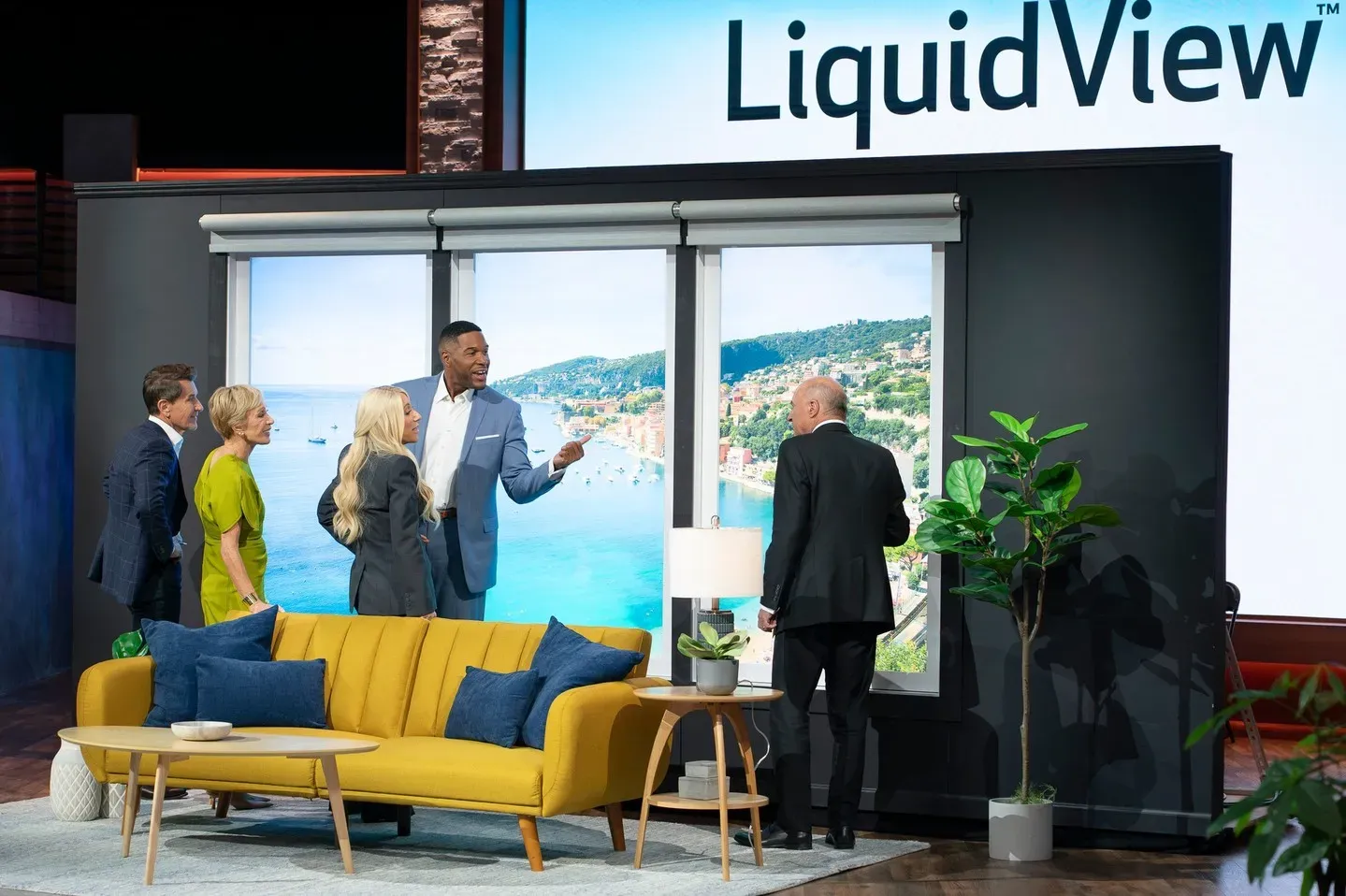
| Pitch term | Details |
|---|---|
| Ask | $250,000 for 2.5% |
| Implied valuation | $10 million |
| Reported prior-year sales | $1 million |
| Demonstrated system price | Approximately $48,000 |
| Reported margin | Approximately 45% |
| Sharks present | Barbara Corcoran, Lori Greiner, Kevin O’Leary, Robert Herjavec, and Michael Strahan |
| Offers | None |
| Final deal | No deal |
Why did the Sharks pass?
Lori Greiner loved the product but preferred consumer goods sold at prices more people could afford. Michael Strahan questioned the price and believed the product was too niche.
Barbara Corcoran saw commercial potential in windowless New York spaces, but the price still stopped her. Kevin O’Leary believed the company was too early and restricted to a small group of wealthy customers.
Robert Herjavec was less concerned about enterprise pricing. Even so, he doubted the company could become large enough.
“I don’t think this is going to scale to something really big.”
Robert Herjavec, Shark Tank Season 17, Episode 8
Every Shark liked what LiquidView created. None believed the investment worked at the valuation and business stage presented.
Episode 8 also featured PeeSport, Flightpath Golf, and Nampons. LiquidView and Flightpath left without deals, while PeeSport and Nampons accepted offers.
How Does LiquidView Make Money?
LiquidView makes money through digital-window systems, media players, content access, and professionally installed commercial projects.
| Business model element | LiquidView’s approach |
|---|---|
| Customers | Hospitals, senior communities, hotels, offices, property owners, designers, and affluent homeowners |
| Value proposition | Adds a realistic outdoor view where a real window is unavailable |
| Revenue sources | Window systems, MediaPlayers, content access, and project-based sales |
| Sales channels | Direct inquiries, architects, audiovisual integrators, and certified dealers |
| Advantages | 24-hour footage, time synchronization, cinematic production, architectural integration, and patent protection |
| Main risks | High prices, cheaper substitutes, installation complexity, and long commercial sales cycles |
The complete systems provide the largest upfront sales. However, the MediaPlayer may offer a more scalable route because customers can use displays they already own.
That places more attention on LiquidView’s strongest assets: its content library, synchronization software, production quality, and recurring access.
The company holds a granted U.S. patent for a “Virtual window apparatus and system.” Still, a customer could create a basic version with a television and scenic video.
LiquidView must show why its full-day footage, precise synchronization, professional displays, architectural framing, and commercial support justify the premium.
Producing the content is expensive. Shoots can last about 30 hours and generate large amounts of footage. Each view then needs editing, color correction, sound design, visual effects, and compression.
The business makes the most sense when customers can measure the value. A hotel may improve an undesirable room, while a hospital or landlord may improve an enclosed space used by patients, residents, or tenants.
What Happened After Shark Tank?
Latest update — October 21, 2026: LiquidView’s official website lists active Vista, Panorama, and MediaPlayer products, alongside dealers across the United States and Europe. The company continues to target healthcare, senior living, hospitality, office, and residential projects. Current revenue and profitability have not been publicly disclosed.
After the episode aired, LiquidView continued operating without a Shark investor. Its expanded product range now gives customers more entry points than the three-window system demonstrated in the Tank.
The $48,000 installation dominated the pitch. According to the official LiquidView pricing page, the Vista now starts at $10,499, the Panorama at $34,999, and the MediaPlayer at $2,999.
Installation, dealer charges, wall work, and electrical work may be extra.
A company LinkedIn announcement described a $4,999 MediaPlayer package with 12 months of content. It listed a future unlimited subscription at $99 per month or $1,000 per year. Because that differs from the current pricing page, buyers should confirm what each package includes.
| Area | Evidence | Assessment |
|---|---|---|
| Website | Active with current products, prices, and project information | Verified |
| Product lineup | Vista, Panorama, and MediaPlayer listed | Verified |
| Dealer network | Dealers listed across the United States and Europe | Verified |
| Social activity | Recent company posts and demonstrations | Active |
| Commercial markets | Healthcare, senior living, hospitality, offices, and homes | Company-supported evidence |
| Shark Tank deal | No offer was made | No deal |
| Current revenue | Not publicly disclosed | Unknown |
| Profitability | Not publicly confirmed | Unknown |
| Business status | Active products, dealers, and public activity | Growing, with private-company uncertainty |
LiquidView has strengthened its commercial positioning. Its website identifies healthcare organizations, senior communities, hospitality projects, offices, nonprofits, and luxury homes among its markets or projects.
The company also lists certified dealers across the United States and Europe. That network matters because projects may require display selection, wall preparation, framing, electrical work, calibration, and technical support.
| Year | Milestone |
|---|---|
| 2020 | The core patent family claimed an August 2020 priority date |
| 2021 | LiquidView incorporated and filed its principal patent application |
| 2022 | WindowLV debuted publicly at InfoComm |
| 2023 | Premium installations gained wider press coverage |
| 2024 | LiquidView received its main U.S. patent |
| 2025 | The company appeared at CES and received Today Show and Sony coverage |
| January 2026 | Braff presented LiquidView on Shark Tank and left without a deal |
| 2026 | The company promoted a lower-cost MediaPlayer option |
| October 2026 | Products, dealers, website, and social channels remained active |
These signals support classifying LiquidView as growing. However, it remains a private business with limited financial disclosure. There is no reliable public evidence confirming current revenue, profit, subscription income, or installation volume.
Lessons From LiquidView’s Journey
LiquidView’s pitch shows that getting investors excited about a product is only the first step. Every Shark liked the demonstration, but they could not see a clear path to a large investment return.
Lead with the scalable part
Kevin O’Leary became more interested when Braff discussed selling content for displays customers already owned. That model required less hardware and created recurring revenue.
Explain price through customer value
A $48,000 virtual window sounds unreasonable beside a television. The comparison changes when a hotel can make an undesirable room rentable or a landlord can improve enclosed commercial space.
Choose the right customer
The Sharks were probably correct that LiquidView was not a mass-market residential product at its original price. Hospitals, senior communities, hotels, and property owners may have stronger reasons to pay.
Keep the difference visible
LiquidView must keep showing why its 24-hour footage, synchronization, production quality, architectural design, and support justify more than a basic television setup.
An aggressive valuation can stop a negotiation
The $10 million valuation placed pressure on the pitch. Braff reported $1 million in prior-year sales, but the company had not reached profitability. A lower valuation might not have solved the scalability problem, but it could have made an offer more likely.
Final Take
LiquidView left Shark Tank without a deal, but the company did not disappear.
It remains active in October 2026 and now offers a lower-cost way to use its content on existing displays. Its dealer network, institutional projects, patent, and public activity all suggest continued development.
Braff understood the main weakness as he left the Tank:
“We just have to find a better way to position it.”
Mitch Braff, after the pitch
That is what LiquidView appears to be doing. It now focuses less on selling a luxury screen and more on improving windowless healthcare, hospitality, senior-living, and office environments.
The financial outcome remains unclear. The company has not confirmed whether it reached profitability or grew beyond its pitch-era revenue.
Its journey offers a useful lesson: people can love a product while investors remain uncertain about its market, price, and ability to scale.
Frequently Asked Questions
Is LiquidView still in business?
Yes. LiquidView’s website, products, dealer network, and social channels remained active in October 2026.
Did LiquidView get a deal on Shark Tank?
No. Mitch Braff received no offer after asking for $250,000 for 2.5% equity.
Who founded LiquidView?
Filmmaker and entrepreneur Mitch Braff founded LiquidView in 2021.
How much does LiquidView cost?
The MediaPlayer starts at $2,999, the Vista at $10,499, and the Panorama at $34,999. Installation and other project costs may be separate.
Where can customers buy LiquidView?
Customers can request information directly from LiquidView or work with an authorized dealer.
Is LiquidView patented?
Yes. Its portfolio includes U.S. Patent No. 11,900,521, granted in February 2024.
How much revenue does LiquidView make?
Braff reported $1 million in prior-year sales during the pitch. Current revenue has not been publicly confirmed.
Is LiquidView’s wellness research conclusive?
No. Available research reports promising preliminary results, but further study is still underway.
The weekly question
From obsession to clarity — one original question every week.
We answer one noisy topic at a time, in full. No daily roundup, no thread bait — just the question, the principles, and the system.