WiSpots Shark Tank Update: What Happened After the Rejection?
WiSpots left Shark Tank without a deal. Primary evidence corrects its merger story, while its current operating status remains unverified.


Waiting for an appointment gives patients time they did not plan to spend in a medical office. Kevin Flannery saw an opportunity to turn that interval into something useful: provide a portable screen for information and entertainment, then let advertising help pay for the service.
WiSpots brought that idea to Shark Tank’s first US episode. The challenge was larger than supplying a few devices. The business needed medical practices willing to participate, patients willing to use the screens and advertisers willing to pay for that attention.
Its later history also requires a correction. Several online summaries describe a merger and rebrand as settled facts. A company-issued announcement says the planned WiFiciency merger was called off. Later reporting also places Flannery still working on WiSpots in 2014, making a confidently stated 2012 shutdown misleading.
This case file follows the dated evidence, explains the advertising model and separates what is known about the venture from what remains unverified today.
WiSpots after Shark Tank: Quick Answer. Kevin Flannery requested $1.2 million for 10% in Season 1, Episode 1 and left without an investment. WiSpots proposed advertiser-supported wireless screens in medical waiting areas. The business had to persuade both host practices and paying advertisers that the audience would justify the system. Current status: Present-day operations and purchasing availability remain unverified. However, dated evidence shows the story continued after the pitch: the company announced in 2010 that a planned merger would not proceed, and a 2014 founder interview described ongoing work on WiSpots. Neither a precise shutdown date nor a current net-worth figure is established.
Product snapshot
| Detail | Information |
|---|---|
| Company | WiSpots |
| Founder | Kevin Flannery |
| Product | Wireless patient information and entertainment system |
| Industry | Waiting-room media and technology |
| Shark Tank appearance | Season 1, Episode 1 |
| Current status | Unverified |
| Current purchasing channel | Not established |
For the other premiere businesses, see our Shark Tank USA Season 1 guide.
What was WiSpots?
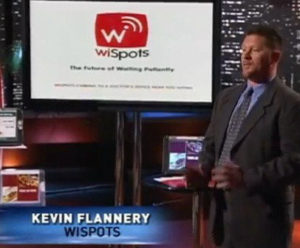
Shark Tank / ABC, via Gazette Review
WiSpots supplied wireless screens for people waiting in medical facilities. Users could access information and online activities while the system carried advertising.
Contemporary coverage of its 2008 search-engine arrangement described WiPad devices that let patients access the internet without bringing their own computer. It also described an advertising-supported service with revenue sharing for medical offices.
That last detail is central. WiSpots was not simply selling internet access to a patient. It proposed bringing an audience and advertisers together inside participating locations.
The product also depended on the practice’s cooperation. Equipment had to fit the space, staff workflow and patient experience. Even if an advertiser liked the audience, the venue still had to see a reason to host the system.
Who founded WiSpots?
Kevin Flannery founded the company. A June 2014 News & Observer report, republished by Working Woman Report, identifies him as its founder and CEO.
That report is valuable because it includes his account several years after the television appearance. He said he was working a full-time telecommunications job while continuing to spend at least 20 hours a week on WiSpots and seeking funding.
Those statements show continued effort at that date. They do not establish that financing subsequently arrived or that the company remains active today.
The old tendency to turn this story into a judgment about his family should be avoided. A founder’s willingness to commit time and money can be discussed without inventing private consequences or treating an uncertain business outcome as a personal verdict.
What happened on Shark Tank?
Flannery asked for $1.2 million in exchange for 10%. No Shark invested.
The pitch recap records concerns about the business proposition. The key issue for a prospective investor was whether a system combining hardware, venue participation and advertising could become commercially convincing.
Deal snapshot
| Item | Outcome |
|---|---|
| Funding requested | $1.2 million |
| Equity offered | 10% |
| Implied asking valuation | $12 million |
| Accepted offer | None |
| Shark investor | None |
| Investment closing | Not applicable |
The $12 million number comes from dividing the request by the proposed stake. It was an asking valuation, not an independent assessment, completed funding round or current net worth.
A useful comparison from the same episode is Ionic Ear. Both pitches left without a deal, but the barriers were different: WiSpots needed a working commercial network, while Ionic Ear proposed an unusually demanding consumer adoption process.
How was WiSpots supposed to make money?
The model connected three groups: medical practices, patients and advertisers. Their interests needed to align.
Business model snapshot
| Participant | Intended benefit | What needed to work |
|---|---|---|
| Medical practice | A service for waiting patients and potential advertising income | Equipment and operation had to suit the venue |
| Patient | Access to information or entertainment during the wait | The screen had to be useful enough to pick up |
| Advertiser | An opportunity to reach a waiting-room audience | Audience reach and response had to justify spending |
| WiSpots | Revenue from running the advertising-supported system | Income needed to cover deployment and ongoing costs |
This table describes the commercial logic. It does not claim the company achieved those results.
The difficult part is the connection between installation and revenue. Devices in a waiting room can create the possibility of an audience. Advertisers still need a reason to pay, and patient use still needs to be demonstrated.
An installation count is therefore different from an advertising-sales figure. A practice agreeing to consider a system is also different from a paying contract. Those distinctions matter when assessing early traction.
The model would need evidence on several questions: how often devices were used, how advertising was sold, how income was shared and what support cost. The material reviewed does not establish enough current financial data to calculate the economics.
What happened after Shark Tank?
Latest update — November 17, 2026: A current WiSpots service offering, active customer network and purchasing channel were not verified. The strongest dated follow-up evidence establishes activity after the show, rather than a confirmed present-day operation.
The planned merger was called off
In February 2010, WiSpots issued an announcement through PR Newswire stating that it would remain independent and was no longer affiliated with WiFiciency.
The release also reported installations at Triangle Orthopaedic Associates locations in central North Carolina and elsewhere. These were company-reported deployments, not an independent audit of revenue.
This source changes how the history should be written. A merger proposal cannot be treated as a completed acquisition or a permanent renaming when a later company announcement explicitly says it did not proceed.
The founder was still discussing WiSpots in 2014
The 2014 interview described continued work on the venture alongside another job. It also referred to a failed merger attempt.
That is inconsistent with a simple account in which WiSpots definitively ended in 2012 and Flannery had already abandoned it. It does not tell us what happened in every subsequent year, so the current status remains open.
Evidence audit
| Evidence | What it establishes | Limit |
|---|---|---|
| 2008 industry coverage | A documented WiPad concept and advertising model | Not proof of later scale |
| 2010 company announcement | Planned merger called off; deployments reported | Company-issued historical information |
| 2014 founder interview | Flannery described continuing work on WiSpots | No guarantee of subsequent funding |
| Current review | No verified present-day service channel established | Does not prove a specific legal closure date |
Selected timeline
| Date | Milestone |
|---|---|
| March 2008 | Industry coverage describes WiSpots’ WiPad and search arrangement |
| August 2009 | Flannery appears in the Shark Tank premiere |
| February 2010 | WiSpots announces that the planned WiFiciency merger will not proceed |
| June 2014 | A founder interview describes continued work and funding efforts |
| November 2026 | Current operating status remains unverified in this review |
The evidence is sufficient to correct a misleading merger story. It is insufficient to assign a current valuation or a definite shutdown date.
Can you buy or use WiSpots today?
No current purchasing or installation route was verified. This article therefore does not recommend a supplier or provide an order link.
A product from another waiting-room technology company should not be presented as WiSpots without evidence of a connection. Likewise, a later venture associated with a similarly named person is not enough to establish ownership, succession or a rebrand.
Healthcare buyers would need current provider details and a live service proposal. Historical publicity cannot substitute for those checks.
What can entrepreneurs learn from WiSpots?
A platform has more than one customer decision. A host location, an end user and an advertiser can each have a different reason to participate. The model works only if those reasons fit together.
Show the link between usage and revenue. Equipment deployed and money earned are separate measures. Evidence about one should not be used as proof of the other.
Keep corporate milestones precise. A proposed merger, a signed agreement and a completed transaction are different events. WiSpots’ own announcement is a useful reminder to read beyond the initial plan.
The Mr. Tod’s Pie Factory story makes a related point about financing: a televised agreement can fail to become a completed investment.
Frequently asked questions
Did WiSpots receive a Shark Tank investment?
No. Flannery left without a deal.
What was the original request?
He asked for $1.2 million for 10%, implying a $12 million asking valuation.
Did WiSpots become WiFiciency?
A February 2010 company announcement says the planned merger was called off and WiSpots was no longer affiliated with WiFiciency. A straightforward completed-rebrand claim is not supported.
Did WiSpots close in 2012?
That date is not established by primary closure evidence. A 2014 interview described Flannery still working on WiSpots.
Is WiSpots operating now?
Current operations could not be verified from the evidence reviewed.
What is Kevin Flannery’s net worth?
A reliable personal net-worth figure was not established. The venture’s asking valuation cannot be used as a substitute.
WiSpots is most useful as a case study in aligning the interests of users, venues and advertisers. Its documented history also shows why a careful update needs dated sources, especially when later summaries disagree.
The weekly question
From obsession to clarity — one original question every week.
We answer one noisy topic at a time, in full. No daily roundup, no thread bait — just the question, the principles, and the system.