
Rip Tie Hair After Shark Tank: The 15% Counter and the Deal Sarah Fox Took
Sarah Fox asked Lori Greiner and Allison Ellsworth to come down to 15%. The on-air Rip Tie Hair agreement was $250,000 for 20%.
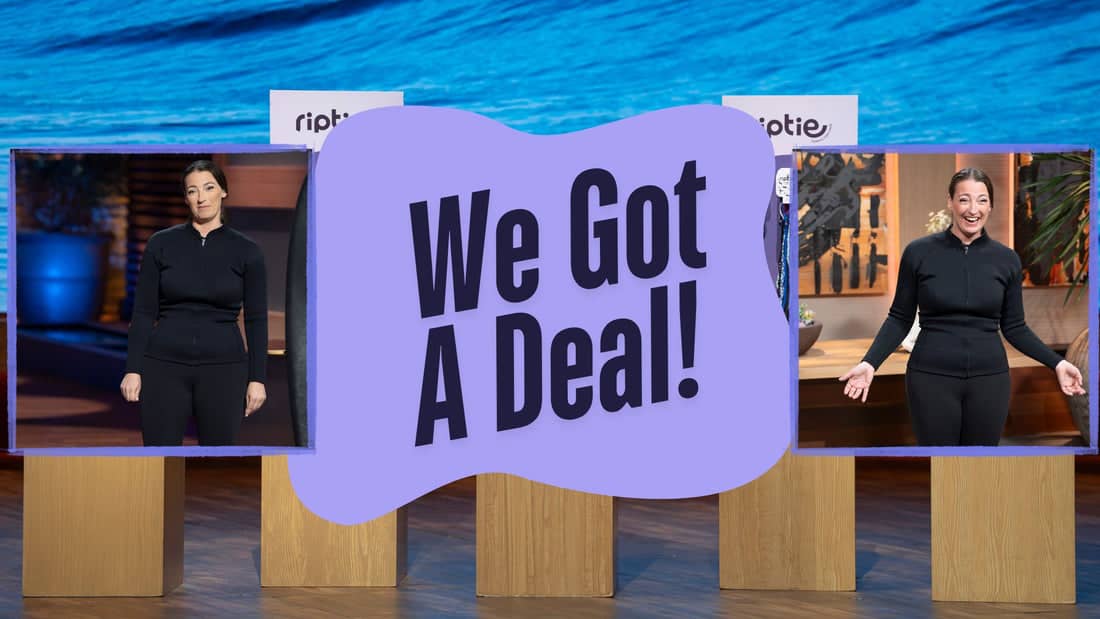
A regular elastic can hold a ponytail neatly at the scalp while the rest of the hair whips through wind, waves or a boat ride. Sarah Fox built Rip Tie Hair for the part the elastic leaves loose. The difference is easiest to appreciate after the activity, when the wearer takes the tie off and reaches for a brush.
Fox pitched that experience to the Sharks and chose two investors who could help explain the product to a much larger audience. The terms are sometimes confused because two percentages were discussed: she asked Lori Greiner and Allison Ellsworth to match 15%, but the offer she ultimately took was $250,000 for 20%. Here’s what the founder demonstrated, what the investors agreed to, and what a shopper can verify today.
On-air deal
Pitch outcome
$250,000 for 20% with Lori Greiner and Allison Ellsworth.
$250,000 for 10%
Opening ask
Terms sought on Shark Tank.
20%
Product detail
The accepted stake; 15% came up during negotiations.
Product snapshot
| Field | Details |
|---|---|
| Company | Rip Tie Hair |
| Founder or founding team | Sarah Fox |
| Product | A wrap-style tie designed to secure the length of a ponytail |
| Industry | Hair accessories and outdoor recreation |
| Shark Tank episode | Season 17, Episode 13 • March 11, 2026 |
| Current status | Rip Tie Hair offers ties and a Shark Tank bundle. |
How does Rip Tie Hair work?
Rip Tie wraps down the ponytail, keeping more of the hair gathered than a tie placed only at its base. It is designed for activities such as swimming, riding or running, where motion and wind can make loose lengths tangle. The manufacturer’s store and instructions are the best place to compare versions and see the wrapping technique before buying.
A shopper with very short hair faces a different problem from someone with long hair who spends hours in salt water. The product’s appeal depends on having enough hair to wrap and a reason to secure more than the base. Those two conditions matter more than the broad category label of hair accessory.
Who built Rip Tie Hair?
Fox was a surfer and diver, and her founder diary traces the product to a scuba shop and early orders she fulfilled herself. The diary includes a photograph of her first order and describes putting together a storefront with a free Shopify template. Starting in a setting where customers had just experienced the problem made the demonstration unusually direct.
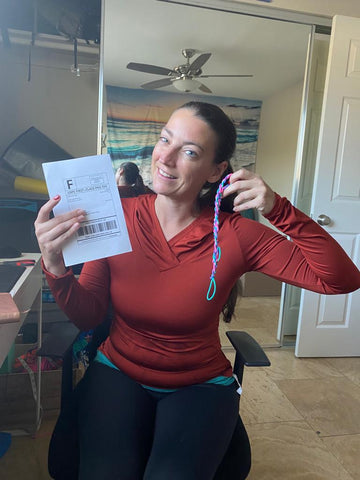
Fox pictured with her first order in the brand’s founder diary.
“After all, we've already proved this hair tie can swim with the sharks.” — Sarah Fox, recalling the demonstration in her pitch diary.
What happened to Rip Tie Hair on Shark Tank?
Fox’s original ask implied a $2.5 million post-money value. As the offers developed, she asked whether the two investors would take 15%. They held at 20% and Fox accepted. Fortune’s interview coverage of Ellsworth independently identifies the $250,000-for-20% joint offer.
The distinction changes the interpretation of the deal. At 15%, the same check would have implied about $1.67 million after investment. At 20%, the implied figure was $1.25 million. Neither number is evidence of current net worth. The decision visible on television was to give up a larger share for the two-investor partnership. Episode reporting.
Deal snapshot
| Negotiation point | What the evidence supports |
|---|---|
| Asked | $250,000 for 10% |
| On-air outcome | $250,000 for 20% with Lori Greiner and Allison Ellsworth. |
| Counter discussed | Fox asked the investors to match 15%. |
| Accepted stake | 20% shared by Greiner and Ellsworth. |
| Closing status | The cited sources establish the on-air outcome. |
Why a hair tie needs a demonstration
An ordinary elastic is cheap, widely available and easy to use without instructions. A premium alternative has to explain why someone should learn a different motion. A clip of a surfer or diver using the tie can do more work than a photograph of the product alone. It shows what the customer is buying: control over the length of the ponytail during the activity.
Selling directly gives the brand room for instructions, bundles and demonstrations. Retail could put the product in front of more shoppers, but packaging would have to communicate the difference in seconds. This is where the choice of investors makes business sense: a partner experienced at showing consumer products can help address a real selling problem, independent of the cash.
Business model snapshot
| Business question | Answer |
|---|---|
| Product | A wrap-style tie designed to secure the length of a ponytail |
| Sales channel | Direct website, social shopping and product bundles. |
| Buyer decision | Choose a version suitable for the wearer’s hair length and activity. |
| Business question | Can a first-time buyer understand the technique without the founder present? |
What happened after Shark Tank?
Latest update — November 12, 2026. The official shop lists products and a Shark Tank bundle. Fox has also published a firsthand account of preparing and delivering the pitch.
The shop establishes that the product is commercially available. The founder diary documents how it was presented. Neither source discloses final investment paperwork or current profits, so it is more accurate to describe an agreement on television than to state the Sharks now hold a particular private stake.
Current status evidence
| Evidence | What it establishes |
|---|---|
| Official offering | Rip Tie Hair offers ties and a Shark Tank bundle. |
| Pitch evidence | $250,000 for 20% with Lori Greiner and Allison Ellsworth. |
| What is still unknown | Final investment documents and the company’s current earnings. |
Company timeline
| Date | Milestone |
|---|---|
| Before Shark Tank | Fox developed and sold the ties, initially handling orders herself. |
| March 11, 2026 | Fox accepted the joint offer in Season 17, Episode 13. |
| After broadcast | Fox published a behind-the-scenes account with pitch photographs. |
| November 2026 | The brand lists a dedicated Shark Tank bundle. |
What should a buyer check?
Watch the wrapping method and check the brand’s guidance for your hair length before choosing a size or bundle. For someone who mostly needs to pull hair off the face at a desk, a regular elastic may already work well. For a swimmer, rider or diver who spends significant time detangling afterward, the right comparison is the time and effort saved across repeated outings.
What can founders learn from Rip Tie Hair?
Fox found a narrow failure in a familiar product: an elastic secures one point, while movement affects the entire ponytail. That is a useful way to develop an accessory. Observe where the existing product already works, then identify the part of the job the customer still does afterward. In this case, the real competition was a wet brush at the end of the day.
The Season 17 episode guide lists the other pitches. Readers following other businesses from Season 17 can also find Hot Girl Soda, Nude Foods Market, Clean Green Golf Balls.
Frequently asked questions
Did Sarah Fox get a deal? Yes. Lori Greiner and Allison Ellsworth made the accepted on-air offer.
Was the deal for 15% or 20%? 20%. Fox discussed 15% during negotiations.
How much money was offered? $250,000.
Where can shoppers find the ties? The official Rip Tie Hair website lists ties, bundles and instructions.
What problem does the tie solve? It wraps the ponytail’s length to reduce loose hair moving and tangling during activity.
The weekly question
From obsession to clarity — one original question every week.
We answer one noisy topic at a time, in full. No daily roundup, no thread bait — just the question, the principles, and the system.
More from Shark Tank USA Season 17
All season pitches
Shark Tank USA
The Christmas Carolers After Shark Tank: Barbara’s 60% Deal, Expansion and Current Status
Shark Tank USA
pi00a After Shark Tank: How the Stein Family Took Deaf-Owned Pizza From Restaurant to Freezer
Shark Tank USA