Notehall Shark Tank Update: The Chegg Sale and What Came Next
Notehall landed Barbara's offer and a Chegg acquisition. See the verified sale price, failed Shark deal and later decision against integration.

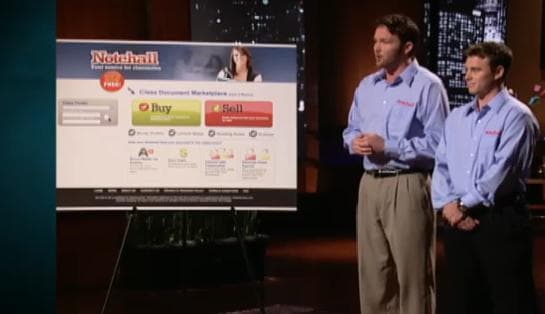
Good lecture notes can be valuable to more than the student who wrote them. Notehall tried to turn that everyday college reality into a marketplace: students could upload class notes and study guides, while classmates could pay to access them.
D.J. Stephan and Sean Conway brought the idea to Shark Tank in Season 1. Their pitch earned an offer from Barbara Corcoran, but the company's later acquisition became the larger part of its story. For viewers returning to the episode, the obvious questions are whether Barbara actually invested and whether Notehall became part of Chegg.
The answers need some care. Contemporary reporting shows that negotiations continued after filming. Later reporting says the Shark investment did not close. Chegg's own filings confirm an acquisition in June 2011, followed by a decision against integrating the acquired content and a subsequent write-off.
That combination makes Notehall an interesting acquisition story, without supporting the familiar claim that its original service simply lives on inside Chegg. It is one of the businesses covered in our Shark Tank USA Season 1 guide.
Quick answer: What happened to Notehall?
Notehall accepted an on-air offer of $90,000 for 25% from Barbara Corcoran after asking for $90,000 for 10%. The investment reportedly did not close. Chegg acquired Notehall on June 22, 2011; its annual report put the fair value of purchase consideration at $4.7 million. The same reporting record later disclosed that Chegg decided against integrating Notehall content into its learning platform. Notehall-related acquired intangible assets were written off in 2012. Those facts establish both an acquisition and a later change of direction, rather than uninterrupted operation of the original marketplace. Current status: Notehall is not verified here as an active standalone service, and it should not be described as successfully integrated into Chegg.
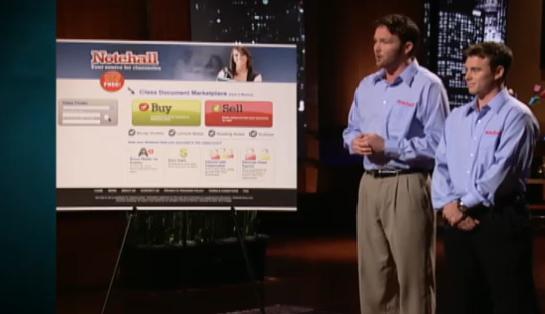
Shark Tank / ABC, via Shark Tank Blog.
What was Notehall, and who created it?
Notehall was a marketplace for student-created class notes and study guides. Its proposed benefit ran in two directions: organized students could earn money from material they prepared, and other students could access another perspective on a course.
A contemporary University of Arizona report identified Sean Conway and Justin Miller as the founders who launched it at the university in October 2008. D.J. Stephan handled marketing, and Fadi Chalfoun was the chief technology officer. Conway and Stephan were the two people viewers saw presenting the business.
The report also described the team's initial emphasis on making the service work at one university before expanding. That was a practical marketplace problem: notes are useful only when they match a student's course, and a campus with very little relevant material is unlikely to attract many paying users.
The concept differed from a publisher commissioning a textbook. Notehall depended on participants contributing useful material and other participants choosing to buy access. Its commercial value therefore depended on the quality and relevance of the content, as well as the website.
What deal did Notehall get on Shark Tank?
The founders sought $90,000 for 10% and chose Barbara Corcoran's $90,000-for-25% proposal. The pitch summary records the televised negotiation.
| Pitch detail | Notehall's result |
|---|---|
| Presenters | D.J. Stephan and Sean Conway |
| Season | Shark Tank USA Season 1 |
| Initial ask | $90,000 for 10% |
| Accepted televised offer | $90,000 for 25% |
| Shark | Barbara Corcoran |
| Original asking valuation | $900,000 |
| Post-show investment | Reportedly did not close |
The revised equity percentage meant the same investment would buy a larger share of the business. The original $900,000 valuation was simply the valuation implied by the founders' request, not their personal net worth.
For the founders, selecting an investor also meant choosing someone they felt supported their approach. The Daily Wildcat's October 12, 2009 follow-up reported that they were still negotiating with Corcoran and had also reached arrangements with other investors.
That contemporary detail is important: the article described a deal still being settled, rather than money conclusively received on the terms shown on television.
How did Notehall's marketplace work?
Notehall connected people supplying study materials with people looking for them. The platform's challenge was to make both sides worthwhile at the level of individual courses.
| Participant or feature | Role in the model |
|---|---|
| Student contributors | Supplied notes and study guides |
| Student buyers | Paid for access to relevant material |
| Marketplace | Organized access and handled the transaction |
| Course relevance | Determined whether a document was useful to a particular buyer |
| Expansion to another campus | Required new useful material as well as new users |
A large total audience does not automatically solve that matching problem. A student taking one course has little reason to buy notes for an unrelated one, however popular the overall website becomes.
Trust matters too. Buyers need enough information to judge what they will receive. Contributors need a reason to keep uploading worthwhile material. Those are practical challenges for this type of marketplace; they are not claims that Notehall failed any particular quality test.
The education focus also makes Notehall a useful comparison with Classroom Jams, which pitched a very different approach to learning in the same season. One relied on a marketplace for student materials; the other centered on educational music.
What happened to Notehall after Shark Tank?
Latest verified business outcome: Chegg's filings document its 2011 acquisition of Notehall and its later decision not to integrate the acquired content. Notehall-related intangible assets were written off in 2012. This record does not support presenting the original marketplace as an ongoing Chegg service.
Barbara's investment reportedly fell through
Looper's retrospective reports that the founders walked away from the Corcoran arrangement after filming. It also discusses her later comments about missing out on the company.
Read alongside the campus newspaper's report that negotiations remained open, the chronology is straightforward: an accepted televised proposal was followed by further discussions, and the reported investment did not ultimately happen.
This is different from a Shark investing and later selling a stake to an acquirer. The verified acquisition cannot be used to calculate a return for Barbara without evidence that she actually owned the relevant shares.
Chegg acquired Notehall in June 2011
Chegg's annual report states that it acquired all of Notehall's outstanding shares and voting interests on June 22, 2011.
The filing put total purchase consideration at a fair value of $4.7 million, comprising approximately $4.4 million in cash and common stock valued at approximately $0.3 million. That is the clearest sourced transaction figure for this update.
It is a company acquisition value, not the amount each founder personally received. Dividing it among the presenters or calling either present-day net worth the same number would ignore ownership, transaction terms and subsequent events.
The acquisition occurred in 2011, well after the 2009 television appearance. Describing it as an immediate sale after the episode would compress the timeline incorrectly.
Acquisition did not lead to the integration often claimed
The later outcome is easy to miss if the research stops with the purchase. In its 2014 quarterly filing, Chegg specifically described Notehall as a business it had acquired but subsequently decided not to integrate.
That disclosure matters more than a later article casually stating that Notehall became part of Homework Help. Ownership of an acquired business and successful integration of its content are separate questions.
Chegg's annual reporting recorded a $292,000 impairment charge in November 2012 for the write-off of Notehall's acquired intangible assets. That charge was not the full purchase price and should not be presented as one. Accounting values assigned to particular acquired assets can be much smaller than total consideration for a transaction.
Nor does the figure prove what the founders thought of the outcome. It documents the buyer's accounting treatment and change of direction.
The verified timeline
| Period | Documented development | Interpretation |
|---|---|---|
| 2008 | Launch at the University of Arizona | A campus-based starting point |
| 2009 | Shark Tank offer and continued negotiations | The televised agreement was not the final closing |
| Post-show reporting | Corcoran investment did not close | Do not assume she owned a stake |
| June 2011 | Chegg acquired Notehall | A confirmed acquisition |
| 2012 | Integration abandoned and acquired intangibles written off | The acquired service did not follow the commonly claimed integration path |
Another Season 1 business, Soy-Yer-Dough, also illustrates why a later acquisition announcement needs to be followed through subsequent financial disclosures. The transaction is a milestone, not the end of the business history.
Can students still use Notehall?
This review did not verify an active standalone Notehall marketplace. Readers should not assume that a present-day Chegg product is the original service simply because Chegg acquired the company years ago.
For the same reason, historical Notehall pricing, university counts or registration instructions are not current buying guidance. They describe how the service worked at a particular stage.
Students considering any notes marketplace should check their course and institution's rules, the relevance of the material and what the seller is actually offering. This article does not recommend a current substitute or make a blanket legal judgment about student-created notes.
What does Notehall's story teach founders?
Notehall shows how a founder's exit and a product's continued life can lead to different conclusions. An acquisition can be a substantial commercial milestone even when the buyer later chooses another direction.
It also demonstrates why a television offer should be tracked separately from a funding round. Exposure, negotiation, final investment and acquisition are different events. Combining them into one uninterrupted success story loses the most useful business detail.
For marketplace founders, the original concept also poses a durable operating question: how do you make a service useful within each small community before expanding to the next? More campuses on a list are not enough unless buyers can find relevant material there.
Frequently asked questions
Who pitched Notehall?
D.J. Stephan and Sean Conway presented it. Contemporary reporting also identifies Justin Miller and Fadi Chalfoun as members of the founding team.
Did Barbara Corcoran invest?
She made the accepted on-air offer, but later reporting says the investment did not close.
How much did Chegg pay for Notehall?
Chegg reported purchase consideration with a fair value of approximately $4.7 million, including cash and shares.
When was Notehall acquired?
Chegg's filing gives June 22, 2011 as the acquisition date.
Did Notehall become Chegg Homework Help?
The evidence reviewed does not support that description. Chegg explicitly disclosed that it decided not to integrate Notehall content.
What is Notehall's net worth now?
No verified current standalone valuation is established. Its historical purchase price should not be labeled present net worth.
The weekly question
From obsession to clarity — one original question every week.
We answer one noisy topic at a time, in full. No daily roundup, no thread bait — just the question, the principles, and the system.