Voyage Air Guitar Shark Tank Update: Still Playing in 2026
Voyage Air left Season 1 without a deal. Follow its later Fender market test, current guitars, and verified 2026 company update.


A full-size guitar is easy to enjoy and awkward to transport. Voyage Air Guitar addressed that problem with an unusual feature: a neck that folds, allowing the instrument to fit into a smaller case without turning it into a miniature guitar.
Jeff and Josh Cohen demonstrated the idea on Shark Tank. The visual surprise attracted attention, but the negotiation became a disagreement about ownership and how to build the business. They left Season 1 without a deal.
That was not the end of the company’s relationship with the show. Voyage Air’s own history describes later discussions and a market-test agreement with Fender. A dated 2026 announcement also provides evidence that the company continues developing and promoting its instruments.
The distinction matters. A later business arrangement should not be counted as an accepted offer in the original episode. Nor should a dramatic pitch be used to invent a current revenue figure.
Quick answer: Jeff and Josh Cohen sought $500,000 for 5% of Voyage Air Guitar and left Shark Tank Season 1 without a deal. The company later described further discussions with Kevin O’Leary and a limited Fender market test. Those developments are separate from the original pitch. Voyage Air’s official catalog remains accessible, and an April 1, 2026 company announcement discusses continuing product development and dealer opportunities. Current status: operating evidence is present through official product listings and a dated 2026 announcement; current revenue and later investment terms are not verified.
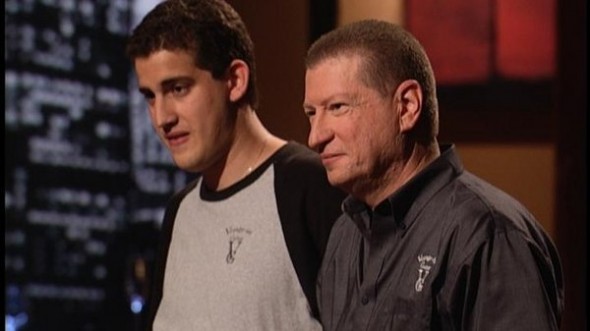
Josh and Jeff Cohen during their Season 1 pitch. Image: ABC, via Shark Tank Blog.
What makes Voyage Air Guitar different?
Voyage Air builds guitars with a folding-neck mechanism. The point is to reduce the space needed for transport while retaining a full-size instrument when it is unfolded.
| Product snapshot | Details |
|---|---|
| Pitch presenters | Jeff Cohen and Josh Cohen |
| Category | Musical instruments |
| Distinguishing feature | Folding neck |
| Intended benefit | Easier transport in a compact case |
| Appearance | Shark Tank USA Season 1, Episode 3 |
The presenters should not automatically receive sole invention credit. In the company’s account of its first-season appearance, Jeff identifies partners Harvey Leach and Adrian Bagale in the development of the folding technology.
The current VAOM-02 product page provides a concrete example of the design. It lists a 25.5-inch scale length and folded dimensions of 20 by 15 by 6 inches, and includes a backpack-style case.
Those are manufacturer specifications, not measurements from an independent hands-on test. The distinction is useful when comparing travel instruments: model details matter more than a broad promise that any guitar will suit every traveler.
Why was there no deal in Season 1?
The opening request was $500,000 for 5% of the company. That implied a $10 million asking valuation.
Shark Tank Blog’s episode recap describes negotiations over majority ownership and licensing. The Cohens did not accept the proposed arrangement.
| Pitch snapshot | Result |
|---|---|
| Cash requested | $500,000 |
| Equity offered | 5% |
| Implied asking valuation | $10 million |
| Accepted Season 1 offer | None |
| Key negotiation issue | Ownership and the route to commercial growth |
The company’s own retrospective confirms that Jeff chose to turn down the offer rather than accept terms he considered unsuitable for the product’s direction.
That does not mean an investor’s approach could never have worked. It means the parties did not agree during that appearance.
Our Shark Tank USA Season 1 guide therefore records Voyage Air as a no-deal pitch, while acknowledging later developments separately.
How does the business model work?
Voyage Air’s core business is selling instruments built around its folding design. Its catalog presents multiple product series and support information for owners.
There is also a potential route through partnerships: another instrument company can explore using the technology in its own product offering.
| Route | What is being offered | Business question |
|---|---|---|
| Own-brand instruments | A complete Voyage Air guitar | Can the company reach players at a sustainable price? |
| Dealer distribution | Instruments sold through retail partners | Can partners explain and support the folding design? |
| Technology collaboration | A folding design used in another brand’s product | How are quality, rights, and brand identity protected? |
| Owner support | Manuals, warranty information, and service routes | Can buyers maintain confidence after purchase? |
This is an analysis of the model, not a breakdown of verified revenue.
The ownership debate has a parallel in LifeBelt’s Season 1 pitch, where the founder also rejected offers involving his invention’s rights. A useful update must identify what each side wanted to buy or retain.
What happened after Shark Tank?
Latest update — November 17, 2026: Voyage Air has an accessible official instrument catalog and issued a company announcement on April 1, 2026 about ongoing development and dealer opportunities. These provide current operating evidence beyond the original television appearance.
The conversation continued after the rejection
Voyage Air’s official Shark Tank history describes follow-up coverage and later off-air discussions. Its separate Season 3 account says a proposed arrangement depended on reaching an agreement with an industry brand.
That is the company’s account of later negotiations. Without the final contracts, this update does not assign a specific ongoing ownership percentage to Kevin O’Leary or claim that every contemplated term was executed.
The original Season 1 result remains unchanged.
The Fender arrangement was a market test
The company’s Season 4 account explains the next stage more precisely. Voyage Air and Fender agreed on a limited market test involving a few hundred Fender Voyage Air guitars intended for selected retailers.
The described arrangement aimed to protect the identity of each brand while testing a product together. That is more specific than saying simply that Fender bought the company.
This review does not establish the full later sales results or claim a permanent, unrestricted partnership. A planned limited run should be described according to the evidence available.
The 2026 announcement provides a fresh checkpoint
In an April 1, 2026 release distributed through GUITARpr, the company discussed continuing design and manufacturing development. It said key proprietary parts were being produced locally in California and described work on cutaway models.
The announcement also invited dealer and distribution inquiries. It supports ongoing company activity at a known date, rather than an inference based solely on an old storefront.
Its promotional statements about quality and performance remain company claims. They are not independent comparative test results.
A timeline of distinct events
| Stage | Documented development | What should not be inferred |
|---|---|---|
| Season 1 | The Cohens left without an accepted offer | That the company ended after rejection |
| Later show relationship | Company describes further discussions and follow-ups | That these were a Season 1 deal |
| Fender stage | Company describes a limited market-test agreement | A sale of the whole company |
| April 2026 | Company issued a development and distribution announcement | A particular revenue or profit figure |
| Current product review | Official listings and owner resources are accessible | Guaranteed stock or suitability for every buyer |
This timeline prevents separate events from collapsing into a single misleading “got a deal” label.
What are its sales and net worth?
No dependable current revenue, profit, or business valuation was verified in the evidence reviewed here.
The $10 million figure implied by the opening pitch was an asking valuation. It is not a current appraisal. Likewise, a later discussion involving large proposed sums would not establish actual funds received without evidence that its conditions were met.
For another case in which an accepted offer and later financial arrangements need separate treatment, Stress Free Kids’ update follows the founder’s own account of revised terms.
Can you still buy a Voyage Air Guitar?
The official site presents guitars for sale and provides model specifications, ordering information, manuals, and warranty resources.
When checked for this update, the VAOM-02 product page displayed a $499 sale price, with $699 crossed out, and an add-to-cart option. Prices can change, and this review did not place an order.
Buyers should check the exact model, case dimensions, delivery availability, return terms, and warranty before purchasing. An instrument’s compact packed size does not by itself establish acceptance under every airline’s baggage policy.
The company also distinguishes standard products from “Travel Tested” stock. Read the individual listing rather than assuming every instrument has the same condition or specifications.
What can founders learn from Voyage Air?
Voyage Air illustrates how a founder’s decision about control can shape the route to market.
Selling a finished product, licensing a mechanism, and developing a product with a major brand are different strategies. Each comes with its own requirements for quality, distribution, and rights.
The later Fender discussion also shows why a rejected pitch need not end a business relationship. Parties can revisit an idea under a different structure. That possibility is not a guarantee of success, but it is part of the documented story here.
Frequently asked questions
Did Voyage Air Guitar get a Season 1 deal?
No. Jeff and Josh Cohen left their first appearance without an accepted investment.
Who presented Voyage Air Guitar?
Jeff Cohen and his son Josh presented the product. The company’s history also credits development partners Harvey Leach and Adrian Bagale.
Did Voyage Air later work with Fender?
The company describes an agreement for a limited Fender market test. That is separate from the original Season 1 negotiation.
Is Voyage Air still operating?
Its official catalog and April 2026 company announcement provide evidence of ongoing activity. Current revenue is not verified.
Does the guitar really fold?
A folding neck is the product’s defining feature. The manufacturer provides model specifications and instructions; this article is not an independent performance test.
What is Voyage Air Guitar worth today?
No reliable current valuation was verified. The $10 million implied by the initial request should not be labeled its present net worth.
The weekly question
From obsession to clarity — one original question every week.
We answer one noisy topic at a time, in full. No daily roundup, no thread bait — just the question, the principles, and the system.