The Bobble Place Shark Tank Update: Where Is the Business Now?
Jeff Wolsky left without a Shark deal. Bobblemaker's official history connects today's custom-bobblehead catalog to The Bobble Place.

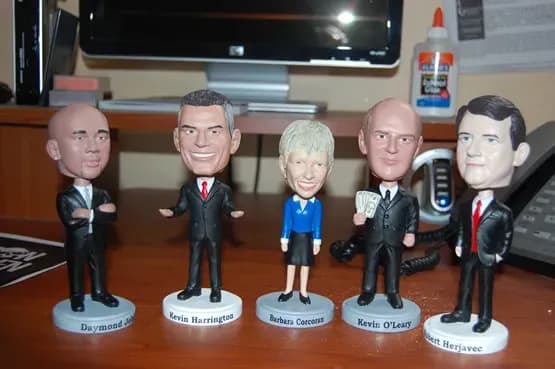
A personalized bobblehead turns a familiar novelty into a recognizable person. Jeff Wolsky brought that idea to Shark Tank, where the investors could see miniature versions of themselves rather than simply imagine the product.
The proposal, however, was not just an invitation to buy into every part of his existing business. Wolsky wanted investment for a retail-kiosk expansion. The difference between that new venture and his established online operation became central to the negotiation.
He left without a deal. That does not mean the underlying custom-bobblehead business ended. Bobblemaker's official history now explicitly connects its founder and operation with The Bobble Place appearance, and its catalog offers personalized products.
For viewers wondering where the company went, that direct connection is more useful than an unexplained claim that the business was renamed or became worth millions. This update separates the kiosk proposal from the broader online business. You can compare its outcome with the other pitches in our Shark Tank USA Season 1 guide.
Quick answer: What happened to The Bobble Place?
Jeff Wolsky asked for $75,000 for 18% of The Bobble Place and did not secure an investment. The pitch concerned a kiosk venture, distinct from the existing online business the Sharks also wanted to discuss. Today, Bobblemaker's own history identifies Wolsky and The Bobble Place as part of its Shark Tank story. Its website offers made-to-order bobbleheads, including fully customized figures and pet designs. This supports a continuing online commercial presence, but not an independently verified revenue or net-worth figure. It also does not prove that the proposed kiosk network was rolled out. Current status: a connected custom-bobblehead business remains visible through Bobblemaker's catalog; the kiosk expansion's eventual scale is unverified.
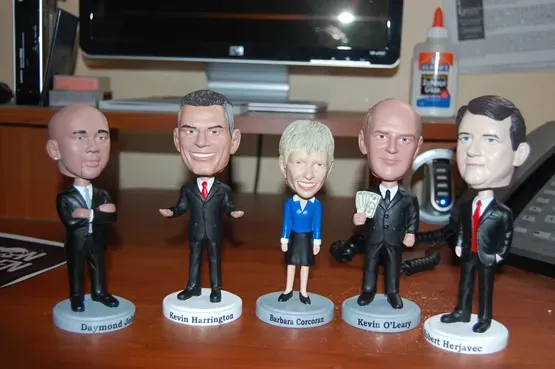
Official Bobblemaker photograph of its Shark Tank bobblehead set.
What did The Bobble Place sell?
The concept was personalized bobbleheads created to resemble customers or gift recipients. Instead of choosing only a generic character, a buyer supplied photographs and details to shape the result.
That gives the product a different buying purpose from a mass-produced collectible. It can commemorate a person, occasion or relationship rather than a licensed entertainment character.
| Product element | Customer purpose |
|---|---|
| Personalized head | Resemblance to a particular person |
| Outfit and pose | A reference to work, hobbies or an occasion |
| Custom details | A more specific gift or keepsake |
| Proofing process | A chance to review the proposed likeness |
These describe the personalized-product model. The extent of customization depends on the actual item ordered.
The company's current history page identifies Jeff Wolsky as the founder associated with the Shark Tank appearance. It also describes the business's earlier wedding-accessory work and its later Bobblemaker presence.
Why did the Shark Tank pitch end without a deal?
Wolsky sought $75,000 for 18%. The pitch recap identifies an important boundary: he was seeking support for the kiosk business, rather than offering the entire established operation.
| Pitch detail | Outcome |
|---|---|
| Presenter | Jeff Wolsky |
| Season | Shark Tank USA Season 1 |
| Initial request | $75,000 for 18% |
| Proposed expansion | Retail kiosks for custom bobbleheads |
| Existing business | An online operation outside the proposed kiosk-only deal |
| Result | No accepted investment |
The disagreement was therefore about the investment's scope as well as the product. A Shark evaluating an established online operation would be assessing different evidence from a Shark financing a new retail format.
The distinction also prevents an exaggerated failure narrative. Rejection of the kiosk proposal did not establish that customers had stopped buying personalized figures online.
Another Season 1 pitch, College Foxes Packing Boxes, similarly required investors to understand which venture was actually included in the proposed deal.
What made kiosks different from online ordering?
A kiosk can introduce a custom product to shoppers who were not already searching for it. It also adds the costs and operational requirements of a physical location.
Online ordering can reach a wider area without requiring each buyer to visit a kiosk. But it still needs clear instructions, good photographs and communication during production.
| Issue | Kiosk model | Online model |
|---|---|---|
| Discovery | Passing shoppers see the display | Customers arrive through search, referrals or promotion |
| Customer assistance | Staff can explain the process in person | Instructions and messages must do more of the work |
| Location costs | Physical space and staffing matter | Website and customer-acquisition costs matter |
| Customization | Details still need to reach the maker | Photos and instructions can be submitted remotely |
This is a comparison of the two approaches, not an audited account of Wolsky's costs. A successful online service does not automatically prove a kiosk expansion will work at the same margin.
What happened after Shark Tank?
Latest verified update: Bobblemaker explicitly links its business to Jeff Wolsky and The Bobble Place on its official site. Its catalog offers custom orders. A large kiosk rollout, current revenue and a present company valuation were not independently established.
The business itself explains the connection
Bobblemaker's official Shark Tank history states that Wolsky presented under The Bobble Place name and identifies the company behind the current site as the operation associated with that appearance.
This is a useful first-party connection. It is stronger than assuming two bobblehead sellers are related because they offer similar products.
The history also displays clay-stage figures and the completed set depicting the original Sharks. The image in this article comes from that official material.
The safest description is continuity confirmed by the business's own account. It is unnecessary to invent a precise corporate reorganization or imply that every trade name began on the same date.
The current catalog offers made-to-order products
The full-custom catalog displays several categories of personalized figures. Examples observed during this review included a single fully custom doll at $129.99, a custom pet figure at $149.99 and a two-person custom figure at $219.99.
These are listed prices, not guaranteed final totals. Options, shipping and other applicable charges need to be checked for the actual order.
The page also describes a proofing process, with customers reviewing stages of the design. That is the seller's stated process; this article did not place a test order or independently assess the finished likeness.
A continuing catalog does not establish the kiosk outcome
The visible evidence supports an online business. It does not establish how many kiosks, if any, were ultimately launched under the original proposal.
This matters because updates sometimes describe the business as having switched from kiosks to online sales after the show. The pitch already involved an existing online operation, so that framing can incorrectly make it sound as though online selling began only after the rejection.
The more accurate story is that the kiosk investment did not happen on the show and the connected online business has a continuing presence.
Financial estimates remain unverified
No audited current revenue figure or independent valuation was established in this review. Claims of a specific multimillion-dollar annual turnover are therefore omitted.
| Evidence | What it establishes |
|---|---|
| Pitch recap | The kiosk proposal ended without a deal |
| Official company history | Bobblemaker identifies its connection to Wolsky and The Bobble Place |
| Current catalog | Custom products are presented for ordering |
| Product process pages | The seller describes customization and proofing |
| Missing financial records | Current revenue and valuation cannot be verified here |
A clear current catalog gives this story a different evidence base from The Funhouse Project, where the proposed venue's launch was not verified.
Where can you order the custom bobbleheads?
Bobblemaker is the verified connected site discussed here. Its catalog distinguishes fully custom figures from other body and theme options, so the scope of the chosen product matters.
Before ordering a time-sensitive gift, check the production and delivery terms, photo requirements, revision process and total price. A custom order may involve several decisions before it can be completed.
This review verified the pages, not a delivered purchase. It does not guarantee a particular turnaround time or customer outcome.
What can founders learn from The Bobble Place?
The pitch illustrates why defining the investment is as important as demonstrating the product. Investors need to know which assets, revenue streams and new activities their money would support.
It also shows why a new channel should be evaluated on its own economics. A product that sells online may still face different costs and customer behavior in a shopping-center kiosk.
Finally, a no-deal television outcome should not replace later research. The current company account and catalog provide evidence of a continuing business beyond the proposal the Sharks declined.
Frequently asked questions
Who pitched The Bobble Place?
Jeff Wolsky presented the custom-bobblehead venture.
What was the investment request?
He asked for $75,000 for 18%.
Did any Shark invest?
No agreement was reached during the pitch.
Is Bobblemaker connected to The Bobble Place?
Yes. Bobblemaker's official history explicitly identifies Wolsky and The Bobble Place as its Shark Tank story.
Can customers still order personalized figures?
The connected site lists made-to-order products. Fulfillment was not independently tested for this article.
How much is the business worth?
A verified current valuation was not established. Online revenue estimates are not treated as audited financial information.
The weekly question
From obsession to clarity — one original question every week.
We answer one noisy topic at a time, in full. No daily roundup, no thread bait — just the question, the principles, and the system.