McMiLLER After Shark Tank: Daniel Lubetzky’s Deal, Retail Growth, and the Viral-Game Risk
McMiLLER’s Shark Tank deal, current status, retail growth, prices, and the risk of turning one viral game into a durable catalog.
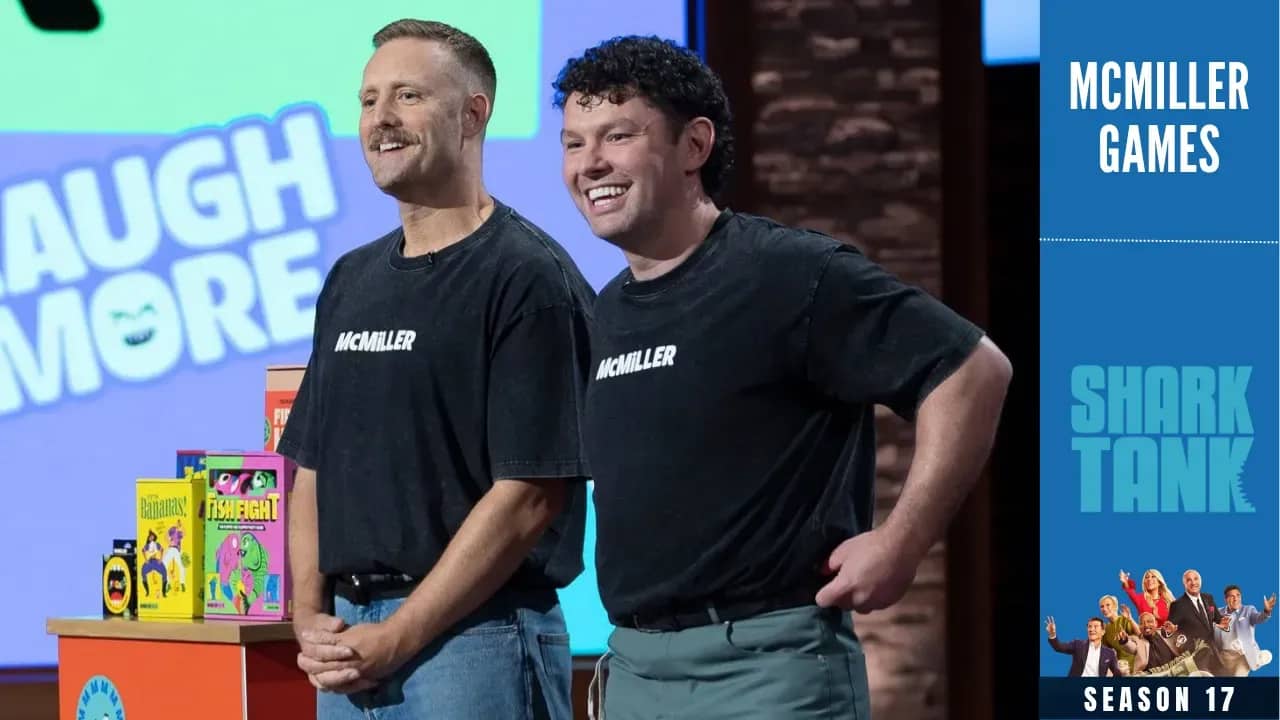
A viral video can sell a party game in hours. Building a durable game company takes much longer.
McMiLLER understands the first part unusually well. Its games use monkey tails, cat mitts, flying fish, pirate props, and silly sounds to create moments people want to film. That helped It’s Bananas! become the company’s breakout product and pushed McMiLLER into eight-figure founder-reported lifetime sales before Shark Tank.
The more useful question is whether David McGranaghan and Julian Miller can turn one viral hit into a reliable catalog. Their company entered Shark Tank with strong direct-to-consumer economics but thin completed profit, heavy holiday seasonality, and plans to take unproven games into retail.
As of September 30, 2026, the operating evidence is positive. McMiLLER has an active store, seven current titles, Target listings, two new 2026 games, and further products in development. A post-show founder interview confirms that Daniel Lubetzky’s televised investment did not close. The company’s Shark Tank revenue forecast remains unverified.
Quick answer: McMiLLER remains active and shows credible growth signals. David McGranaghan and Julian Miller accepted $200,000 for 9% plus a temporary $0.99-per-unit royalty from Daniel Lubetzky on television, but the founders later confirmed that the deal did not close. The company currently sells seven games, has products listed by Target, and says JOLT is heading to Walmart.
| Company | McMiLLER Entertainment |
|---|---|
| Founders | David McGranaghan and Julian Miller |
| Product | Visual party, family, and card games |
| Industry | Toys, games, and entertainment |
| Shark Tank episode | Season 17, Episode 7; December 10, 2025 |
| On-air deal | $200,000 for 9% plus $0.99 per unit until repayment |
| Deal status | Did not close (founder-confirmed) |
| Current status | Active and showing growth signals |
| Website | McMiLLER’s official store |
What Is McMiLLER?
McMiLLER makes short, visual games for families, friends, parties, and gift buyers. Its best-known title, It’s Bananas!, asks players to wear monkey tails and use body movements to complete challenges.
That description also explains the company’s marketing advantage. A viewer can understand the joke in seconds. The product demonstration becomes the advertisement.
The current range stretches beyond one physical game. Fish Fight! uses team challenges. The Cat Mitt Game combines dice and oversized mitts. Fire in the Hole! centers on a pop-up pirate ship. UpRoar! is a compact sound-based card game.
Two 2026 additions broaden the audience further. JOLT is a two-player magnetic strategy game, while DUMMEEZ is an adult party game. Current official prices run from $11.99 for UpRoar! to $25.99 for Fire in the Hole!.
The company also promotes sustainability. It says every current game except It’s Bananas! uses plastic-free, compostable, and biodegradable materials. Those claims come from McMiLLER and have not been independently tested for this review.
The catalog’s larger purpose is simple: replace passive screen time with a shared comic experience. Yet its commercial strength comes from how well that experience travels back through a screen.
Who Founded McMiLLER?
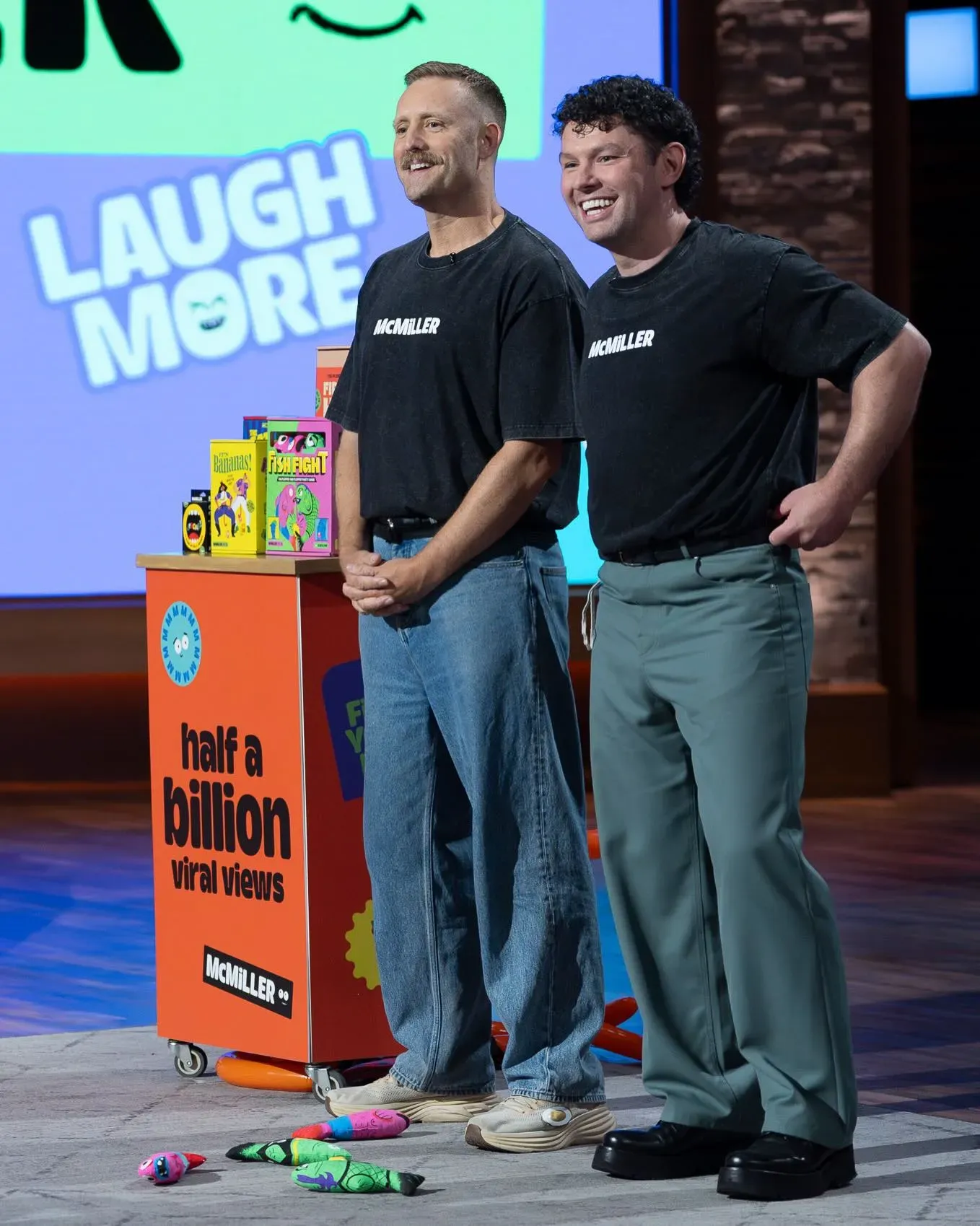
David McGranaghan and Julian Miller met on a blind date in London in 2010. Both came from performance backgrounds.
David, originally from Scotland, trained in musical theatre and performed in London’s West End and with the Royal Shakespeare Company. Julian grew up in the Netherlands, studied musical theatre at the Royal Academy of Music, and worked in film and comedy.
David had already developed Game for Fame, a party game built around performance challenges. The pair later created games for family Christmas gatherings. Their relatives’ reactions helped reveal a wider opportunity: people did not need complicated mechanics to have fun. They needed permission to act silly together.
The founders moved to Los Angeles in 2017 and built the company that became McMiLLER. David went full-time in 2020 as game sales accelerated.
Their entertainment experience created founder-market fit. They knew how to hold attention, stage a joke, and judge whether an audience understood a concept quickly.
A founder interview with People of Play shows how that advantage evolved into an e-commerce system. Julian said the second It’s Bananas! TikTok video reached more than 50 million views, while David explained that the games photographed and demonstrated well.
“The e-com engine doesn’t replace the industry itself.”
— Julian Miller, People of Play interview
Trade shows brought the founders into contact with retailers, distributors, inventors, and other publishers. That transition would later become central to their Shark Tank pitch.
What Happened on Shark Tank?
McMiLLER appeared in the December 10, 2025 holiday episode. Viewers can find the complete lineup in the Shark Tank Season 17 directory.
David and Julian asked for $200,000 for 5%, implying a $4 million valuation. Kevin O’Leary objected immediately, but the founders still had to demonstrate why the business deserved it.
Daniel Lubetzky and Kevin played It’s Bananas! on stage. The demonstration confirmed one part of the pitch: people watching the game could enjoy it even before buying.
The founders then reported more than 650,000 units sold for It’s Bananas! and $12.5 million in company sales to date. They said the flagship sold for $23.99 and landed for $3.
They also described a sharp difference between completed and expected performance. The previous year produced $3.2 million in sales and $120,000 in profit. The founders expected the current year to reach $5 million in revenue and $750,000 in profit.
Kevin valued the business against the completed $120,000 profit. He also warned that placing new products in stores could trap cash in inventory if retailers failed to sell them.
“I just can’t get my head around your valuation.”
— Kevin O’Leary, during the pitch
Barbara Corcoran offered $200,000 for 10% plus $2 per unit until recovering her investment. Daniel, Daymond John, and Lori Greiner entered with similar structures. Barbara later reduced her royalty request to $1.
The founders asked Daniel to accept 8% and a $0.99 temporary royalty. Daniel countered at 9%, and they agreed.
| Founder ask | $200,000 for 5% |
|---|---|
| Ask valuation | $4 million |
| Final on-air deal | $200,000 for 9% plus $0.99 per unit until repayment |
| Shark | Daniel Lubetzky |
| Final implied equity valuation | Approximately $2.22 million |
| Royalty units needed for repayment | Approximately 202,021 |
| Closing status | Did not close (founder-confirmed) |
The final equity valuation was about 44% below the founders’ opening position. In exchange, they secured the Shark they believed could help with international partnerships and established game companies.
How Does McMiLLER Make Money?
McMiLLER began as an e-commerce-driven publisher. Its main channels included the official website and Amazon, with social videos supplying much of the customer discovery.
The pitch economics looked attractive at the product level. A $23.99 selling price minus a $3 landed cost leaves $20.99 before other expenses. That equals an 87.5% product gross margin.
It is not an 87.5% net margin. Advertising, marketplace fees, fulfillment, warehousing, returns, payroll, product development, and overhead all sit below that calculation. The founders’ prior-year numbers illustrate the difference: $120,000 profit on $3.2 million in sales equals about 3.75%.
Retail changes the model again. A retailer keeps part of the shelf price, reducing McMiLLER’s revenue per unit. The company may also need to manufacture more inventory before receiving payment.
| Customers | Families, adult groups, party hosts, gift buyers, and retailers |
|---|---|
| Value proposition | Easy-to-learn games that produce visible, shareable group entertainment |
| Revenue model | Direct sales, Amazon sales, wholesale orders, and retail sales |
| Acquisition | Viral video, marketplace discovery, Shark Tank, trade shows, and retail shelves |
| Advantages | Visual demonstrations, low-language gameplay, broad age appeal, and flagship awareness |
| Risks | Seasonality, inventory funding, imitation, wholesale margin pressure, and dependence on hit products |
The founders said holiday demand once dominated the business. Retail can reduce reliance on fourth-quarter website sales, but it also introduces markdown and working-capital risk.
This tension resembles the seasonal financing challenge faced by Edible Architecture, another company from the same Shark Tank episode. Demand matters, but the timing of production spending and retailer payments can matter just as much.
What Happened After Shark Tank?
The Daniel Lubetzky deal did not close
The televised agreement was real, but the investment did not close. In a post-show interview with Steve Rad, David McGranaghan and Julian Miller discussed the Shark Tank deal that never happened, providing direct founder-source confirmation that Daniel Lubetzky’s on-air offer did not become a completed investment.
The distinction matters: the episode documents the offer and acceptance, while the founder interview establishes the post-show outcome. The Shark Tank appearance still delivered exposure, but Daniel should not be described as a current investor.
Retail expansion became visible
Target currently lists It’s Bananas! and Fish Fight!. The Target listings show active purchasing controls and positive early ratings, although price and store availability can change.
This is meaningful because retail expansion was a central pitch goal. It does not prove that Shark Tank caused the placement, nor does it establish order volume or profitability.
The company also says Walmart selected It’s Bananas! and plans to carry JOLT. A live Walmart product page was not located during this review, so that placement remains announced rather than independently verified.
The catalog expanded
JOLT and DUMMEEZ represent two different attempts to move beyond the flagship.
JOLT is especially important because it is a quieter, two-player strategy game. That reaches a different customer from McMiLLER’s larger physical party titles. DUMMEEZ moves in the other direction with an adult-focused format.
McMiLLER also told industry buyers that it would preview four unrevealed games for Toy Fair 2027. The company’s September 2026 public activity supports continued development, retail outreach, and trade participation.
Sales and reach need cautious wording
The official site reports more than one million games sold. That is a company claim, not an independently audited figure.
Its social-reach claims also conflict. The US homepage displays more than 500 million viral views, while the About page says more than one billion. The difference may reflect dates, platforms, or counting methods, but the pages do not explain it.
Those numbers are less useful than observable operating evidence: active products, current retail listings, new launches, and continued industry activity.
| Signal | Evidence | Limitation |
|---|---|---|
| Website | Active with seven current titles | Does not reveal sales |
| Product availability | Prices and purchasing controls displayed | Regional stock can vary |
| Target | Two products located | Order volume unknown |
| Walmart | JOLT placement announced | Live listing not verified |
| Social activity | Recent company updates | Reach does not equal revenue |
| Product development | Two 2026 launches and four future games | Future demand unknown |
| Deal | On-air agreement confirmed | Founders say it did not close |
| Business status | Growing | Current profitability unknown |
The company’s trajectory is encouraging, but it is too early to say whether retail has produced better profits. Its success now depends on repeat sales across several games rather than another viral spike for It’s Bananas!.
Where Can You Buy McMiLLER Games?
The official website offers the widest current range. Listed US prices checked on September 30, 2026, were:
| Game | Official listed price |
|---|---|
| It’s Bananas! | $23.99 |
| JOLT | $24.99 |
| DUMMEEZ | $21.99 |
| Fish Fight! | $24.99 |
| The Cat Mitt Game | $24.99 |
| Fire in the Hole! | $25.99 |
| UpRoar! | $11.99 |
Selected games are also available through Target and Amazon. Buyers should compare the delivered price, return policy, and stock status.
Target may be the most convenient source for It’s Bananas! or Fish Fight!. The official store is better for comparing the full catalog.
Buyers who prefer other outdoor or physical games can also examine QB54’s Shark Tank journey. It provides a useful comparison: an entertaining demonstration can attract attention, but distribution and repeat demand still determine the business outcome.
Lessons From McMiLLER’s Journey
Build the demonstration into the product
McMiLLER does not need a long explanation to show what many of its games do. The action itself generates the marketing asset.
That lowers the distance between awareness and understanding. Founders should ask whether a stranger can grasp a product’s benefit in a few seconds without narration.
Do not value a forecast like a completed result
The founders forecast $750,000 in profit after producing $120,000 the prior year. Kevin refused to give both figures equal weight.
Forecasts help explain potential. Completed revenue, cash flow, and profit show what the company has already learned to execute.
Model wholesale economics before celebrating retail
A retail order can increase revenue while reducing per-unit margin and consuming cash earlier. Founders need to model manufacturing deposits, freight, retailer terms, returns, markdowns, and payment timing.
McMiLLER’s attractive direct-to-consumer margin does not answer those retail questions.
Use the first hit to finance a catalog
A flagship product creates customer attention and operating cash. It can also hide concentration risk.
McMiLLER’s long-term value depends on whether JOLT, DUMMEEZ, Fish Fight!, and later releases produce repeatable demand. A publisher with several dependable titles is more defensible than a viral-product company searching for its second hit.
Strategic fit can justify negotiation movement
David and Julian accepted more dilution than they initially wanted because they believed Daniel offered relevant relationships and international experience.
That choice makes sense only if the partnership became real. Until closing is confirmed, the strategic benefit remains a reason for the televised decision rather than a proven post-show outcome.
Final take
McMiLLER has progressed beyond being a single-product curiosity. Its active catalog, Target listings, new games, and trade activity support a growing-business classification in September 2026.
The unresolved questions are now narrower. The founders have confirmed that Daniel Lubetzky’s investment did not close, while the $5 million pitch-year forecast and current profitability remain unverified.
For entrepreneurs, the central lesson is not simply to go viral. McMiLLER shows how product design can create its own customer-acquisition engine. It also shows what comes next: financing inventory, protecting margins, and proving that one successful product can become a sustainable line.
Frequently Asked Questions
Is McMiLLER still in business?
Yes. Its website remains active, it sells seven current titles, and selected games appear at Target.
Who founded McMiLLER?
Scottish founder David McGranaghan and Dutch founder Julian Miller. They are married and previously worked as actors and entertainers.
What did McMiLLER ask for on Shark Tank?
The founders asked for $200,000 for 5%, implying a $4 million valuation.
What deal did McMiLLER receive?
They accepted $200,000 for 9% from Daniel Lubetzky, plus $0.99 per unit until he recovered the $200,000 investment.
Did Daniel Lubetzky’s deal close?
No. In a post-show interview with Steve Rad, David McGranaghan and Julian Miller discussed the Shark Tank deal that never happened, confirming that the televised agreement did not become a completed investment.
How much revenue did McMiLLER report?
The founders reported $12.5 million in lifetime sales during the pitch. They also forecast $5 million in current-year sales, but no reliable public result verifies that forecast.
What is McMiLLER’s best-known game?
It’s Bananas!, a physical monkey-tail party game, remains its best-known title.
Where can you buy McMiLLER games?
The official store carries the broadest selection. Target and Amazon also carry selected titles, subject to stock and regional availability.
The weekly question
From obsession to clarity — one original question every week.
We answer one noisy topic at a time, in full. No daily roundup, no thread bait — just the question, the principles, and the system.