Chopstick Art Shark Tank Update: What Happened After No Deal?
Bryan Parks left without a deal. Check Chopstick Art’s official store, product availability, wholesale presence, and verified post-show story.
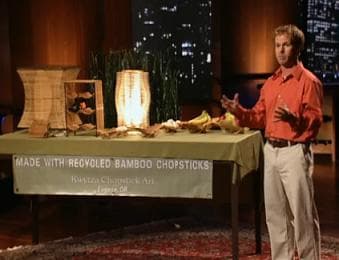
A pair of disposable chopsticks usually has a short working life. Bryan Parks saw a way to extend it by turning used bamboo chopsticks into useful objects for the home.
Chopstick Art was a tangible business when it reached Shark Tank: Parks brought a display of finished designs rather than only an idea. The Sharks still declined to invest. Their decision raised a question that remains useful for small product businesses: can an appealing craft range also meet an investor’s expectations for growth?
The answer to what happened afterward is more grounded than some dramatic headlines suggest. The brand’s official website remains accessible, with product listings and a wholesale referral. That is meaningful evidence of a continuing online presence. It does not prove a multimillion-dollar valuation, current revenue, or that every listed item can be ordered.
This update follows the official product pages and founder story, while separating the pitch result from financial estimates that could not be verified.
Quick answer: Bryan Parks asked for $100,000 for 10% of Chopstick Art and left Shark Tank without a deal. The brand’s official site remains online with a store and a wholesale page directing retailers to Faire. Its folding-basket listing currently displays “Unavailable,” so an accessible store should not be treated as proof that every product is in stock. No dependable current revenue or net-worth figure was verified. Current status: official retail and wholesale presence remains online; stock and order fulfillment need confirmation.
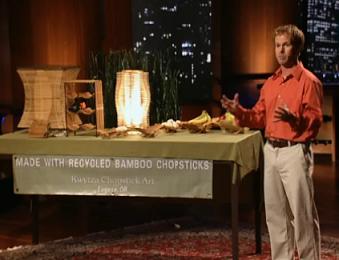
Bryan Parks with his Chopstick Art display. Image: ABC, via Shark Tank Blog.
What does Chopstick Art make?
Chopstick Art turns used bamboo chopsticks into home accessories. Its identity combines a visible material with designs intended to be useful as well as decorative.
| Product snapshot | Details |
|---|---|
| Founder | Bryan Parks |
| Material | Reused bamboo chopsticks |
| Category | Home accessories |
| Examples listed on the official store | Folding baskets, collapsible chopsticks, folding soap dish |
| Appearance | Shark Tank USA Season 1, Episode 3 |
According to the brand’s own story, Parks developed the idea while living in China. The company describes collecting used chopsticks from restaurants, sanitizing them at high temperature, and sorting and assembling them into products.
That is the company’s description of its process. This review did not independently audit its environmental impact, so it does not assign a carbon-saving figure or repeat broad forestry statistics as established facts.
The founder’s own website uses Bryan, although some recaps spell his first name Brian.
Why did the Sharks pass on Chopstick Art?
Parks sought $100,000 in exchange for 10% of the business. The pitch ended without an investment.
Shark Tank Blog’s recap describes the Sharks liking the products but questioning the scale of the investment opportunity. It also reports Parks discussing $500,000 in sales over five years. That is a historical pitch claim, not a current annual sales figure.
| Deal snapshot | Result |
|---|---|
| Investment requested | $100,000 |
| Equity offered | 10% |
| Valuation implied by the request | $1 million |
| Accepted offer | None |
| Shark investor | None |
The valuation calculation comes from dividing the requested investment by the offered ownership. It does not establish what the business would sell for today.
A rejection also does not mean a product has no customers or no purpose. A small business can be useful to its customers without matching a particular investor’s preferred size or growth rate.
For the season’s broader range of outcomes, see our Shark Tank USA Season 1 guide.
How does the business model work?
Chopstick Art’s website presents two routes to customers: individual shoppers and retailers.
Its official wholesale page directs trade buyers to Faire. Its own store lists a small range of products. These pages establish the routes the brand advertises, rather than verified sales through either route.
| Sales route | Intended customer | What the public site shows |
|---|---|---|
| Direct retail | A person buying a home accessory or gift | Individual product listings |
| Wholesale | Retailers buying for resale | Referral to the brand’s Faire store |
| Brand storytelling | Shoppers interested in the material and process | Founder story and reuse process |
The economic challenge is that a low-cost discarded material does not automatically produce a low-cost finished item. Collection, cleaning, assembly, packaging, and delivery all require work.
That observation is an analysis of the business model, not a claim about Chopstick Art’s unpublished margins. The finished design still has to earn its place in a customer’s home.
Another first-season product, Sticky Note Holder, illustrates a different stage of that challenge: establishing demand before a sales record exists. Chopstick Art arrived with finished products and reported historical sales, so the two businesses should not be described as having the same starting point.
What happened to Chopstick Art after Shark Tank?
Latest update — November 17, 2026: The official Chopstick Art site remains accessible. It lists retail products and a wholesale route through Faire. The folding-basket page displays “Unavailable,” and this review did not test checkout or confirm order fulfillment.
The official store still exists
The current store page lists folding baskets at $42–$70 and collapsible chopsticks and a folding soap dish at $13 each. Those are displayed prices checked for this update, not guaranteed purchase prices or evidence of stock.
The more detailed 30-pair folding-basket page includes dimensions, a color selector, and an unavailable message. That mixed presentation is a reason to confirm availability directly before relying on a listing.
What the online presence proves
An official catalog is stronger evidence than a recap saying a brand disappeared. It is still a limited kind of evidence. Websites can remain accessible while products are temporarily unavailable or fulfillment arrangements change.
| Question | Verified observation | What remains unknown |
|---|---|---|
| Is there an official website? | Yes, the site is accessible | How often every page is maintained |
| Are products listed? | Yes, with displayed prices | Current stock across the range |
| Is a wholesale route advertised? | Yes, through Faire | Current wholesale order volume |
| Can every item be purchased now? | The basket listing says unavailable | Availability of each variant or other item |
| Is the business worth $2 million? | No supporting financial evidence verified | Current valuation |
| What is current annual revenue? | No dependable figure verified | Actual sales and profit |
Why this update removes the net-worth headline
The earlier draft’s “$2M success” framing went beyond the evidence available for this update. Neither a Shark Tank asking valuation nor an online storefront establishes a current company value.
Secondary coverage also repeats annual-revenue estimates without providing financial statements or a clearly attributable current founder disclosure. Those estimates are excluded here.
The defensible story is still interesting: a rejected company has an official product and wholesale presence years after the pitch. It does not need an unverified wealth figure to make that point.
Where can you buy Chopstick Art?
Start with the official store and confirm stock, delivery, and the exact product before purchasing. Retailers can use the wholesale route linked by the brand.
The folding basket is currently marked unavailable on the page reviewed. This article therefore does not promise immediate delivery or treat every catalog entry as in stock.
A similarly named product on another marketplace should not automatically be identified as Parks’ brand. Verify the seller and manufacturer if the connection matters to your purchase.
For another example of why availability needs a current source, Classroom Jams’ creator still has an online resource site, even though some recaps say its materials are gone. In both cases, visible pages and verified fulfillment are separate questions.
What can small businesses learn from Chopstick Art?
The pitch illustrates the difference between a product that customers may appreciate and an investment that fits a particular investor.
A distinctive material story can help a business get attention. The design, quality, price, and buying experience then have to support a purchase. The reuse story is part of the offer, not a substitute for those practical requirements.
The longer-term lesson for readers is equally useful: judge the business using the evidence that exists. A rejection is not proof of closure, and a storefront is not proof of a particular valuation.
Frequently asked questions
Who founded Chopstick Art?
Bryan Parks founded the business. His official brand story uses that spelling of his first name.
Did Chopstick Art get a Shark Tank deal?
No. Parks asked for $100,000 for 10% and left without an investment.
Does Chopstick Art still have a website?
Yes. The official site remains accessible with a store, founder story, and wholesale page.
Are its folding baskets available now?
The specific folding-basket page reviewed for this update says “Unavailable.” Confirm stock directly rather than assuming the catalog listing guarantees availability.
Does Chopstick Art sell wholesale?
Its official wholesale page directs retailers to Faire. This review did not verify current wholesale fulfillment or sales volume.
What is Chopstick Art’s net worth?
No reliable current figure was verified. The $1 million implied by the original asking terms is a historical pitch valuation, not today’s business value.
The weekly question
From obsession to clarity — one original question every week.
We answer one noisy topic at a time, in full. No daily roundup, no thread bait — just the question, the principles, and the system.