Ink Flip Shark Tank Update: Why the Cartridge Service Didn't Get a Deal
Ink Flip left Shark Tank without funding. See how its refill service worked, why the Sharks passed and why its exact closure date remains unclear.
Running out of printer ink halfway through a job is an ordinary frustration. Andy Sperry built Ink Flip around making replacement cartridges easier to manage: customers could keep a spare, return an empty cartridge and receive a refill through the mail.
The appeal was a repeat service rather than a new kind of printer. If customers kept returning their cartridges, the company could keep serving them. That made an important question unavoidable when Sperry entered Shark Tank: how much would it cost to persuade a customer to join in the first place?
Ink Flip's Season 1 appearance became a lesson in that missing number. Sperry sought $150,000, but none of the Sharks invested. The business is subsequently reported to have closed, although later accounts disagree about the date.
This update explains what the service offered, why the investment discussion stalled and what can actually be said about the aftermath. It does not turn a possible business challenge into an unsupported explanation for the closure. You can compare it with the other pitches in our Shark Tank USA Season 1 guide.
Quick answer: What happened to Ink Flip?
Ink Flip did not receive a Shark Tank investment. Andy Sperry asked for $150,000 for 20% of his mail-order printer-cartridge refill business. The Sharks questioned the economics of attracting customers, and he could not provide the acquisition-cost information they wanted. Later coverage reports the business closed, but published dates conflict: some accounts give April 2010, while others say 2011. No primary closure announcement was located to resolve that difference. Current sales, a relaunch and a working original service were not verified. Claims that a particular firmware change or legal dispute caused the shutdown are not established by the reviewed evidence. Current status: reported closed; exact closure date unverified.
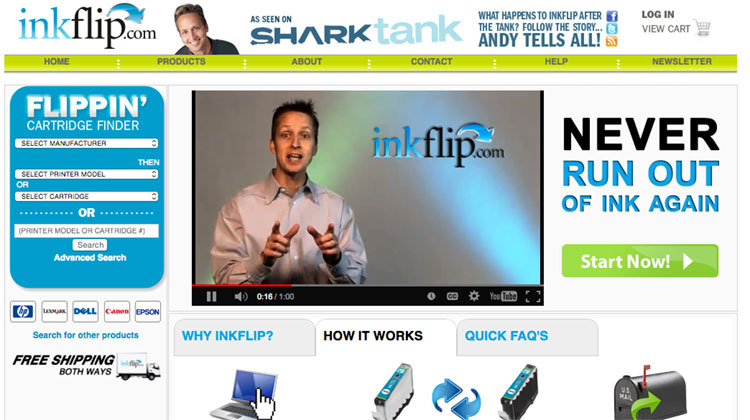
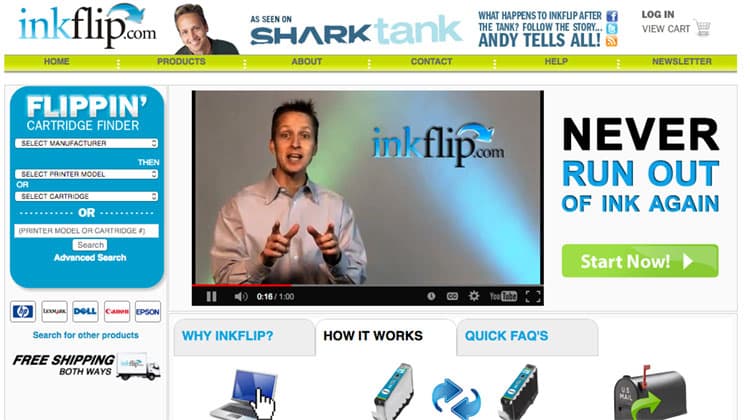
Historical Ink Flip website image via Shark Tank Blog; not a current store.
How did Ink Flip work?
The service was built around returning and refilling cartridges. A customer selected a cartridge compatible with their printer, kept a replacement ready and mailed an empty one back for the next cycle.
All Shark Tank Products' service description explains the use of a prepaid, addressed return box and a website that let customers choose by printer or cartridge model. The image above shows that historical storefront, not an available checkout today.
| Stage | Intended customer action |
|---|---|
| Choose a cartridge | Match the printer or cartridge model |
| Keep a replacement | Have a spare available |
| Replace the empty cartridge | Continue printing |
| Return the empty one | Use the supplied mailing arrangement |
| Receive a refill | Prepare for the next replacement cycle |
The business promised convenience through reuse and repeat delivery. This article does not claim a measured environmental benefit, a guaranteed saving for every printer, or compatibility with all current models.
What happened in the Shark Tank pitch?
The contemporary RealityWanted recap records the $150,000 request for 20% and the no-deal result. That request implied a $750,000 business valuation at the time, not a verified present valuation.
The central concern was the cost of acquiring a customer. An attractive recurring service still needs a way to bring people in without spending more than those relationships return.
| Pitch detail | Outcome |
|---|---|
| Entrepreneur | Andy Sperry |
| Business | Mail-order cartridge refill service |
| Investment requested | $150,000 |
| Equity offered | 20% |
| Result | No deal |
| Main issue in the discussion | Unproven customer-acquisition economics |
Gazette Review's detailed recap describes Sperry's difficulty answering the marketing-cost questions. It also records the concern that investor money would be used to discover whether the economics worked, rather than expand an already demonstrated model.
That distinction matters. The Sharks were evaluating an investment proposal, not declaring that every cartridge-refill service was impossible.
Why did customer acquisition matter so much?
A repeat customer can generate several orders, but those orders are not pure profit. The company still has to pay for the product or refill, packaging, postage and support. Marketing adds another expense.
For example, a business needs to know how much it spends to attract a buyer, how often that buyer returns and how much remains after fulfilling those orders. If those figures are uncertain, simply increasing advertising can increase losses as well as sales.
| Business question | Why an investor would ask |
|---|---|
| What does a new customer cost? | Measures the expense of growth |
| How often do customers return? | Tests the repeat-service assumption |
| What remains after fulfillment? | Separates sales from contribution toward overhead |
| How long do customers stay? | Determines whether acquisition spending can be recovered |
These are analytical questions suggested by the model, not newly discovered Ink Flip financial results. No complete financial statements were available for this update.
The Notehall update provides another Season 1 example where the later company record is more informative than the investment request alone.
What happened after Shark Tank?
Latest verified update: Later sources consistently report Ink Flip as closed, but disagree on whether it ended in 2010 or 2011. No primary closure record or verified relaunch was found during this update, so the precise date remains unresolved.
Shark Tank Blog gives April 2010 in its later update. Shark Tank Recap instead gives 2011. Those are conflicting secondary accounts, not two separate confirmed business events.
The difference should not be smoothed over by repeating whichever date appears most often. Nor should a dated social-media post automatically be treated as proof that a business was fulfilling orders at that time.
The broader point is better supported: the original service is reported to have stopped operating, and no current original purchase route was verified here. That is enough to answer a reader looking for the business without inventing precision.
| Question | What the research supports |
|---|---|
| Did a Shark fund the pitch? | No |
| Did later reporting describe closure? | Yes |
| Is the exact date settled? | No; sources conflict |
| Was a relaunch verified? | No |
| Was a single cause of closure established? | No |
Some newer summaries assign the failure to printer technology, competition or legal barriers. Those may be issues faced by businesses in the wider market, but this research did not find evidence establishing them as the cause of Ink Flip's closure.
Likewise, a founder's later employment should not be inferred from an old biography. This update concentrates on the verified business story rather than presenting an unchecked job title as current.
Can you use Ink Flip today?
A functioning original Ink Flip service was not verified. The historical website image is included to show what customers were offered, not to direct readers to a current subscription.
There are other cartridge sellers and refill services, but they are not automatically successors to Ink Flip. A similar business model, or a search result containing the same words, does not establish ownership or continuity.
Anyone evaluating a different service should check the exact printer model, cartridge compatibility, return process and current pricing with that seller. Those details cannot be carried over from a 2010 television pitch.
What does Ink Flip teach founders?
The useful lesson is to test the economics before assuming that a larger marketing budget will solve a sales problem. Customer interest, repeat orders and the cost of earning those orders all belong in the same calculation.
It also helps to be precise about the help being requested. An investor may be willing to expand a working system but reluctant to pay for the earliest experiment. That was the tension visible in Ink Flip's pitch.
The Chef in Black update offers a contrasting example from the same episode: an offer was accepted, yet a disagreement about the plan prevented the partnership from closing.
Frequently asked questions
Who founded Ink Flip?
Andy Sperry, also referred to as Andrew Sperry, presented the company.
How much did Ink Flip request?
Sperry asked for $150,000 for 20% of the business.
Did Ink Flip get a deal?
No. None of the Sharks invested during the pitch.
Why did the Sharks pass?
The discussion focused heavily on unproven customer-acquisition costs and the uncertainty of scaling the model.
When did Ink Flip close?
Secondary sources report either 2010 or 2011. A primary record establishing the precise date was not found.
What is Ink Flip worth now?
No reliable current valuation was verified. The $750,000 implied by the original request was a historical pitch figure, not current net worth.
The weekly question
From obsession to clarity — one original question every week.
We answer one noisy topic at a time, in full. No daily roundup, no thread bait — just the question, the principles, and the system.