
Everything Blocks After Shark Tank: A Big Toy With a Small Storage Footprint
Kaity and Tim Wade pitched giant learning blocks that pack flat. Sales showed demand, but the Sharks still questioned price and inventory.

Giant blocks have an obvious appeal to a child and an equally obvious drawback to the adult who has to put them away. A tower can come down in seconds. Twenty-six large cubes still occupy much of a room afterward. Kaity and Tim Wade designed Everything Blocks to keep the scale of the play while changing the amount of space the toy needs at bedtime.
The Wades had sales to show the Sharks, but they also described periods when they could not supply the sets people wanted. They left without the $100,000 investment they sought. Their case turns on a distinction that matters well beyond toys: selling out is evidence that a batch found buyers, but it does not reveal how large a business a more reliable supply chain could support.
No deal
Pitch outcome
No deal
$100,000 for 10%
Opening ask
Terms sought on Shark Tank.
26 blocks
Product detail
The original set gives each letter of the alphabet a place.
Product snapshot
| Field | Details |
|---|---|
| Company | Everything Blocks |
| Founder or founding team | Kaity and Tim Wade |
| Product | Oversized learning cubes that fold flat for storage |
| Industry | Children’s toys and educational play |
| Shark Tank episode | Season 17, Episode 15 • March 25, 2026 |
| Current status | The company continues to list its learning blocks online. |
How does Everything Blocks work?
A child can build a tower, explore letters or arrange the printed faces into activities such as a map. When playtime ends, the soft-sided cubes collapse and go into a storage bag. The official website emphasizes the contrast between size in use and size in storage. It is a physical feature a shopper can verify without relying on promises of a particular educational outcome.
The same product can serve different rooms. A family may care most about clearing the floor. A teacher or caregiver may value being able to put a large activity out for a group and pack it away before the next one. Those customers may also have very different budgets.
Who built Everything Blocks?
The Wades brought experience in gymnastics and youth coaching to the pitch. Their design uses movement and stacking to invite play rather than asking a child to complete an exercise on a screen. ABC’s episode guide identifies the oversized, collapsible blocks as one of the four products featured. The opportunity was not to invent alphabet blocks from scratch; it was to make a physically large play set manageable in an ordinary home.
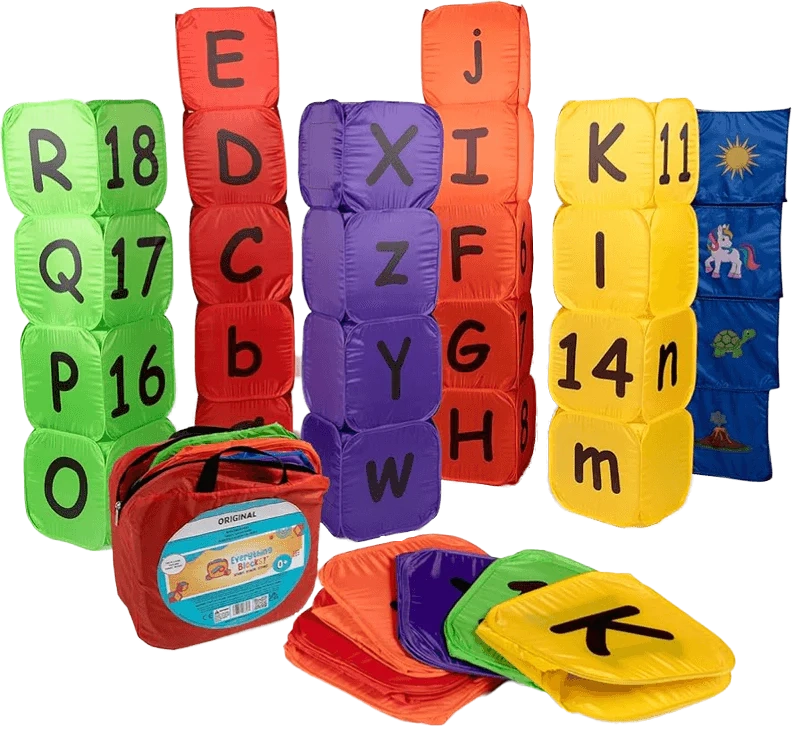
A set of the company’s learning blocks. Photo: Everything Blocks.
“Giant learning blocks, easy storage.” — Everything Blocks’ product description.
What happened to Everything Blocks on Shark Tank?
The couple offered 10% for $100,000, implying a $1 million post-investment valuation. Episode coverage describes sales exceeding $350,000 and periods when blocks were not available to buy. The sales demonstrated interest. The stockouts made it harder to tell whether demand was continuing at the same level or how much additional inventory should be ordered.
The Sharks questioned price and scalability in a category full of inexpensive alternatives. No one invested. That outcome established the panel’s decision, not the end of the company or a verdict on whether a particular classroom or family would find the set useful. Episode reporting.
Deal snapshot
| Negotiation point | What the evidence supports |
|---|---|
| Asked | $100,000 for 10% |
| On-air outcome | No deal |
| Key negotiating point | Reported sales supported demand, while stock gaps and premium pricing complicated expansion. |
What a stockout can hide from a toy company
A business that sells its entire order has a known minimum demand and an unknown maximum. It may have missed a handful of sales or an entire season of gift orders. Paying for a much larger batch on that evidence alone can turn a shortage into excess inventory. More useful measures include waiting-list conversion once stock returns, return rates and how demand changes outside gift-buying periods.
The folding design can also affect the economics of delivery and storage. The relevant measure is the packaged set’s actual size and freight cost, not the volume of an assembled tower. Those numbers are not disclosed in the public pitch account.
Business model snapshot
| Business question | Answer |
|---|---|
| Product | Oversized learning cubes that fold flat for storage |
| Sales channel | Direct-to-consumer toy sets in original and smaller formats. |
| Buyer decision | Compare cube size, number of blocks, storage and realistic play space. |
| Business question | Can the company keep enough inventory without tying up too much cash? |
What happened after Shark Tank?
Latest update — November 12, 2026. The brand’s website offers an ordering route. Product reporting distinguishes the original 12-inch format from six-inch minis and a combination bundle.
An order page confirms a commercial offering. It does not establish that every format is always in stock, that the Wades raised replacement capital or that the product produces a particular learning result. Check the current availability of the exact set before planning around a gift or classroom delivery date.
Current status evidence
| Evidence | What it establishes |
|---|---|
| Official offering | The company continues to list its learning blocks online. |
| Pitch evidence | No deal |
| What is still unknown | Current unit sales, stockout frequency and profit per set. |
Company timeline
| Date | Milestone |
|---|---|
| Before broadcast | The Wades developed folding cubes and reported more than $350,000 in sales. |
| March 25, 2026 | They asked for $100,000 and left without a deal. |
| November 2026 | Everything Blocks continues to market the original concept online. |
What should a buyer check?
Measure the area where children will actually build. Folding solves storage between sessions, but the tallest and widest structures still need room during play. Check the age guidance, supervision instructions, set dimensions and storage bag information. A smaller set may work better where play and living space overlap.
What can founders learn from Everything Blocks?
When a founder says a product sold out, ask what happened when it came back. Did the people who had been waiting buy at full price? Did they purchase the same size, and did demand continue once the waitlist was exhausted? Those questions turn a promising anecdote into evidence for the next inventory order.
The Season 17 episode guide lists the other pitches. Readers following the other investment decisions in this part of Season 17 can also find R1SE, Hang Hero, Hele Outdoors.
Frequently asked questions
Who presented Everything Blocks on Shark Tank? Kaity and Tim Wade
What did the founders ask for? $100,000 for 10%.
What happened in the negotiation? No deal
Is Everything Blocks still operating? The company continues to list its learning blocks online.
Are these conventional solid foam cubes? No. The distinguishing feature is that the oversized cubes fold down for storage.
The weekly question
From obsession to clarity — one original question every week.
We answer one noisy topic at a time, in full. No daily roundup, no thread bait — just the question, the principles, and the system.
More from Shark Tank USA Season 17
All season pitches
Shark Tank USA
The Christmas Carolers After Shark Tank: Barbara’s 60% Deal, Expansion and Current Status

Shark Tank USA
pi00a After Shark Tank: How the Stein Family Took Deaf-Owned Pizza From Restaurant to Freezer

Shark Tank USA