
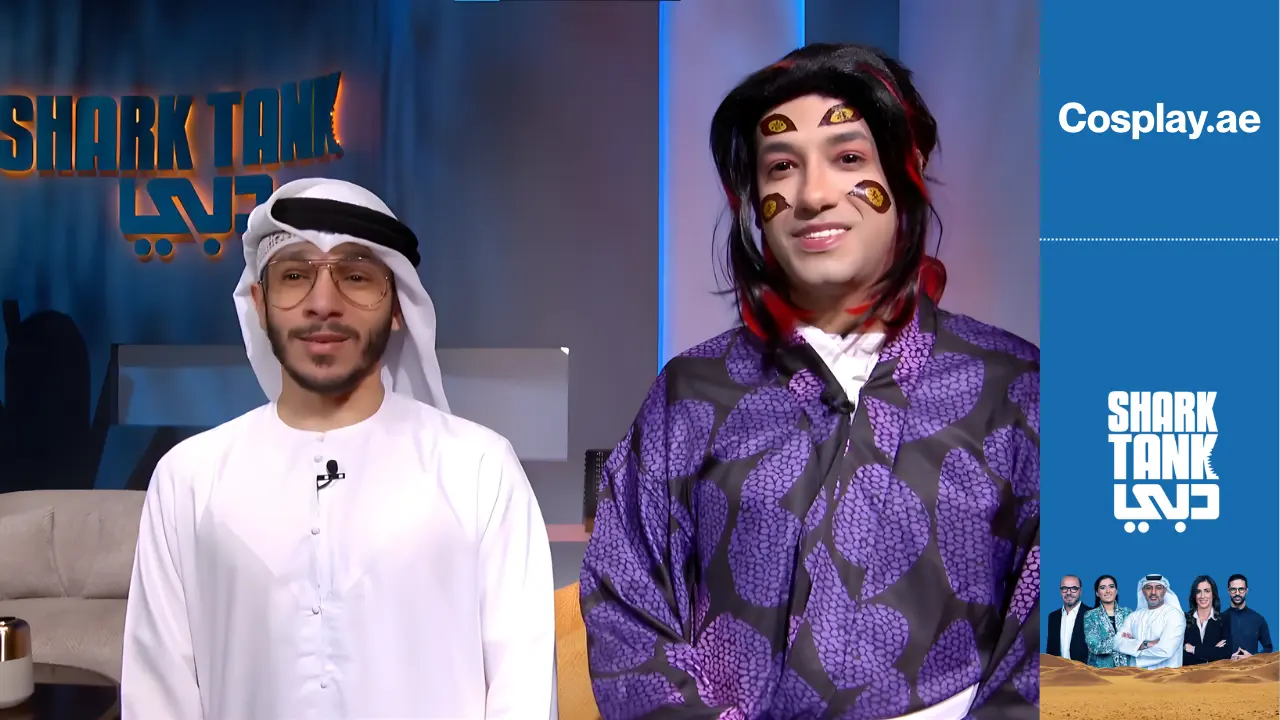
When Hamad Al Nuaimi and Mohammed Al Ansari walked onto the Shark Tank Dubai stage, their entrance immediately felt different from typical startup pitches.
They did not just bring slides or financial projections. They brought costumes, culture, and even flowers as a playful apology for their dramatic arrival. The founders of Cosplay.ae were not simply pitching a business idea. They were pitching an entire lifestyle built around anime, gaming, and cosplay culture.
Their goal sounded ambitious. They asked the Sharks for 350,000 AED in exchange for 10 percent equity, valuing their company at 3.5 million AED. What followed quickly turned into a powerful lesson about the gap between passion driven communities and investor ready business models.
Shark Tank Dubai Pitch Summary
| Category | Details |
|---|---|
| Company | Cosplay.ae |
| Founders | Hamad Al Nuaimi and Mohammed Al Ansari |
| Industry | Anime and Cosplay Event Management |
| Investment Ask | 350,000 AED |
| Equity Offered | 10% |
| Company Valuation | 3.5 Million AED |
| Business Model | Cosplay and anime themed events and community management |
| Deal Outcome | No deal |
The Cost of Cosplay: 5 Hard Lessons from the Shark Tank Dubai Floor
The Cosplay.ae pitch quickly evolved into a fascinating case study for entrepreneurs across the UAE startup ecosystem. It showed how powerful communities can spark businesses but also how difficult it can be to convert passion into a scalable company.
For founders watching Shark Tank Dubai, the story of Cosplay.ae offers practical lessons about pitching, valuation, and investor expectations.
1. Community Is Powerful Currency But It Is Not a Balance Sheet
The strongest asset Cosplay.ae brought into the Tank was their deep connection to the anime and cosplay community. The founders began as fans and visitors in 2013. Over time they transitioned into organizers who helped bring together the region’s growing cosplay culture.
By the time they faced the Sharks, they had built a network of 400 Emirati artists and more than 300 active cosplayers. In niche event industries this type of insider access can be extremely valuable because the performers themselves become the attraction.
As the founders explained during the pitch, “Without the cosplayers, the exhibition doesn’t succeed.” Their strategy reflected a truth about the modern creator economy. In subculture markets the community is not just the audience. The community is the product.
However the Sharks quickly highlighted a limitation. Community access creates momentum but it does not automatically translate into a sustainable business model. Investors still expect measurable revenue streams, predictable margins, and scalable growth.
2. The Dangerous Moment When Passion Meets Financial Reality
The mood in the room shifted when the conversation moved from culture to numbers. When the Sharks asked about profitability the founders stated that their events could generate 4 million AED in profit in just three days.
The claim triggered skepticism. To justify the projection the founders referenced an Abu Dhabi event that attracted 33,000 visitors paying 150 AED per ticket. The issue was not the audience size. The issue was the gap between projections and real performance.
At that time Cosplay.ae had generated only 156,000 AED in total revenue. For experienced investors the gap between those two numbers raised a serious red flag.
This moment highlights one of the most common mistakes founders make during high stakes pitches. Mixing optimistic projections with actual profit figures creates confusion and weakens credibility. Investors expect founders to clearly understand unit economics including what it costs to host each attendee and what margin remains after expenses.
3. The Cultural Gap Between Fandom and Investors
During the discussion the founders suggested that some Sharks might be “a bit old” to fully understand anime and cosplay culture. The comment revealed a deeper challenge faced by many subculture startups.
When a business is built around a niche passion founders often assume investors must personally understand the culture to believe in the opportunity. In reality investors do not need to love the culture. They need to understand the business model.
The Sharks may not recognize legacy anime icons like Captain Majed or Grendizer. But they do recognize market demand, revenue potential, and scalable operations.
The real skill founders must develop is cultural translation. They must explain how a passionate community becomes a profitable market.
4. The Comic Con Question That Changed the Pitch
The most decisive moment of the pitch came when a Shark asked a simple but devastating question.
“How are you different from Comic Con?”
This question forced the founders to explain their competitive advantage. In business strategy this advantage is often called a moat. It means a structural barrier that prevents competitors from copying your idea.
The founders struggled to define that moat. They believed their close relationship with the cosplay community created differentiation. From the Sharks’ perspective community access alone did not protect the business.
Without exclusive intellectual property, long term venue agreements, or a proprietary platform another organizer with stronger marketing could launch a similar event and compete directly.
For investors evaluating startups defensibility matters as much as creativity.
5. Investors Look for Assets or Dominant Brands
One of the Sharks delivered a practical lesson about how successful event businesses operate. According to the investor high returns in the industry usually depend on one of two advantages.
The first advantage is owning hard assets. Companies that own staging equipment, lighting systems, and production gear reduce their event costs significantly. These assets can also be rented to other organizers which creates additional revenue streams.
The second advantage is brand power. A powerful brand attracts sponsors, media coverage, and loyal audiences who return every year regardless of the specific performers or attractions.
Cosplay.ae had not yet built either of these structural advantages. Without owned equipment or a dominant brand identity the business appeared vulnerable to competition and unpredictable event performance.
For the Sharks this meant the investment risk remained too high compared to the requested valuation.
The Final Outcome: A Lesson in Miscommunication
As the pitch concluded every Shark declined to invest in the company. The founders left the Tank disappointed and described the outcome as a “catastrophe.” They believed the investors did not understand their project.
But the episode raises a deeper question every entrepreneur must eventually confront. Did the investors fail to see the potential of the Middle East’s growing anime fandom or had the founders not yet translated their passion into a structured business model?
The truth likely sits somewhere between the two.
Cosplay and anime culture continue to grow across the Middle East. Communities expand and events attract thousands of enthusiastic fans. Yet investors still require the same fundamentals from every startup. They look for defensibility, clear financials, and scalable operations.
Passion can ignite a movement. Community can create momentum. Sustainable businesses are built on structure, assets, and disciplined execution.
For founders watching Shark Tank Dubai, the Cosplay.ae pitch offers a powerful reminder. Authenticity can open the door to opportunity but only strong business fundamentals convince investors to walk through it.