
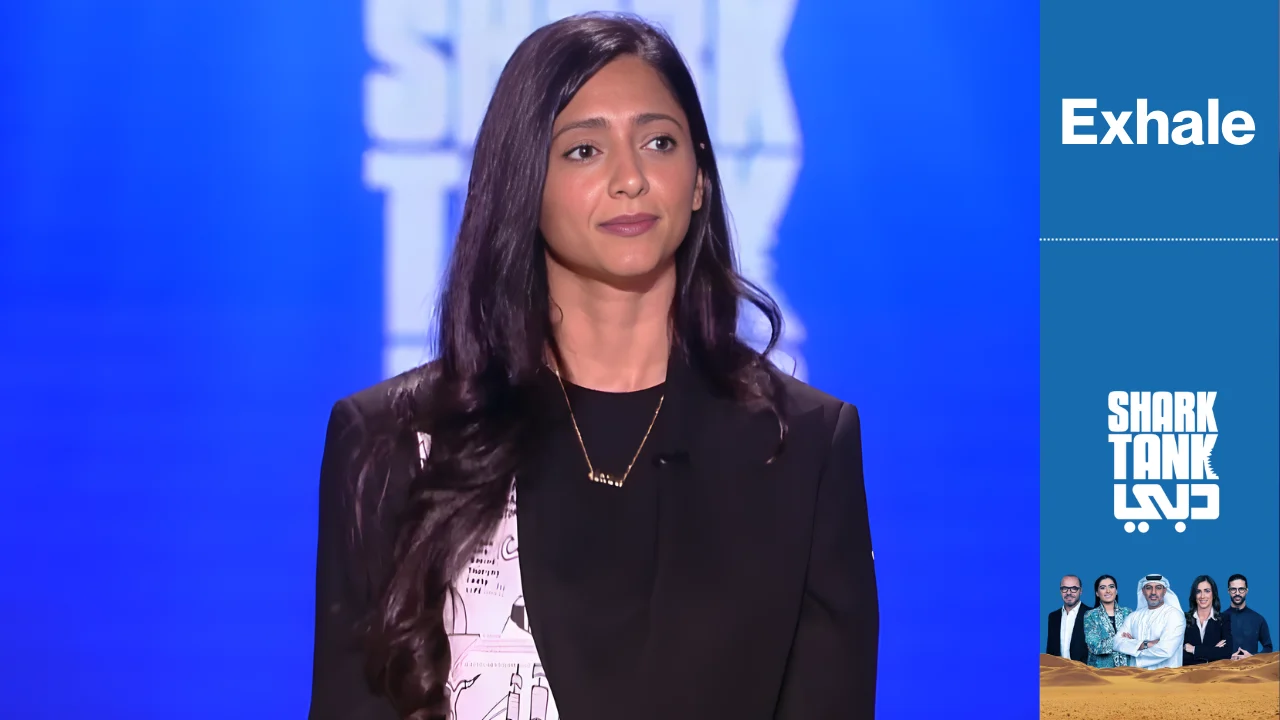
In the high-stakes arena of Shark Tank Dubai, every pitch becomes a public test of whether a business idea can survive intense investor scrutiny.
When entrepreneur Nawal El Masri, a Palestinian-Lebanese-Canadian graduate of the American University of Sharjah, stepped into the tank, she asked the Sharks for 1 million AED in exchange for 15% equity in her company, Exhale. Her mission was not simply to grow a startup. She wanted to reshape how companies support employee mental health.
What unfolded during the pitch became more than a funding negotiation. It revealed a deeper truth about one of the Gulf region’s fastest-growing industries: corporate wellness.
For founders and investors watching the episode, Exhale’s pitch became a powerful case study in what many now call the Corporate Wellness Gold Rush.
Shark Tank Dubai Pitch Summary
| Company | Exhale |
|---|---|
| Founder | Nawal El Masri |
| Business Focus | Corporate mental health and workplace wellness programs |
| Investment Asked | 1,000,000 AED |
| Equity Offered | 15% |
| Revenue Model | Corporate wellness programs priced up to 95,000 AED |
| Projected Revenue | 4.2 million AED target for 2024 |
| Outcome | No deal |
These numbers summarize the pitch. But the real lessons from Exhale’s Shark Tank Dubai appearance go far deeper than valuation.
How Personal Struggle Shaped Exhale’s Mission
Many memorable Shark Tank Dubai businesses begin with deeply personal experiences. Exhale’s story followed that powerful pattern.
Founder Nawal El Masri shared that from age 16 to 24, she navigated years of personal psychological challenges. Rather than hiding that journey, she turned it into the foundation of her company.
Exhale was built on a simple but profound realization: the workplace is not just where people work. It is where they spend a major portion of their lives.
During her pitch, Nawal summarized this idea in a statement that resonated across the room.
“You spend half your time and your life in this company, and the company is supposed to support you.”
For founders, this moment highlighted a critical startup principle. A mission-driven company like Exhale needs an authentic story that people believe in. Emotional truth often becomes the spark that attracts customers, communities, and investors.
However, Shark Tank Dubai repeatedly proves one important reality. A powerful story may open the door to investment, but it rarely closes the deal on its own.
Why Exhale Moved From Community to Corporate Clients
Before appearing on the show, Exhale had already built strong early traction.
The platform attracted 15,000 subscribers and developed a creative community network of 350 people. These numbers showed that Nawal had successfully built engagement around mental wellness.
But she soon recognized a financial challenge common in the wellness industry.
Direct-to-consumer wellness services are difficult to scale profitably.
Small subscription payments rarely create the kind of predictable revenue that venture-backed companies need. To solve this problem, Exhale pivoted toward a business-to-business (B2B) corporate wellness model.
This shift transformed the economics of the company.
Instead of small individual subscriptions, Exhale began offering structured corporate mental health programs priced as high as 95,000 AED per engagement. These programs were designed for organizations seeking to reduce burnout and improve employee wellbeing.
With this model, Nawal projected 4.2 million AED in revenue for 2024.
She told the Sharks that the 1 million AED investment would allow Exhale to expand its team and scale these corporate wellness programs across larger organizations.
At first glance, the opportunity looked massive. Corporate wellness spending across the UAE and the wider GCC region is rising rapidly as companies face increasing pressure to protect employee mental health.
But the Sharks quickly began asking harder questions.
Why the Sharks Questioned Exhale’s Expertise
As the pitch progressed, the Sharks shifted their focus away from storytelling and toward the team’s professional expertise.
They discovered that while Exhale had strong marketing capabilities, the leadership team lacked deep clinical or psychological specialization.
Most of the core team experience appeared to be in branding and marketing rather than mental health practice.
For investors, this raised serious concerns.
When a company signs a 95,000 AED corporate wellness contract, the buyer is not simply purchasing inspiration or motivational content. They are investing in structured solutions designed to reduce stress, burnout, and workplace mental health risks.
Without clinical experts guiding the program design, Exhale risked being perceived as a marketing-led wellness initiative rather than a professional mental health solution.
This moment revealed a common startup challenge known as the Specialist Trap. Passion and purpose can attract attention, but high-value B2B markets demand credible domain expertise.
In industries connected to health and wellbeing, professional validation becomes the foundation of trust.
Why Investors Want Simpler Business Models
Another major concern raised by the Sharks involved the structure of Exhale’s business model.
During the pitch, the company appeared to be running multiple initiatives and creative programs simultaneously. While this showed ambition, it also created confusion about the company’s core product.
The Sharks described the strategy as too complex.
This reflects a common startup problem known as the Complexity Tax.
Many visionary founders see opportunities everywhere and attempt to build several products at once. However, investors typically prefer the opposite approach.
They look for startups that do one thing exceptionally well before expanding.
A company with too many moving parts becomes difficult to scale, difficult to manage, and difficult for investors to evaluate.
For a 1 million AED investment, the Sharks wanted Exhale to demonstrate a sharper focus on a single scalable corporate wellness solution.
Without that clarity, the opportunity appeared too risky.
Why the Sharks Walked Away From Exhale
In the end, the Sharks declined to invest in Exhale.
However, their rejection was not a dismissal of the mission behind the company. Instead, it served as a strategic critique of the business structure.
Their advice centered on a single theme: focus.
They encouraged the founder to simplify the business model, strengthen the leadership team with specialized experts, and concentrate on building one scalable product.
For entrepreneurs watching Shark Tank Dubai, this moment offered a valuable insight.
Investor rejection often contains the most valuable feedback.
In the startup world, knowing what to say no to can be more important than chasing every opportunity. The Sharks’ response effectively diagnosed the structural weaknesses preventing Exhale from securing a venture-scale investment.
Is Corporate Wellness Ready for Professionalization?
The Exhale pitch highlights a larger transformation taking place across the corporate wellness industry.
Demand for mental health support inside companies is rising quickly. Employees expect their workplaces to provide structured wellbeing programs, and employers increasingly recognize that burnout reduces productivity and increases turnover.
This growing demand is fueling what many observers describe as the Corporate Wellness Gold Rush.
However, the Shark Tank Dubai episode revealed an important truth.
To secure high-value corporate wellness contracts, companies must deliver more than creative campaigns.
- clinical expertise
- measurable results
- structured methodologies
- credible professional teams
As the industry evolves, wellness startups may need to transition from marketing-led initiatives to clinically validated services.
The Real Lesson From Exhale’s Shark Tank Dubai Pitch
Exhale entered the tank with a powerful mission and a bold plan to scale corporate mental health solutions.
The pitch reminded viewers that entrepreneurship often begins with deeply personal experiences and a desire to solve real-world problems. But it also showed how quickly investors shift from emotion to evidence.
The Sharks were not rejecting workplace wellness. Instead, they were challenging Exhale to evolve into a more focused and professionally specialized organization.
For founders across the Middle East watching Shark Tank Dubai, the lesson is clear.
A compelling story attracts attention.
A scalable business model attracts investment.
Focus and expertise are what ultimately close the deal.