
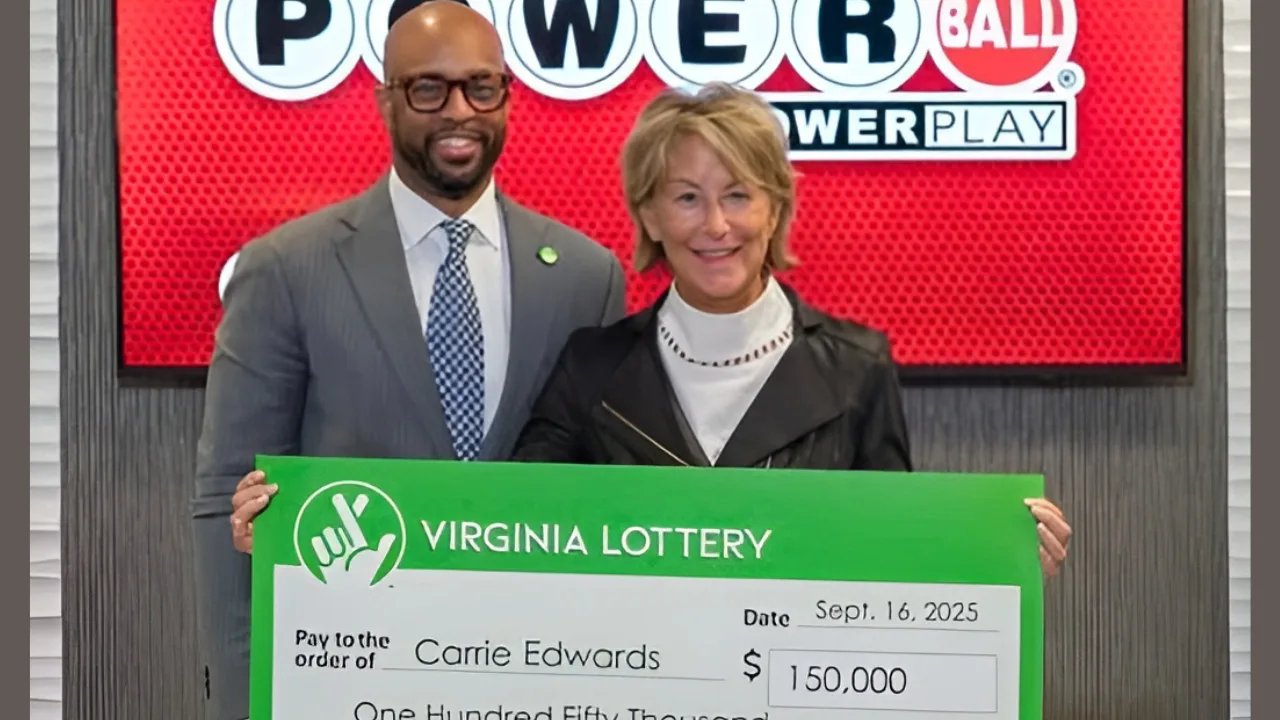
In September 2025, a grandmother from Virginia shocked the world when she won $150,000 in the Powerball. Carrie Edwards, from Midlothian, asked ChatGPT for lottery numbers, bought a ticket online, and hit big. But instead of keeping her winnings, she gave every cent away to charity. Her story has sparked curiosity, raised ethical questions, and inspired countless people across the country.
Fast Facts
- Winner: Carrie Edwards, a grandmother from Midlothian, Virginia.
- Prize: $150,000 Powerball win on September 8, 2025.
- How: Asked ChatGPT for lottery numbers; matched 4 white balls + Powerball.
- Donation: Gave 100% of winnings to three charities, AFTD, Shalom Farms, Navy-Marine Corps Relief Society.
- Odds: Winning her prize tier had a 1 in 913,000 chance.
The Shocking Win That Started With a Simple Question
On September 8, 2025, the Powerball numbers drawn were 26, 28, 41, 53, 64, and the Powerball 9, with a 3x Power Play multiplier. Edwards asked ChatGPT a simple question on her phone.
“I’m like, ChatGPT, talk to me … Do you have numbers for me?” — Carrie Edwards
The AI generated a set of numbers that matched four white balls plus the red Powerball. That alone was worth $50,000. But because she paid an extra $1 for the Power Play option, the prize tripled to $150,000.
At first, she thought the win notification was a scam.
“I thought, ‘I know I didn’t win.’” — Carrie Edwards
Only after verifying through the Virginia Lottery did she realize it was real. This was her very first time playing online. ChatGPT, like always, included a reminder that lottery numbers are random and cannot be predicted. Still, the outcome captured headlines worldwide.

Can AI Really Predict the Lottery or Was It Pure Luck?
Powerball is designed to be unpredictable. The odds of winning the exact prize Edwards hit, four white balls plus the Powerball, are about 1 in 913,000. The jackpot odds are much harder, at 1 in 292 million. Experts are clear: no AI, no matter how advanced, can beat those odds.
ChatGPT works by generating random-looking sequences. It cannot “see” future numbers or predict outcomes. Tests with AI lottery tools, from custom GPTs to apps like Lotto Champ, show results that perform no better than flipping a coin. In other words, Edwards’ win was luck, not science.
Some gamblers may now try AI for number picks, but researchers warn this could create false hope. As one analyst put it: “AI is powerful, but predicting random draws isn’t within its reach.”
Want deeper analysis on AI risks and responsibility? Read the full investigation here.
What the Law Says About Using AI in Gambling
In the United States, it’s perfectly legal to use AI to choose lottery numbers. Lotteries let players pick numbers in any way they want, whether it’s birthdays, quick-picks, or AI-generated suggestions. The Virginia Lottery treated Edwards’ case as a normal claim.
No state or federal laws ban AI in lotteries. However, other gambling areas are under review. The SAFE Bet Act, for example, focuses on AI in sports betting promotions but does not touch lotteries.
The ethical concern lies in perception. Stories like this might convince people AI has a hidden advantage. Psychologists caution that such beliefs can fuel gambling addiction. The truth is simpler: AI doesn’t improve your odds. For regulators, the risk isn’t about cheating but about preventing false promises that exploit vulnerable players.
Why She Donated Every Dollar Instead of Keeping the Prize
Edwards’ generosity is what makes her story truly remarkable. After learning she had won, she decided to give it all away.
“As soon as that divine windfall happened and came down upon my shoulders, I knew exactly what I needed to do with it. And I knew I needed to give it all away, because I’ve been so blessed, and I want this to be an example of how other people, when they’re blessed, can bless other people.” — Carrie Edwards
She split the $150,000 prize equally among three charities:
- The Association for Frontotemporal Degeneration (AFTD): honoring her late husband, who passed from dementia.
- Shalom Farms: providing food access and equity in Richmond.
- Navy-Marine Corps Relief Society: supporting military families.
Her husband Steve was a veteran who responded to the Pentagon on 9/11. For her, donating was both a tribute and a calling.
“God is blessing me so I can bless others through him.” — Carrie Edwards
After taxes, each group received about $36,000. For organizations that rely on donations, such a gift has real impact—funding research, feeding families, and helping veterans.
From Skepticism to Inspiration
The public reaction split into two camps: admiration and doubt. Many people praised Edwards as a model of generosity, with social media threads calling her “real America” and “proof that kindness still wins.” Charities expressed deep gratitude, highlighting how the donations would create lasting change.
Others were skeptical, asking whether she donated for tax purposes or if the AI angle was exaggerated. Still, the official records confirm her winnings, the donation, and the charities’ acknowledgment. Virginia Lottery officials also described her decision as “rare” and inspiring.
The combination of technology, luck, and charity made her story viral. It spread across outlets like People, Futurism, and The Guardian, fueling debates on AI’s role in everyday life.
A new study reveals ChatGPT is quietly changing the way we talk every day. See how language is evolving.
How to Use AI for Lottery Numbers (If You’re Curious)
Many readers wonder how Edwards actually did it. The process is simple:
- Open ChatGPT or a similar AI app.
- Ask for Powerball numbers (five between 1–69 and one between 1–26).
- Purchase a ticket in person or online, with Power Play if desired.
- Check after the draw.
Important reminder: ChatGPT always warns that the numbers are random. AI tools like Lottery Pro AI or Lotto Champ claim pattern analysis but have no proven accuracy. Lotteries are entertainment, not an investment strategy. If you try AI picks, do so with clear expectations.
AI, Gambling, and Human Hope
Edwards’ win highlights more than luck. It shows how people are blending new tools into old traditions. Whether for fun or faith, people are experimenting with AI in unexpected ways.
But it also carries warnings. Experts stress that AI cannot overcome randomness, and presenting it as such risks encouraging unhealthy gambling. Lawmakers may not regulate AI in lotteries yet, but bills like the SAFE Bet Act show rising scrutiny in gambling spaces.
At its core, though, this is not a story about algorithms. It’s about a woman who took luck and turned it into generosity.
“These three organizations represent healing, service, and community. Shalom Farms heals through food and soil, AFTD brings hope through research, and the Navy-Marine Corps Relief Society carries forward the tradition of supporting military families in times of need.” — Carrie Edwards
She showed that the true prize was not the money itself, but the chance to change lives.
Conclusion
Carrie Edwards’ story will be remembered less for the AI lottery numbers and more for her decision to give everything away. Her choice turned a random stroke of luck into a powerful act of kindness. It proves that while AI cannot predict the lottery, human generosity can create outcomes far greater than chance.