This 21-Year-Old Just Used AI to Read a Scroll Buried Since 79 C.E., and the First Word Is Blowing Historians’ Minds
A burned scroll buried for 2,000 years just gave up its first secret, and a college student with a laptop is the one who cracked it open using AI.
In the year 79 C.E., Mount Vesuvius erupted and covered an entire Roman town in ash. Everything was destroyed. But deep inside the ruins, hundreds of ancient scrolls were found. These scrolls came from a library in Herculaneum, and they were turned into black, fragile lumps by the heat.
No one could read them for 2,000 years. Touching them meant destroying them. For centuries, the secrets inside stayed locked away.
But that changed when a 21-year-old student named Luke Farritor did something no one expected. He used artificial intelligence to read one of those scrolls without opening it. And what he found stunned historians.
Fast Facts
- Name: Luke Farritor, 21-year-old computer science student
- Breakthrough: Used AI to read a scroll buried since 79 C.E.
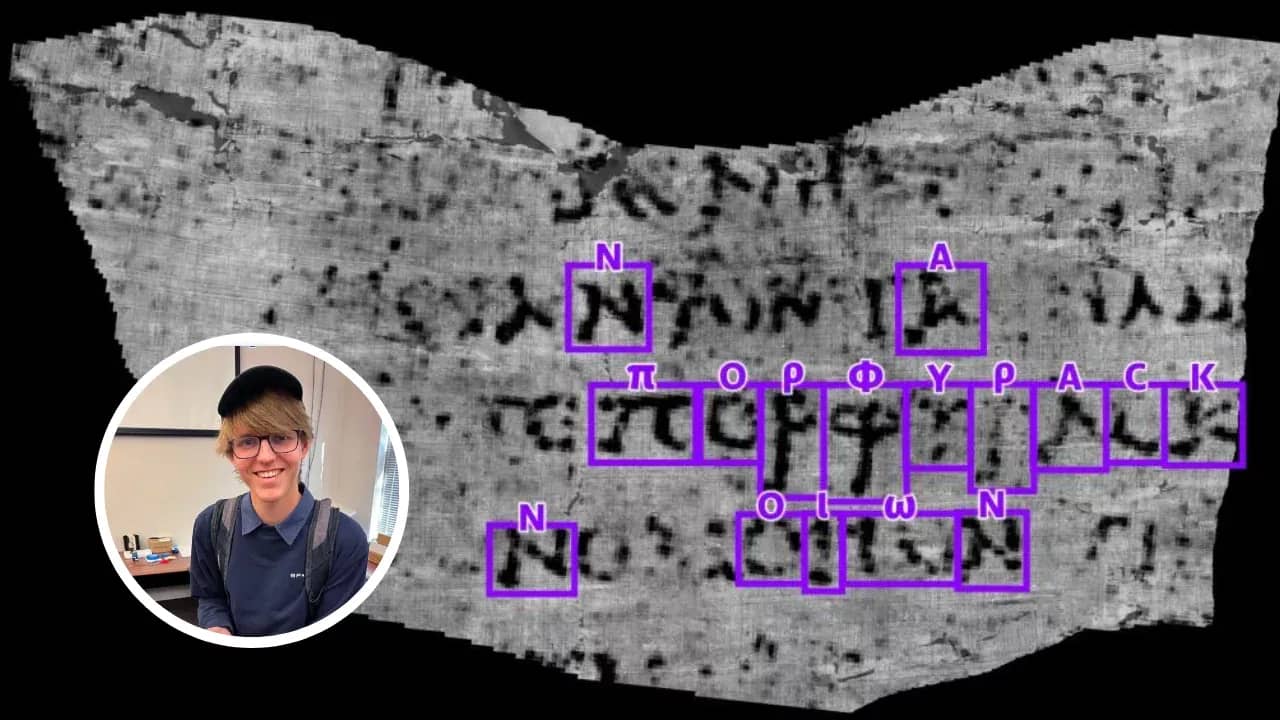
- Decoded Word: “Porphyras” (ancient Greek for “purple”)
- Project: Vesuvius Challenge. AI-based scroll decoding
- Prize: Co-winner of $700,000 Grand Prize for full passage discovery
Meet Luke Farritor
Luke Farritor is a computer science student from Nebraska. He was also an intern at SpaceX, which means he was already working on cutting-edge tech before making headlines.
In October 2023, Luke became the first person to read a word from inside a sealed Herculaneum scroll. He entered a global science competition called the Vesuvius Challenge, where people were invited to use AI to detect ancient ink on virtual scans of the scrolls.
Luke’s machine learning model spotted a very faint word: “porphyras,” the ancient Greek word for purple.
According to a press release by the University of Nebraska, Luke said,
“It will probably be the largest revelation of text from the ancient world since the Dead Sea Scrolls.”
How a Burnt Scroll Became Readable with AI
At first glance, the scrolls look like charred pieces of wood. But inside, they still have layers of text. Scientists used 3D CT scanning to capture images of the scrolls layer by layer, just like how doctors use scans to look inside the human body.
These scans were turned into digital scrolls. But even then, the letters were invisible. That is because the ink was made from carbon, and the papyrus was also made from carbon. So regular scans could not tell them apart.
Here is where Luke’s genius came in.
He noticed tiny patterns in the texture of the papyrus. These patterns were called “crackles.” They are little marks left by dried ink. Luke trained an AI model to look for crackles shaped like Greek letters. After thousands of tries, it worked. The AI found the word.
This process allowed him to read the scroll without touching it.
Why “Purple” Is a Big Deal
The word “porphyras” might sound simple, but it means a lot.
In ancient Rome, purple dye was rare and very expensive. Only emperors, priests, and the rich could afford it. So, the word tells us that the scroll might be about politics, power, or high society. It may even come from a famous philosopher or poet.
This discovery helps historians connect dots in ancient writings. It is a small word with a big message.
Read more : Meet Kairan Quazi, the 16-year-old Elon Musk hired for Starlink who is now inspiring a new wave of geeks
The Internet Reacts: A Geeky Breakthrough Goes Viral
Luke’s discovery made headlines across the world. Nat Friedman, former GitHub CEO and co-sponsor of the challenge, shared it on X (formerly Twitter). It was then picked up by major outlets like Smithsonian, Nature, and Ars Technica.
Today we are announcing a major breakthrough in the Vesuvius Challenge: we have read the first word from an unopened Herculaneum scroll.
The word is "πορφυρας" which means "purple dye" or "cloths of purple."https://t.co/0EDGBX4t4hCongratulations to 21yo computer science… pic.twitter.com/VLwtU9I8xl
— Nat Friedman (@natfriedman) October 12, 2023
On Reddit, users in programming and science communities shared the news. People were amazed that a college student cracked a code no one else could for two millennia.
One user on Reddit said,
“This is like watching Indiana Jones meet ChatGPT.”
What Happened Next: From One Word to Full Passages
Luke did not stop after finding one word. He later joined forces with two other coders, Youssef Nader and Julian Schilliger. Together, they built a more powerful model and won the Grand Prize of 700,000 dollars from the Vesuvius Challenge in February 2024.
Their model revealed entire passages of text, likely written by the philosopher Philodemus, a follower of Epicurus. These texts talk about pleasure, ethics, and politics.
This was not just a geek moment. It was a historical breakthrough.
Can You Try This Too?
Yes, but it takes effort. You need to know Python, machine learning, and how to work with 3D imaging. That said, the project is open to the public, and many tools are free.
Anyone interested can join the Vesuvius Challenge community, download the scroll scans, and experiment with AI models.
This is citizen science in action.
Why This Matters More Than Ever
This story is not just about AI or old scrolls. It is about how young minds and modern tools are solving problems once thought impossible. It also shows that ancient knowledge is not lost forever. With the right mix of curiosity and tech, we can bring it back to life.
Luke’s discovery reminds us that a single word can open a whole world.
Luke Farritor may have started as a student, but now he is part of history. He turned a challenge into a discovery and showed that even the quietest scroll has something to say. All it takes is the right person to listen.
The weekly question
From obsession to clarity — one original question every week.
We answer one noisy topic at a time, in full. No daily roundup, no thread bait — just the question, the principles, and the system.