
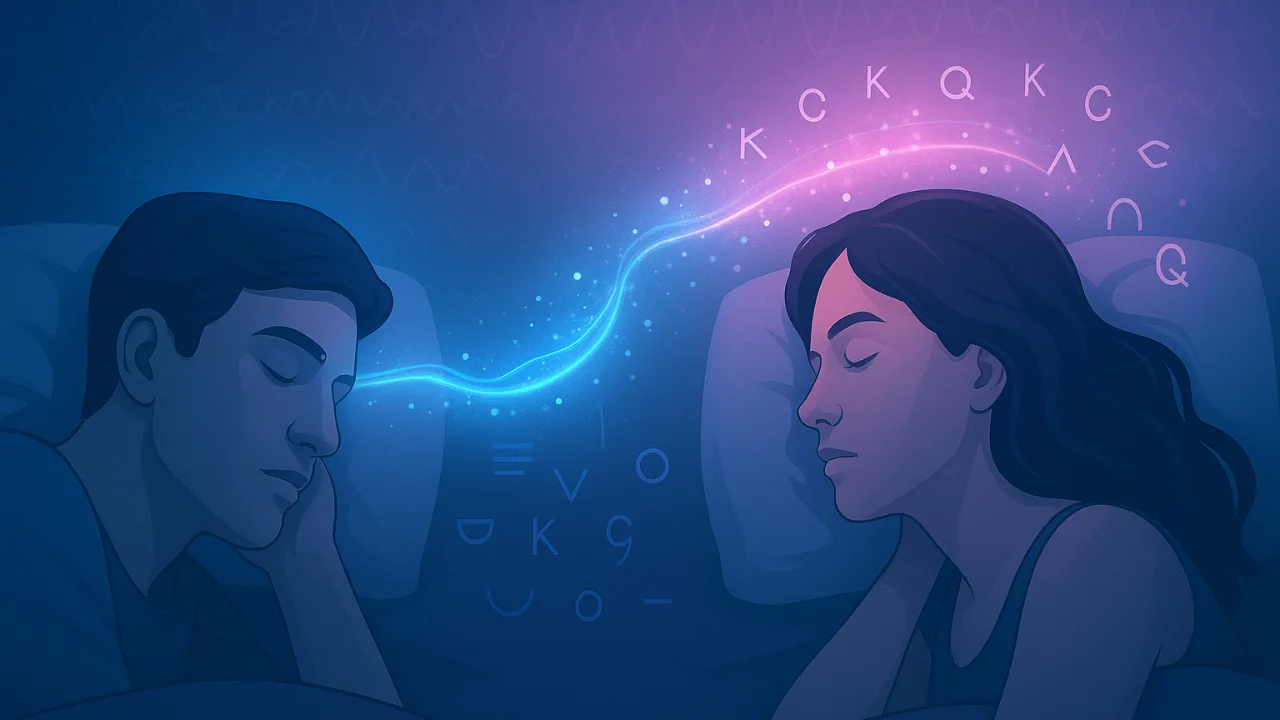
In late 2024, a small neurotech company called REMspace, based in Redwood City, California, claimed it had achieved what once belonged to science fiction, communication between two people inside their dreams. Using custom equipment and a self-developed “dream language” called Remmyo, the team said one lucid dreamer sent a word to another while both were asleep.
CEO Michael Raduga described it as a milestone toward “real-time communication in dreams.” The announcement spread across social media and tech news outlets, stirring equal parts fascination and doubt. For many scientists, this claim touched one of the last untouched frontiers of human consciousness.
Fast Facts
- Breakthrough: REMspace claims to have achieved the first communication between two humans inside a lucid dream.
- Technology: Used EEG and EMG sensors with a custom “Remmyo” dream language for transmitting signals.
- Verification: Results are unverified and await peer review; current evidence is based on internal logs.
- Founder: Led by CEO Michael Raduga, a long-time lucid dream researcher now based in Silicon Valley.
- Goal: To develop real-time dream-to-dream communication for therapy, learning, and creativity enhancement.
How the Experiment Worked
According to REMspace, the first successful dream-to-dream communication happened on September 24, 2024, and was repeated on October 8, 2024. Both participants were in separate homes, monitored remotely by a server connected through EEG and EMG sensors.
When the system detected the first participant entering a lucid dream, a random Remmyo word was played through earbuds. Inside the dream, he repeated the word, his facial muscle signals were captured and translated into Remmyo code. Eight minutes later, the second participant, also lucid, received that same word in her dream and confirmed it upon waking.
All interactions were logged digitally. Lucidity was confirmed through pre-agreed eye movement signals, a standard used in dream research. However, this setup has not yet been independently replicated or peer reviewed.
What Exactly Is Remmyo?
Remmyo is an electromyographical (EMG) language designed for states like lucid dreams or sleep paralysis, where full muscle control is impossible. It uses six consonant sounds—K, B, L, C, H, and S— each linked to a specific muscle contraction on the face.
In lucid dreams, these twitches can still be detected by EMG sensors. Words are formed by combining them with short pauses between sounds. The grammar is simple, allowing dreamers to “speak” through minimal muscle activity while paralyzed in REM sleep.
Raduga developed this system in 2021 after years of lucid dreaming research. The company says it allows “short but clear messages” to be sent from one sleeper to another.
The Science Behind the Claim
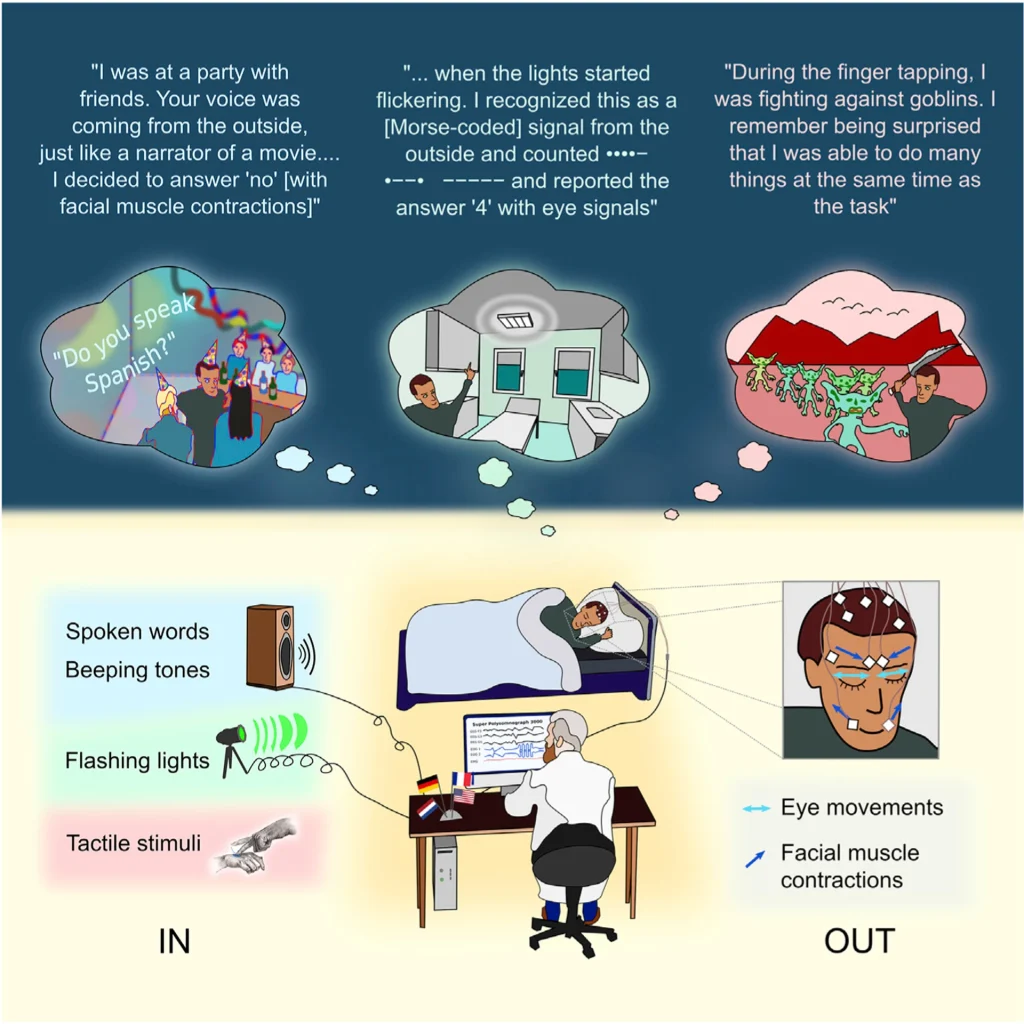
Dream communication has been studied for decades. In 2021, researchers at Northwestern University proved that real-time two-way communication between an awake experimenter and a sleeping lucid dreamer is possible. They used EEG, facial signals, and audio cues to exchange basic math questions and answers.
REMspace’s experiment builds on that concept but claims to bridge two sleeping brains—a step further than the Northwestern model. However, no public paper or third-party review currently verifies this result.
Scientific outlets like IFLScience and ScienceAlert have urged caution, noting that “extraordinary claims require extraordinary evidence.” Until data logs, replication studies, and peer-reviewed documentation appear, the claim remains unverified.
Who Is Behind REMspace?
REMspace was founded by Michael Raduga, a lucid dream researcher originally from Russia. He moved his company to Silicon Valley in 2024, focusing on dream research and neurocommunication.
Raduga’s past experiments include transmitting sound and controlling avatars through dreams, as well as testing pain transfer across dream states. His earlier projects drew attention for their ambition and controversy, especially his 2023 self-implant experiment to study dream control.
As of early 2025, REMspace has about 14 employees and received around $1 million in seed funding. Its stated goal is to make “dream communication as common as video calls.”
Reactions from the Scientific Community
Neuroscientists agree that lucid dream communication is feasible, but dreamer-to-dreamer exchange has yet to pass the scientific threshold.
Experts like Dr. Ken Paller from Northwestern acknowledge that controlled communication inside dreams is real but stress that REMspace’s claim must be replicated under laboratory conditions. Without independent verification, it remains an internal experiment, not a proven breakthrough.
Critics also point to the absence of detailed data such as EEG graphs, replication attempts by other labs, and full methodology disclosure.
Curious how world leaders are shaping the future of AI? Read about Rishi Sunak’s new AI leadership roles.
Ethical and Privacy Concerns
Beyond proof, the experiment raises complex ethical questions. Could dream communication be misused to influence or manipulate someone while unconscious? Who owns the data recorded from a person’s brain activity during sleep?
Currently, REMspace’s data handling policy is unclear. Since the experiment was conducted via online servers, security risks, such as unauthorized access or hacking, are plausible. Experts in neuroethics argue that consent in altered states, like lucid dreams, requires deeper legal discussion before such technology scales.
What Could This Mean for the Future?
If verified, dream-to-dream communication could transform how humans understand consciousness and mental connection. The potential applications extend far beyond novelty.
- Therapy and trauma: Patients could revisit distressing dreams safely and reshape them in guided sessions.
- Grief and loss: People might “visit” lost loved ones in lucid dream settings.
- Learning and creativity: Dream practice could reinforce real-world skills or trigger original ideas.
- Entertainment and social use: Future “dream networks” could let people meet in shared virtual dreamscapes.
Still, experts warn that REMspace is far from real-time dialogue between dreamers. Achieving stable communication requires reliable REM detection, synchronized timing, and emotional safety protocols, challenges that remain unsolved.
Public Interest and Next Steps
The public response has been explosive. Videos of the experiment on YouTube have drawn thousands of views, and discussions on Reddit mix excitement with skepticism. Some see it as the dawn of “dream internet.” Others dismiss it as overhyped self-promotion.
REMspace continues recruiting experienced lucid dreamers for new trials through its LucidMe app. The company plans to publish peer-reviewed results by mid-2026 and eventually sell at-home dream communication kits.
For now, dream-sharing remains experimental and limited to trained lucid dreamers.
Why It Matters
Whether REMspace’s experiment proves true or not, it signals the next stage of neurocommunication research. The line between brain, machine, and shared experience is getting thinner.
If verified, it could change how humanity views the mind’s last private space, our dreams. If not, it still pushes science closer to understanding how consciousness and technology might one day meet.
The first step has been taken. Now the world waits for proof.
See how brain-computer interfaces are redefining gaming boundaries, read the story of the Twitch streamer who played a game using only her mind.
FAQs
REMspace used a combination of EEG and EMG sensors to detect brain and muscle activity during lucid dreaming. Participants communicated using Remmyo, a custom electromyographical language based on facial muscle signals. One dreamer sent a word while asleep, and another dreamer received it in their own lucid dream through a server relay.
Not yet. While REMspace’s internal data suggest success, no peer-reviewed scientific paper has confirmed the results. Researchers emphasize that independent replication and published studies are essential before the claim can be accepted as verified science.
If proven reliable, dream-based communication could support therapies for trauma, grief recovery, and creative problem-solving. Scientists also believe it may help explore human consciousness, skill learning, and new brain-computer interaction methods.