

Twitch Streamer Plays Game Using Only Her Mind After Intense Brain Training
Perri Karyal, a Twitch streamer, amazed the internet by playing games like Elden Ring using only her brainwaves.
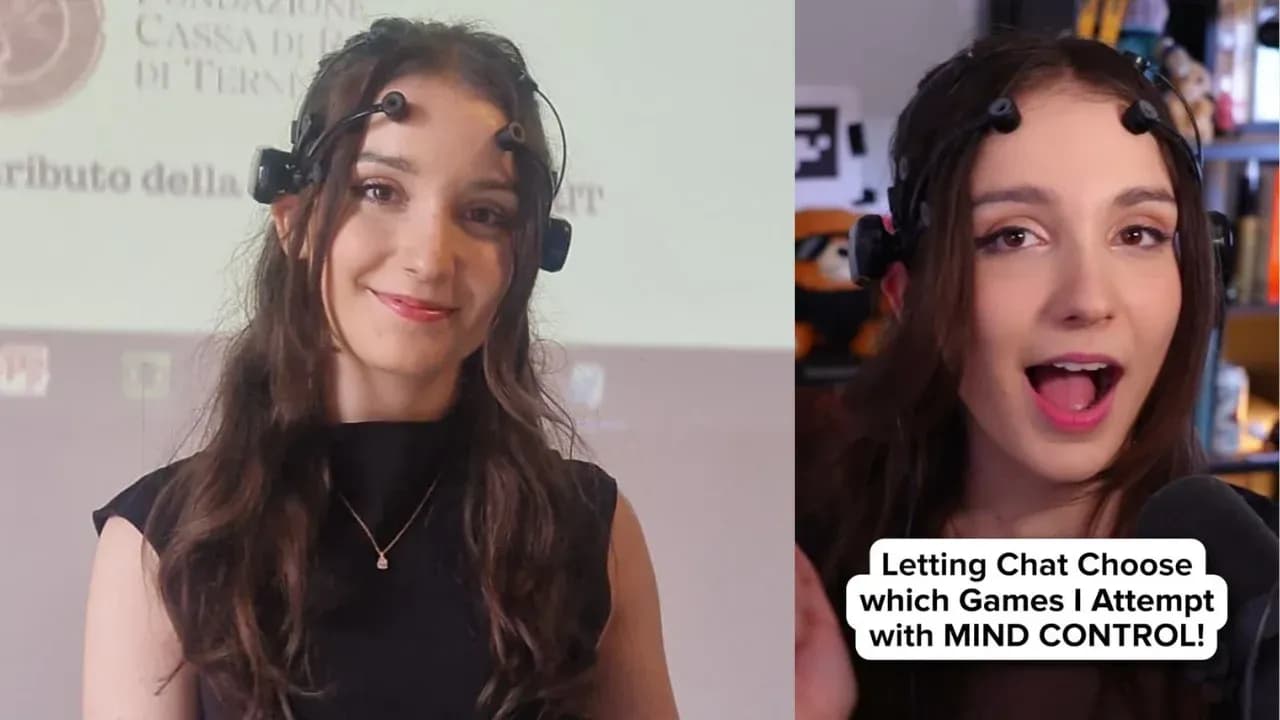
In the ever-evolving world of gaming, controllers have come a long way. From old-school joysticks to motion sensors, each step has made players feel closer to their games. But one Twitch streamer has taken the leap that feels like science fiction. Instead of a controller, she plays using only her brain.
Meet Perri Karyal, the UK-based streamer turning her thoughts into gameplay. Her setup blends psychology, neuroscience, and sheer dedication. The result has amazed her Twitch community and sparked viral conversations across the internet.
Fast Facts
- Who: Perri Karyal, UK-based Twitch streamer with a psychology background.
- What: Plays games like Elden Ring and Armored Core using only brainwaves.
- How: Uses an Emotiv EPOC X EEG headset customized with her own scripts.
- Training: Over 250 hours of neurofeedback practice to master reliable commands.
- Why it matters: Shows potential for accessibility, VR, and the future of gaming.
Meet Perri Karyal: The Gamer Who Turned Thought Into Action

Perri Karyal, known online as perrikaryal, is not your average gamer. She holds a Master’s degree in psychology, which gave her a unique curiosity about the mind. That curiosity soon became a quest to see if she could connect her brain directly to her favorite games.
Her journey began in early 2023 with a stream of Elden Ring. Viewers watched in disbelief as she defeated bosses without touching a controller. The clips went viral on Reddit and YouTube, and soon mainstream outlets like Rolling Stone and PC Gamer picked up the story.
Over time, she has tested her setup with different titles, including Palworld and Valorant. But her Armored Core stream showed how precise her mind control had become. Twitch chat exploded with comments like “This is the future” as she battled mechs hands-free.
She also revealed that her work caught the attention of academics. She has given talks at Imperial College and even had outreach from Yale, showing how her experiments bridge gaming and science.
How Brainwave Gaming Actually Works
So how does someone play a game with just their mind? The secret is an EEG headset, short for electroencephalogram. Perri uses the Emotiv EPOC X, a 14-channel wireless model that costs about $849. It has saline-based sensors that read electrical activity on the scalp. These signals show patterns when a person imagines specific movements or thoughts.
Through neurofeedback, the headset learns to recognize those patterns. For example, Perri might imagine pushing forward. The system links that thought to a “move” command. Over time, her brain adapts and produces those signals more reliably.
“All I’m doing is teaching the EEG to recognize patterns, then I coded it up in Python to push a button. It sounds simple, but it took me months of training for it to actually work.” — Perri Karyal
She customized the software using open-source tools and her own scripts. Sometimes she combines brain input with eye-tracking for extra precision. In one clip, she flew a drone by using gaze for direction and thought-based thrust. It looks futuristic, but it is simply the result of clever mapping between signals and game actions.
Training the Brain: The Hours Behind the Magic
While the end result looks effortless, training the brain is anything but simple. Perri has spent over 250 hours practicing with her headset. In one case, she trained the system more than 400 times to recognize a single command.
Her cues range from mental images, like a cricket jumping for “attack,” to subtle physical tricks like inner ear twitches. These unique thought patterns create signals that the EEG can detect.
“I’ll imagine pushing something heavy, that’s my dodge. Then I’ll spin a plate to the tune of You Spin Me Round — that’s my attack. I’ve trained that about 800 times and it’s solid now.” — Perri Karyal

The training curve is steep. EEG headsets studies suggest some users adapt in 10 to 20 sessions, but mastering complex controls may take months. Accuracy hovers between 70 and 90 percent, which means errors and delays are common. For fast-paced games, that can be a serious challenge.
Perri is transparent about the struggles. She often mentions lag, misfires, and the mental fatigue of focusing for hours. Yet her excitement shines through. “This is only the beginning and I’m so frickin excited,” she told her followers.
She also admits streaming with EEG adds unpredictability.
“People have killed me several times in Elden Ring because I was trying to dodge, but chat sounds distracted me. My brain was focused on spinning plates instead of dodging.” — Perri Karyal
These moments make her streams both entertaining and authentic, showing the human side of experimental technology.
View this post on Instagram
Beyond Fun: Why This Matters for Accessibility
Perri’s streams are entertaining, but the implications go far beyond gaming. For people with disabilities, brain-computer interfaces (BCIs) could open doors once thought closed. Someone with quadriplegia could control a game, a wheelchair, or even a prosthetic limb with their thoughts.
Companies like Emotiv and OpenBCI are working on similar projects, while researchers explore medical uses. BCIs could help stroke patients regain motor control or allow ALS patients to communicate. In education, neurofeedback might improve focus. In VR, mind control could create the most immersive experiences yet.
By showing what’s possible on Twitch, Perri helps make the technology more visible. What once seemed like an academic experiment now feels within reach for ordinary people.
Read how Neuralink helped a patient write again after 20 years
Risks, Limits, and Skepticism
Despite the excitement, brainwave gaming has its limits. Consumer-grade EEG headset devices are non-invasive, so the health risks are minimal. Some users report mild scalp irritation or mental fatigue, but there is no radiation risk.
The bigger concerns are accuracy, cost, and complexity. Even high-end consumer headsets rarely achieve perfect reliability. Setup requires technical knowledge, and at $500 to $1000, the price is steep.
Privacy is another growing issue. Brainwave data can reveal emotions or cognitive states. Some governments, like Colorado in the United States, have already passed laws to protect neurodata. Experts warn that as BCIs expand, regulation will become essential.
Scientists also remind us that EEG has limitations. It cannot read deep brain activity with high precision. Invasive implants, like those developed by Neuralink, offer more accuracy but come with surgical risks.
The Future of Mind-Controlled Gaming
Perri’s project is not the only one pushing this frontier. Neuralink has shown patients playing games with implants. OpenBCI offers open-source kits for enthusiasts and researchers. Game developers and hardware makers are watching closely.
Experts predict that brain control will first supplement, not replace, traditional inputs. Gamers might mix thought commands with hand controls for hybrid play. In esports, BCIs could add new dimensions, letting pros control abilities at the speed of thought.
Valve co-founder Gabe Newell has spoken about mind-controlled VR as a likely reality by the 2030s. If that prediction holds true, what Perri is doing on Twitch may look like an early demo of what millions will one day experience.
Public Reaction and Cultural Impact
The internet’s response to Perri’s streams has been explosive. On Twitch, chat scrolls with disbelief and praise. On Reddit, threads like “Girl completes Elden Ring using mind control” attract thousands of upvotes. Memes spread across Twitter, with jokes about beating bosses through sheer willpower.
Mainstream coverage from outlets like Rolling Stone, PC Gamer, and Freethink has amplified her reach. Each article frames her not as a novelty act but as someone demonstrating a serious step in human-computer interaction.
Perri herself embraces both the fun and the responsibility. “This was so much fun! Thanks for having me Dexerto :)” she tweeted after one feature. Her streams blend spectacle with education, showing viewers how the brain can be trained.
Discover 12 mind-blowing Neuralink moments you haven’t seen yet
FAQ: About Brainwave Gaming
Brainwave gaming works through EEG (electroencephalogram) headsets that detect electrical signals from your brain. These signals show patterns when you imagine actions, like pushing forward or spinning. With neurofeedback training, the headset learns to link those patterns to in-game commands. Research published in Frontiers in Neuroinformatics shows EEG-based control is effective with enough training. Perri Karyal trained her brain for hundreds of hours so her imagined actions could move her character in Elden Ring and Armored Core.
She uses the Emotiv EPOC X, a consumer-grade EEG headset with 14 sensors that capture brain activity. It costs around $849 and has about nine hours of battery life. Similar devices in this category range from $500 to $1,000 depending on features. While the headset is marketed for research and enthusiasts, Perri customized the software herself to make it work with complex games, highlighting both the device’s potential and its limitations.
Yes, brainwave gaming is real and backed by neuroscience. Perri demonstrates it live on Twitch, where thousands of viewers have seen her play without a controller.
Absolutely. BCIs have enormous potential to improve accessibility. For example, someone with quadriplegia or ALS could use brain signals to control a game, type on a computer, or move a wheelchair. Research labs and companies like OpenBCI are actively exploring these applications. For now, consumer BCIs are still experimental, but progress is steady.
Training depends on the person and the complexity of the game. Studies suggest users need at least 10 to 20 sessions to see improvements, but full mastery can take months. Perri has trained her system for over 250 hours, repeating certain actions hundreds of times to make them reliable. This reflects both the difficulty and the promise of neurofeedback gaming. Scientists also caution that mental fatigue can affect accuracy, so pacing training is important.
Final Thoughts
Perri Karyal’s streams show more than just a gaming trick. They show how human curiosity and persistence can turn sci-fi ideas into reality. By training her brain for hundreds of hours, she unlocked a new way to interact with machines.
For now, brainwave gaming is still experimental, and it comes with challenges. But the potential is enormous. From helping disabled gamers to shaping the future of VR, this technology could transform how we connect with the digital world.
The next time you pick up a controller, imagine what it would feel like to simply think your next move. For Perri, that future is already here.
Disclosure: We may earn a commission when you make a purchase through the ads.
From obsession to clarity — one original question every week.
We answer one noisy topic at a time, in full. No daily roundup, no thread bait — just the question, the principles, and the system.