
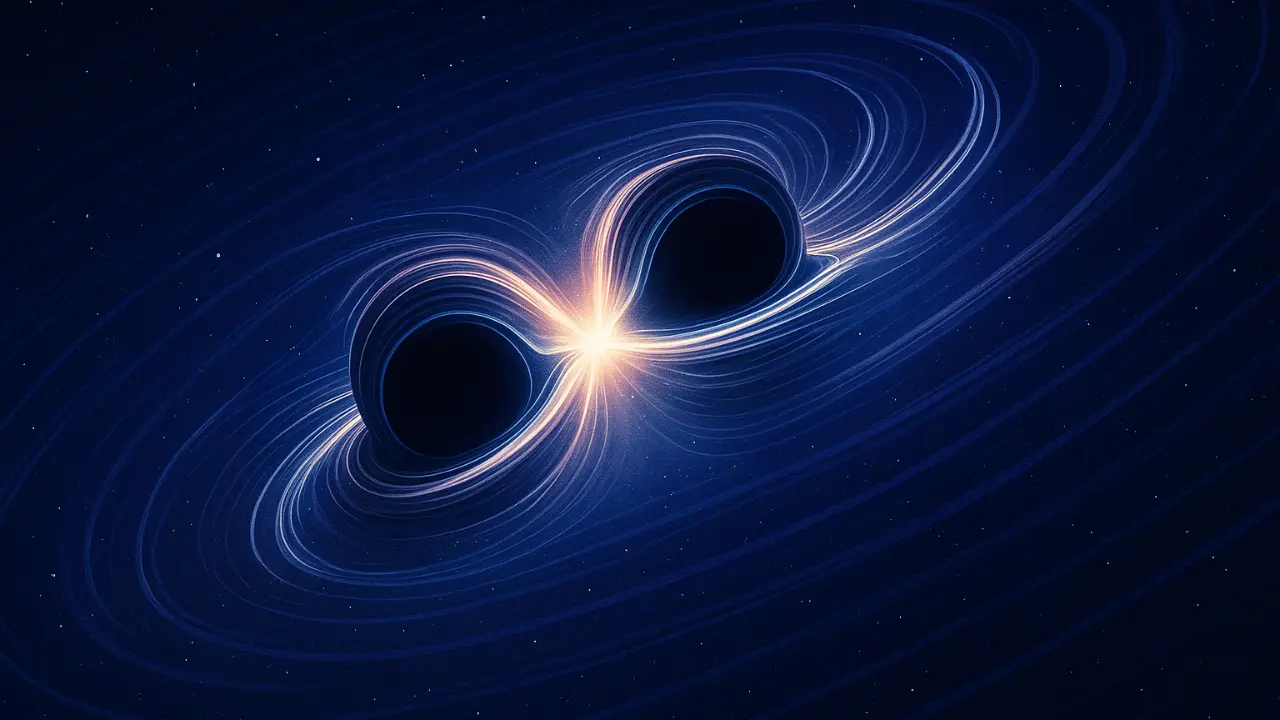
For the first time, scientists have confirmed two of the most famous predictions about black holes. The discovery came from a powerful gravitational wave signal named GW250114. It was captured by the Laser Interferometer Gravitational-Wave Observatory (LIGO) on January 14, 2025.
The event confirmed Albert Einstein’s prediction that black holes are fully described by their mass and spin, as set out in his theory of general relativity. At the same time, it provided the strongest evidence yet for Stephen Hawking’s area theorem, which states that a black hole’s surface area can never shrink.
This event was extraordinary. Two black holes, each about 33 times the mass of our Sun, collided and merged into a single giant black hole spinning at 100 revolutions per second. The crash released energy across space in the form of gravitational waves. LIGO detected these ripples with a clarity never seen before.
Fast Facts
- Event: GW250114 black hole merger detected on January 14, 2025.
- Discovery: Strongest gravitational wave signal ever, over three times clearer than 2015’s first detection.
- Confirmed: Stephen Hawking’s area theorem and Albert Einstein’s relativity predictions.
- Significance: Proved black holes follow simple rules of mass and spin, supporting thermodynamic laws.
- Future: Next-gen detectors will be ten times more sensitive, enabling thousands of new discoveries.
The Clearest Black Hole Collision Ever Detected
Gravitational waves are ripples in space-time that spread out when massive objects move violently. Black hole mergers are the strongest known source of these waves. The first detection in 2015, called GW150914, proved that gravitational waves exist.

Image Credit: LIGO Scientific Collaboration, Physical Review Letters, CC BY 4.0
A decade later, GW250114 is even more important. The signal had a strength, or signal-to-noise ratio, of 80. That makes it more than three times clearer than the first detection. This allowed scientists to follow the entire process, from the first moments of collision to the faint final ringing of the new black hole.
“This is the clearest view yet of the nature of black holes,” said Maximiliano Isi of Columbia University and the Flatiron Institute in New York City. “We’ve found some of the strongest evidence yet that astrophysical black holes are the black holes predicted from Albert Einstein’s theory of general relativity.”

Image Credit: LIGO Scientific Collaboration, Physical Review Letters, CC BY 4.0
Hawking’s Bold Prediction About Black Holes
In the 1970s, Stephen Hawking proposed what is now called the area theorem. It states that the surface area of a black hole’s event horizon can never shrink. The event horizon is the invisible line around a black hole beyond which nothing, not even light, can escape.
Hawking’s idea connected black holes to the laws of thermodynamics. Just as entropy, or disorder, always increases in physical systems, the surface area of black holes should always grow. This bold link between gravity and entropy became one of Hawking’s most famous ideas.
Until now, testing the theorem with real data seemed out of reach. After the first detection in 2015, Hawking himself wondered if the merger signature could confirm his theorem. By 2019, a tentative confirmation appeared, but confidence was still low. GW250114 finally provided the clarity scientists needed.
Related Reading
Scientists discovered strange “leopard spots” in a Mars rock, which may be the strongest clue yet of possible past life on the Red Planet.
Read the Full StoryHow Scientists Put Hawking to the Test
To test Hawking’s theorem, the team studied the gravitational wave signal in two stages.
- Before the merger: They measured the masses and spins of the two original black holes and calculated their total horizon area.
- After the merger: They analyzed the “ringdown,” when the new black hole vibrated and settled. Using advanced methods to isolate specific frequencies, they determined the mass and spin of the final black hole. From those values, they calculated its horizon area.
The result was clear. The final black hole’s area was larger than the combined areas of the two that merged. This confirmed Hawking’s prediction with more confidence than ever before.
“It’s really profound that the size of a black hole’s event horizon behaves like entropy,” Isi explained. “It has very deep theoretical implications and means that some aspects of black holes can be used to mathematically probe the true nature of space and time.”
Proving Einstein and Kerr Right Too
The scientists also tested Einstein’s theory of relativity and Roy Kerr’s 1963 description of black holes. Kerr showed that real black holes can be described by only two numbers: their mass and spin.

Image Credit: LIGO Scientific Collaboration, Physical Review Letters, CC BY 4.0
GW250114 gave scientists the best chance yet to test this idea. They captured not just one but two distinct ringing tones from the new black hole. These matched the predictions of Kerr black holes within about 30 percent. That level of accuracy shows black holes really are as simple as the theory suggested.
“Listening to the tones emitted by these black holes is our best hope for learning about the properties of the extreme space-times they produce,” said Will Farr of Stony Brook University and the Flatiron Institute.
Why This Discovery Matters for Science
This result is more than a confirmation of old theories. It shows that modern detectors can probe the universe at its most extreme and test the laws of physics under conditions impossible to recreate on Earth.
For physics, the discovery strengthens general relativity and Hawking’s thermodynamic view of black holes. Astronomers see it as the start of a new era, where gravitational wave detectors move beyond simple detection and provide precise measurements. To the public, it demonstrates that bold theories can be tested and confirmed by real signals from billions of light-years away.
Who Is Most Impacted by This Breakthrough
- Astrophysicists gain firm evidence that real black holes are simple, as theory predicted.
- Theoretical physicists face stronger constraints. Any alternative gravity theory must match these results.
- Technology fields benefit from spinoffs of the precision tools used in gravitational wave astronomy.
- The general public gains new understanding of the universe and fresh inspiration for the next generation of scientists.
What Comes Next in Black Hole Science
The success of GW250114 is only the beginning. Detectors like LIGO, Virgo, and KAGRA will continue to improve. In the next decade, sensitivity is expected to increase by a factor of 10. That means thousands of black hole collisions could be tracked in detail every year.
With each new signal, scientists will test relativity, thermodynamics, and perhaps even quantum gravity. Cracks in today’s theories may appear, leading to even deeper discoveries.
A Cosmic Story That Comes Full Circle
Stephen Hawking once wondered if his theorem could ever be proven. Now, a decade after the first detection of gravitational waves and years after his death, the universe has delivered the answer.
The crash of two black holes confirmed Hawking’s area theorem, Einstein’s relativity, and Kerr’s vision of simple black holes.
For decades, these were ideas written on paper. Today, they are facts written in the waves of space-time itself.
Related Reading
New findings suggest Mars stayed warm in the past thanks to volcanic gases beyond just carbon dioxide.
Read the Full StoryFAQs
Scientists confirmed Stephen Hawking’s area theorem, showing a black hole’s surface area never decreases. They also validated Albert Einstein’s prediction that black holes are described only by mass and spin.
The GW250114 signal was more than three times stronger than the first detection in 2015. This clarity let scientists track the entire collision, including the faint final “ringdown” when the new black hole settled.
Hawking’s theorem links the surface area of a black hole’s event horizon to entropy. Just as entropy always increases, a black hole’s surface area also only grows. This shows a deep connection between gravity and thermodynamics.
Detectors like LIGO, Virgo, and KAGRA will soon become ten times more sensitive. In the next decade, scientists expect thousands of black hole mergers to be tracked. These signals will help test relativity, thermodynamics, and even the link between gravity and quantum physics.