

NASA’s Perseverance rover has delivered its most compelling clue yet in the search for life on Mars. While exploring a rocky outcrop called Cheyava Falls in the Bright Angel formation, the rover collected a sample now known as Sapphire Canyon.
This rock, part of an ancient riverbed carved by water rushing into Jezero Crater billions of years ago, contains unusual mineral patterns that look like leopard spots. After more than a year of close study, scientists say Sapphire Canyon remains the mission’s best candidate for containing signs of ancient microbial processes.

Fast Facts
- Sample: NASA’s Perseverance rover collected the Sapphire Canyon core from Cheyava Falls in Jezero Crater.
- Discovery: The rock contains leopard spots of iron minerals and organic carbon, potential fingerprints of microbial activity.
- Earth Link: These minerals usually form with the help of microbes on our planet.
- Surprise: Younger rocks suggest Mars may have been habitable longer than once thought.
- Next Step: A future sample return mission will test the rock for proof of life.
What Makes the Leopard Spots So Special
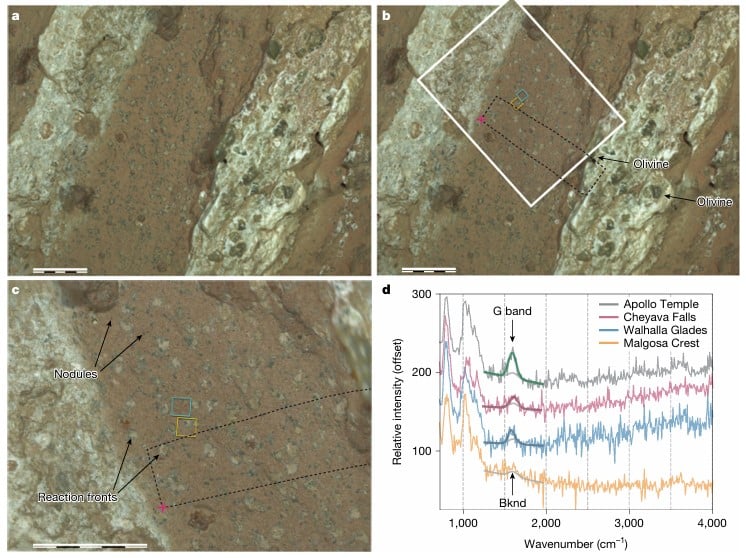
The leopard spots are tiny patches of minerals arranged into reaction fronts, places where chemical activity once reshaped the rock. When Perseverance’s PIXL and SHERLOC instruments first examined Cheyava Falls in 2024, they saw colorful nodules made of iron-rich minerals: vivianite (iron phosphate) and greigite (iron sulfide).
On Earth, vivianite often appears in bogs and around decaying organic matter, while certain microbes produce greigite as part of their metabolism. The presence of these minerals together with organic carbon, sulfur, and phosphorus makes the rock especially intriguing.
Why It Matters for Life on Mars
The minerals likely formed through redox reactions, the chemical swaps of electrons that microbes often use to produce energy. While such reactions can happen without biology, they usually require heat or acidic conditions. The Bright Angel rocks do not show signs of either, which makes a biological explanation harder to dismiss.
Scientists call these mineral–organic associations potential biosignatures. That means they are features consistent with life but not yet confirmed as biological.

“The combination of chemical compounds we found could have been a rich source of energy for microbial metabolisms,” said Perseverance scientist Joel Hurowitz of Stony Brook University and lead author of the study.
Related Reading
New research suggests Mars may have stayed warm thanks to sulfur-rich volcanic gases, not only carbon dioxide. This surprising twist reshapes how scientists view ancient Martian climate.
Read the Full StoryThe Surprise of Younger Rocks
Perhaps the most surprising detail is the age of the rocks. Scientists expected to find possible signs of life in much older formations. Instead, these leopard spots are preserved in younger sedimentary rocks, suggesting Mars may have remained habitable for longer than once thought.
This extends the timeline during which microbes might have thrived on the planet. It also means that older rocks could still hold life’s signals, but in subtler ways that are harder to detect.
What Sedimentary Rocks Tell Us
The Bright Angel formation is made of clay and silt, types of rock known on Earth for preserving traces of past life. These fine-grained sediments, combined with organic carbon and oxidized iron, create the kind of environment where evidence of biology can last for billions of years.
That is why scientists are so focused on this location. Jezero Crater’s history as an ancient lake and river system makes it one of the best places on Mars to search for fossil signs of microbes.
NASA’s Next Steps and Scientific Rigor
NASA leaders are treating this as one of the most important discoveries of the Perseverance mission.
“This finding by Perseverance is the closest we have ever come to discovering life on Mars. The identification of a potential biosignature on the Red Planet is a groundbreaking discovery,” said acting NASA Administrator Sean Duffy.
Scientists also stress caution. They use strict tools like the CoLD scale and Standards of Evidence to measure how confident they can be in a biosignature claim. Extraordinary claims require extraordinary proof, which is why this finding is exciting but not yet confirmed as life.
“Astrobiological claims, particularly those related to the potential discovery of past extraterrestrial life, require extraordinary evidence,” said Katie Stack Morgan, Perseverance’s project scientist at NASA’s Jet Propulsion Laboratory.
The Role of Mars Sample Return
The Sapphire Canyon sample is now one of 27 cores collected by Perseverance. NASA and the European Space Agency plan to bring these samples back to Earth in the Mars Sample Return mission within the next decade.
Only in advanced Earth labs can scientists fully test whether the leopard spots were formed by geology alone or by microbial life. Until then, Sapphire Canyon stands as the strongest candidate yet for answering the question: Are we alone?
The Bigger Picture for Humanity
This discovery touches everyone, not just scientists. If proven biological, it would mark the first evidence of life beyond Earth. Even if the spots are purely chemical, they still reveal that Mars once had the right conditions for life.
As Perseverance continues its journey, each rock adds a piece to the puzzle of Mars’ past. And with every new clue, humanity edges closer to knowing whether life once flickered on the red planet.
Related Reading
Scientists have discovered a breakthrough way to turn sunlight directly into fuel. This advance could change how we power the future.
Read the Full StoryFinal Thoughts
The leopard spots of Sapphire Canyon may be the strongest hint of Martian life ever found. They remind us that discovery is a process: cautious, rigorous, and thrilling. As scientists prepare to study these rocks on Earth, the world waits for an answer to the question that has inspired generations, was Mars ever alive?
Disclosure: We may earn a commission when you make a purchase through the ads.