
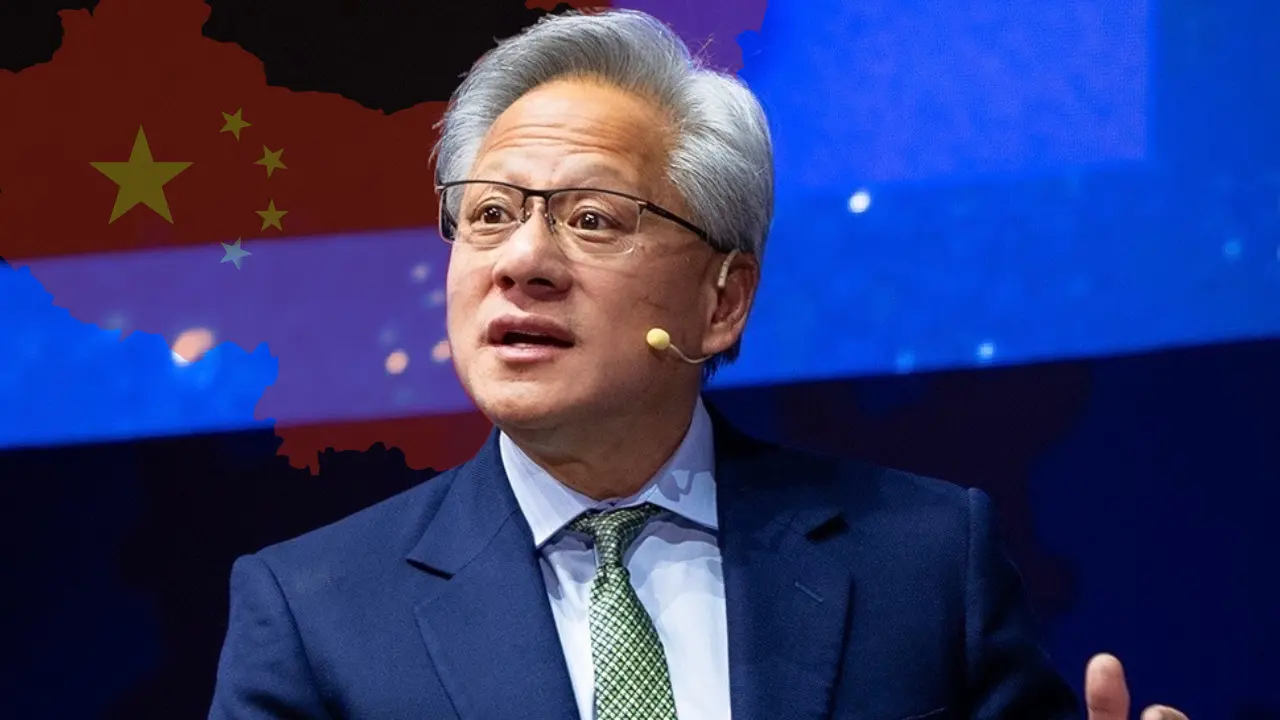
Speaking in London, Jensen Huang warned that China’s rapid expansion in artificial intelligence could soon outpace the United States. His statement came as both nations intensify their rivalry over chips, compute power, and innovation. Huang pointed to China’s subsidized electricity, unified policies, and developer-heavy workforce as the driving forces behind its rise. “While America argues over rules, China is already building the future,” he said.
Within hours, NVIDIA clarified that Huang’s remark was not a concession but a warning. He later wrote on X that China is “nanoseconds behind America in AI” and that the U.S. must lead by “winning developers worldwide.”
Fast Facts
- Date & Event: November 5, 2025 – Future of AI Summit, London
- Key Quote: “China will win the AI race” – Jensen Huang, NVIDIA CEO
- Main Argument: U.S. regulations slow progress, while China builds faster with cheaper energy
- Clarification: Huang later said China is “nanoseconds behind” and urged the U.S. to “race ahead”
- Implication: AI power could shift toward Asia if current U.S. policies persist
Why Jensen Huang Believes China Could Surpass the U.S.
China’s advantages are both structural and strategic. Its government subsidizes power for AI data centers by as much as 50%, cutting compute costs dramatically. Unlike the U.S., which faces fragmented state regulations, China’s unified approach allows faster infrastructure rollout. Huang described Western policy as “cynical,” arguing that overregulation and high costs slow down progress.
He also noted that China now accounts for nearly half the world’s AI developers, a figure supported by global talent trackers. Local giants like Alibaba, Tencent, and DeepSeek continue scaling domestic models and AI clusters at record speed, thanks to cheap energy and centralized planning.
Concrete Evidence Behind the Claim
Multiple reports support Huang’s assessment. The Financial Times confirmed that China’s energy subsidies have helped tech firms operate vast AI data centers. Reuters reported that Chinese regulators are prioritizing domestic chip manufacturing to offset U.S. export restrictions. Stanford’s 2025 AI Index shows China leading the world in research volume with over 52,000 active AI researchers.
At the same time, the U.S. still dominates in investment and quality. American institutions produced 40 major AI models in 2024 compared to China’s 15, with $109 billion in private AI investment versus China’s $9 billion. These figures reflect a close but uneven race, one defined by scale versus sophistication.
How Export Bans Are Changing the AI Landscape
Since 2022, the U.S. has restricted exports of advanced AI chips to China, including NVIDIA’s H100, A800, and the newly designed H20. These bans cut NVIDIA’s China revenue to around 6% of its total, down from more than 20%.
Huang warned that such restrictions “may weaken America’s position” by forcing China to innovate independently. Evidence of that shift is already visible through Huawei’s Kirin processors and DeepSeek’s homegrown AI models.
Analysts from the Center for Strategic and International Studies argue that export controls, while protecting U.S. security, risk fragmenting global supply chains. Some experts believe the bans accelerate China’s self-sufficiency rather than slow it.
Global Stakes and Urgency
The implications reach far beyond corporate competition. AI dominance determines control over innovation, defense capabilities, and global economic influence.
If China’s acceleration continues, the global technology map could tilt toward Asia. The U.S., meanwhile, risks losing leadership not because of capability, but because of policy drag. As Huang put it, “The race isn’t just about chips, it’s about control of the future.”
NVIDIA’s Strategic Position in the AI Race
NVIDIA stands at the center of this global divide. Once holding 95% of China’s AI chip market, the company now faces sharp revenue declines under export bans. Huang’s approach emphasizes developer engagement over isolation. His stance reflects a broader philosophy: to secure U.S. leadership, the country must out-innovate, not out-restrict.
While some policymakers view his remarks as controversial, industry analysts see them as a wake-up call. “You can’t win a technology race by building walls,” one AI economist noted. “You win by building faster, smarter, and with everyone.”
A Shifting Global Balance
Huang’s warning encapsulates the new reality of global AI competition. China’s government-backed ecosystem is scaling rapidly through strategic energy subsidies, talent programs, and domestic chip design. The U.S., while leading in venture funding and innovation quality, faces growing friction from regulatory delays and fragmented policy debates.
As the world enters 2026, both countries stand at a pivotal crossroads. The U.S. must decide whether to double down on restrictions or reignite its developer-led advantage. China, meanwhile, continues to expand AI infrastructure across Asia, Africa, and the Middle East.
U.S. vs. China in Key AI Metrics (2024–2025)
| Metric | United States | China |
|---|---|---|
| Private AI Investment | $109.1 billion | $9.3 billion |
| Notable AI Models Produced | 40 | 15 |
| Annual STEM PhDs | ~40,000 | ~77,000 |
| Top AI Talent Share (2022) | 38% from China | 28% global top talent based domestically |
| Energy Costs for Data Centers | High, grid delays | Subsidized up to 50% |
| Regulatory Environment | Fragmented, security-focused | Unified, incentive-driven |
| AI Research Output | High quality, fewer papers | Highest global volume |
FAQ
The U.S. still leads in AI innovation and investment, but China is closing the gap quickly through cheaper compute, faster regulation, and government-backed programs.
NVIDIA’s market share in China has dropped sharply due to U.S. export restrictions, but the company continues to advocate for engagement with global developers to preserve long-term leadership.
Not entirely. While export bans slow access to top-tier chips, they also motivate China to accelerate domestic innovation, potentially strengthening its ecosystem over time.
External References:
Financial Times – Jensen Huang Interview
Reuters – NVIDIA CEO on China’s AI Race
Stanford HAI – 2025 AI Index