

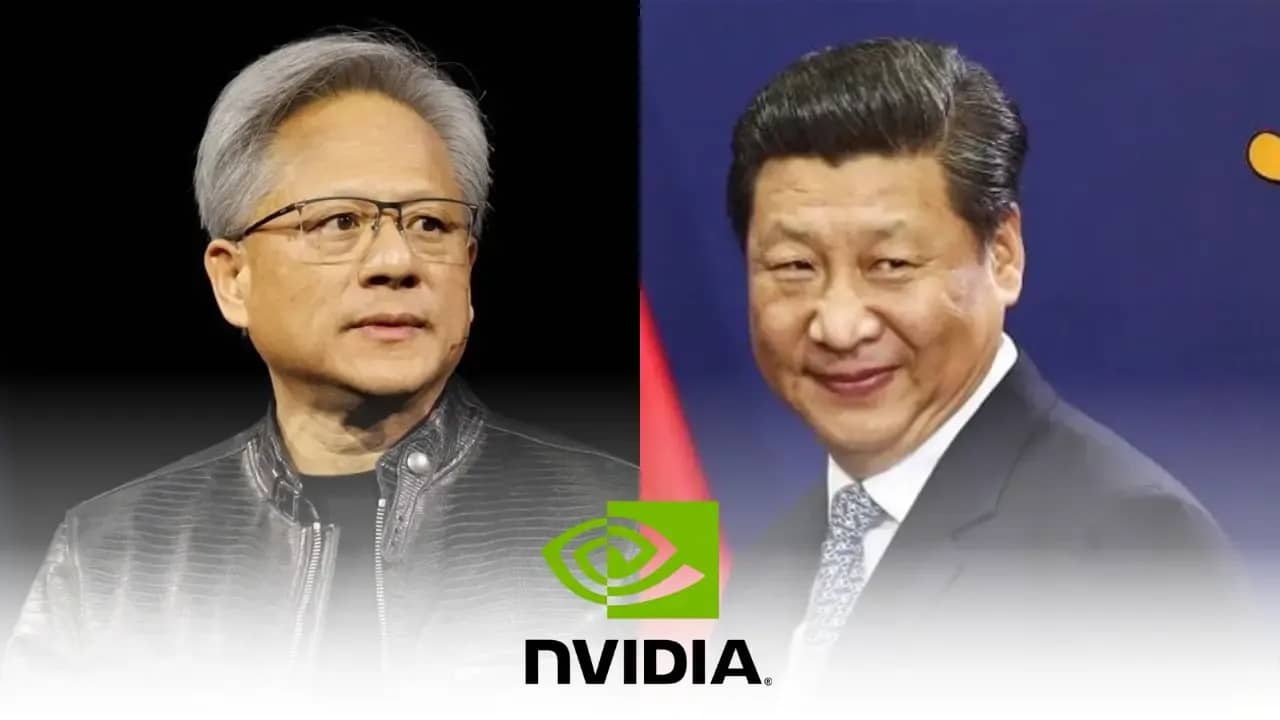
China Bans NVIDIA AI Chips for Big Tech, Signals New Phase in Global Chip War
A sweeping directive from Beijing has halted NVIDIA AI chip sales to Chinese tech giants, escalating the global chip war.
In September 2025, China’s Cyberspace Administration of China (CAC) issued a sweeping directive . Tech giants like Alibaba, Baidu, and ByteDance were told to stop buying NVIDIA’s AI chips and cancel all existing orders. The ban covered models such as the H20, RTX 6000 AI, and RTX Pro 6000D, chips specifically designed to comply with earlier U.S. export rules.
This move stunned the global tech community. For years, NVIDIA dominated China’s AI hardware market. Now, Beijing declared domestic alternatives strong enough to take over, signaling not just a policy shift but a new chapter in the global chip war.
Fast Facts
- Date of Ban: September 2025, issued by China’s Cyberspace Administration.
- Chips Affected: NVIDIA H20, RTX 6000 AI, and RTX Pro 6000D.
- Impact on NVIDIA: China accounted for $17.1B revenue (13% of total) before the ban.
- Winners: Huawei, Alibaba’s T-Head, and other domestic AI chipmakers.
- Geopolitical Context: Seen as part of the wider U.S.–China tech war over AI dominance.
Why China Said No to NVIDIA
The ban is the latest twist in the escalating U.S.–China tech rivalry. Since 2022, Washington has restricted exports of NVIDIA’s most advanced chips, citing national security concerns. NVIDIA responded by creating downgraded versions for China, including the A800 and H20.
At first, this compromise allowed business to continue. But in 2025, U.S. regulators revoked export licenses for the H20, then briefly restored sales with strict revenue-sharing conditions. By September, Beijing pushed back. Officials said the chips posed “information risks” and argued that domestic processors now matched NVIDIA’s performance .
NVIDIA CEO Jensen Huang admitted the situation was “disappointing,” but also called it part of “larger agendas” between two superpowers. The company stressed that it complies with all laws but cannot control geopolitics.
Are Chinese AI Chips as Good as NVIDIA?
Beijing’s confidence rests on rapid progress from domestic players such as Huawei, Biren Technology, Cambricon, and Alibaba’s T-Head unit. These companies have scaled output and announced chips with specifications close to NVIDIA’s restricted products.
Technical Comparisons
| Metric | NVIDIA H20 | Huawei Ascend 910C | Biren BR100 | Cambricon MLU590 |
|---|---|---|---|---|
| FP32 Performance | 44 TFLOPS | ~26 TFLOPS | Comparable to H20 | 624 TOPS (INT8) |
| Memory | 96 GB HBM3 | 128 GB HBM | Similar | N/A |
| Energy Efficiency | High | Improving | Lagging | Competitive |
| Suitability | High for training | 60–80% of H20 | Partial substitute | Strong for inference |
Huawei alone aims to ship 400,000 Ascend units in 2025, with yields improving from 20% to 40% . Alibaba’s T-Head PPU already powers data centers where 72% of accelerators are domestic .
Still, major gaps remain. Chinese chips perform well in inference tasks but lag in high-end training of large models. Developers also rely heavily on NVIDIA’s CUDA software ecosystem, which remains unmatched in tools and support.
How Will Alibaba, Baidu, and ByteDance Adapt?
The ban directly affects companies building large-scale AI models. Alibaba’s Qwen, Baidu’s Ernie, and ByteDance’s LLM initiatives all rely on NVIDIA chips for training. Analysts expect three to six months of delays as firms transition to domestic hardware.
These companies are not starting from scratch. Alibaba has already deployed its T-Head processors, Baidu has tested internal chips, and all three are working with Huawei’s Ascend line. Publicly, none of them have admitted severe disruptions. Privately, engineers face the challenge of scaling systems without the mature ecosystem that NVIDIA provides.
The shift may slow some projects, but it also forces China’s tech giants to adapt quickly. With state support and rising chip production, they are betting that domestic options will catch up in a few years.
NVIDIA’s Rollercoaster in China
For NVIDIA, China has been a vital yet volatile market. In fiscal 2025, the country contributed $17.1 billion, about 13% of total revenue. This was already down from 25% in earlier years due to U.S. restrictions. Analysts estimate the new ban could cost the company $5–10 billion annually.
The financial impact is significant. NVIDIA projected 50% earnings growth into 2026, but risks tied to China could derail that outlook. Huang previously said the Chinese market might be worth $50 billion if unrestricted, highlighting what is at stake.
Stock traders reacted quickly. NVIDIA shares dropped 2–3% after the ban was announced. Investors remain divided. Some see a long-term pivot toward U.S. and European markets; others worry that losing China accelerates competition from domestic and global rivals.
Curious about NVIDIA’s staggering growth? Read how each employee is now worth $111M in market value .
What’s Next in the Global Chip War?
The ban is not an isolated event. It fits into a longer timeline of tit-for-tat measures:
- October 2022: U.S. bans exports of A100 and H100 chips.
- October 2023: Restrictions expand to A800 and H800.
- April 2025: U.S. revokes H20 licenses, costing NVIDIA $5.5 billion.
- July 2025: Partial lift allows H20 sales with 15% revenue share.
- August 2025: China warns firms against purchases.
- September 2025: Full ban announced by CAC.
This history shows a steady march toward decoupling. Experts from Brookings and RAND note that aggressive U.S. controls may have backfired , accelerating China’s domestic development. Beijing’s move signals confidence that its chips can compete, at least in the medium term.
The geopolitical stakes are high. The United States aims to slow China’s military and AI capabilities. China seeks to prove it can achieve self-reliance. Allies in Europe, South Korea, and Japan watch closely, strengthening their own semiconductor supply chains.
Who Wins and Loses from China’s NVIDIA Ban?
In the short term, NVIDIA and U.S. exporters lose revenue and market share. Domestic Chinese chipmakers, especially Huawei, gain momentum. Over the next decade, the global AI hardware market, projected at $231 billion by 2035, may look more multipolar, with China capturing a growing share.
For global AI innovation, the picture is mixed. Fragmentation could slow collaboration and progress. At the same time, competition may push breakthroughs in design and energy efficiency.
The viral question remains: Will China fall behind or catch up? Many experts say the ban could actually speed up China’s progress, closing the gap within three to five years.
This is more than a trade fight. It is a battle over who will shape the next generation of intelligence. NVIDIA’s dominance is under pressure, China’s chipmakers are rising, and the global chip war has entered a new phase that will define the future of AI.
Want the inside scoop on Trump’s secret AI dinner? Discover why Elon Musk’s absence stole the spotlight .
FAQs
China’s Cyberspace Administration (CAC) banned NVIDIA’s H20, RTX 6000 AI, and RTX Pro 6000D chips in September 2025. Officials cited “information risks” and claimed domestic alternatives now provide comparable performance. Analysts view the move as part of Beijing’s push for self-reliance in semiconductors and a response to years of U.S. export restrictions on advanced chips.
Chinese chipmakers like Huawei, Alibaba, and Biren have made significant progress. Their processors are competitive in inference tasks and mid-level training, but still lag behind NVIDIA in high-end model training and ecosystem maturity. Experts note that while Chinese chips can serve as partial substitutes, NVIDIA’s CUDA software platform remains unmatched, making a full replacement challenging in the short term.
Disclosure: We may earn a commission when you make a purchase through the ads.
From obsession to clarity — one original question every week.
We answer one noisy topic at a time, in full. No daily roundup, no thread bait — just the question, the principles, and the system.