
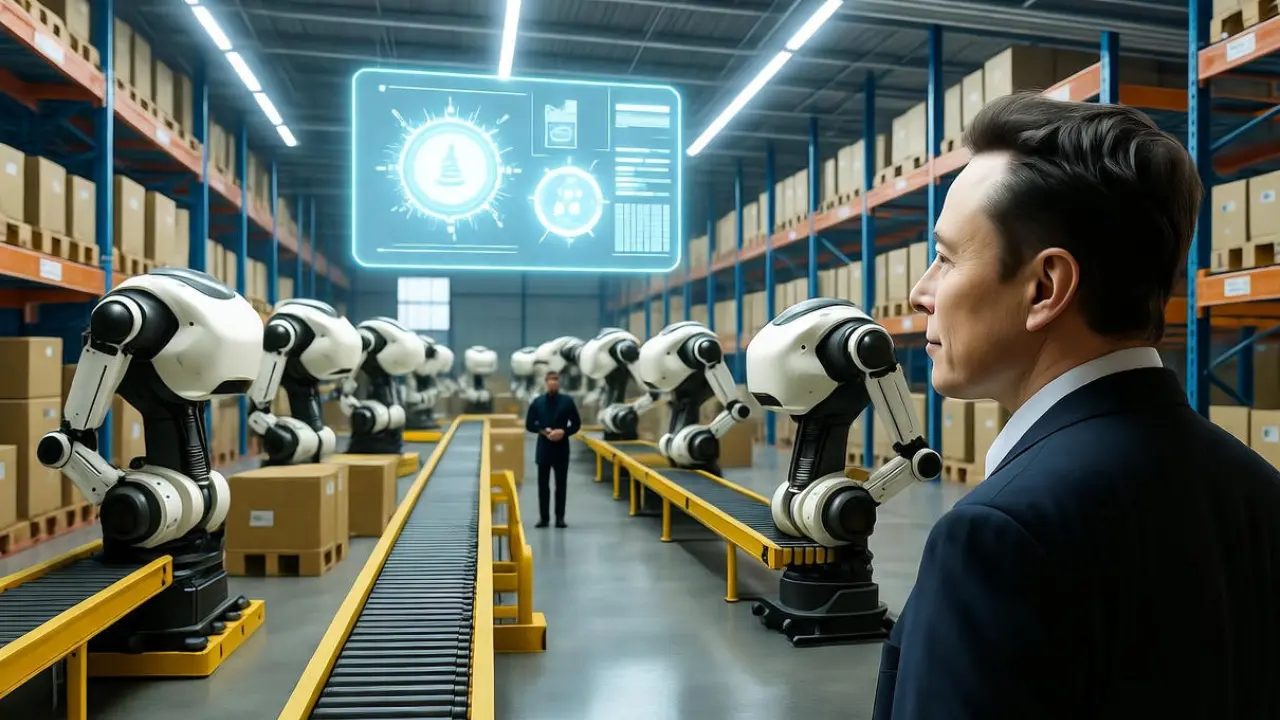
Elon Musk’s recent comment shook the internet: “AI and robots will replace all jobs. Working will be optional, like growing your own vegetables.”
The statement followed a shocking report that Amazon pautomate up to 75% of its operations by 2033, potentially removing 600,000 future jobs. The idea sounds futuristic, but the transition has already begun. Across warehouses, robotic arms are sorting, stacking, and moving packages faster than any human can.
Musk’s response reflects a larger truth: the world’s largest companies are quietly rewriting what it means to work. The question is no longer if robots will replace people but when and how deeply that change will alter our lives.
Amazon’s Automation Plan
The New York Times and The Verge revealed internal Amazon documents showing the company’s plan to deploy robots and AI aggressively. By 2027, the move could eliminate the need for around 160,000 jobs, with an estimated $12.6 billion in savings over two years. Robots could soon handle three out of every four warehouse tasks.
Amazon rejected claims of large-scale job cuts, calling the leaks incomplete and misleading. Yet the numbers align with what experts like economist Daron Acemoglu have long warned. “Once Amazon figures out how to automate profitably, others will follow,” he said. That shift could make Amazon not just a logistics giant but a catalyst for the next wave of industrial disruption.
@amazon’s new automation push involves eliminating 600,000 warehouse jobs by 2033. Workers built this company and now, Amazon is using our data and labor to design machines to replace us.https://t.co/YtmKMLBEDx
— Amazon Labor Union IBT (@amazonlabor) October 21, 2025
Elon Musk’s Bold Vision for a Job-Free Future
Musk’s statement wasn’t offhand. It came after years of warning that AI would make traditional jobs obsolete. Speaking at global AI summits, he predicted that machines would soon perform all labor better and cheaper than humans. In that world, he said, “working will be optional, not required.”
His idea rests on a simple logic. As AI systems grow smarter, the need for human labor in most industries fades. Factories, offices, and delivery networks become self-running ecosystems. Musk imagines a future where universal basic income keeps people financially secure, freeing them to pursue creative or personal goals.
But critics argue this vision risks ignoring a human need that money alone cannot fill, purpose. Psychologists note that work provides identity and structure. If automation removes that, people must find new sources of meaning. Musk himself once asked, “If the machines can do everything better than us, what gives our lives meaning?”
Curious about how fast AI is evolving? Read how AI models are now passing the world’s hardest finance exam in minutes.
How Automation Threatens Human Purpose and Job Security
In Amazon’s warehouses, these questions already feel real. Workers wonder what happens when the robots arrive. The Amazon Labor Union warned that “the company is using our labor to design machines to replace us.” For many, the fear isn’t just losing income, it’s losing relevance.
History offers a warning. Past automation waves displaced millions before new industries emerged. The difference now is speed. Robots don’t just replace hands; AI replaces minds. The change hits low-wage, high-volume sectors first, workers who can least afford disruption.
Still, Musk’s “optional work” world could create new opportunities. Humans might shift toward roles that machines cannot master easily, empathy-based jobs, creative arts, and complex decision-making. For those willing to adapt, there is hope in retraining, remote work, and entrepreneurship. Yet for others, the transition may feel like the ground giving way beneath their feet.
How Amazon’s Warehouse Robots Are Changing Work Forever
Amazon’s robotic ecosystem is massive and growing. Systems like Blue Jay use AI to coordinate ceiling-mounted arms that pick and sort packages with speed and precision. Project Eluna monitors safety conditions in real time, predicting accidents before they happen. The company also partners with Agility Robotics to deploy “Digit,” a bipedal robot that walks and carries boxes.
The goal is not total replacement, at least not yet. Amazon’s robotics chief, Tye Brady, said, “There’s no such thing as 100 percent automation.” Instead, humans oversee and troubleshoot. Robots handle heavy lifting and repetitive motion while people focus on problem-solving and supervision.
However, the economic incentive is clear. Analysts estimate that by 2033, Amazon’s advanced robotics could cover 75 percent of its logistics network, saving billions but transforming communities that depend on warehouse jobs.
The Ethical and Political Battle Over Robot Workers
Lawmakers are beginning to pay attention. Some propose a “robot tax” to fund retraining or universal income programs. Others warn such measures could stifle innovation. Countries like Sweden have tested models combining automation with social safety nets. The United States has yet to commit to a clear policy path.
The ethical dilemma runs deeper than economics. Automation often hits marginalized communities hardest. In towns reliant on warehouse jobs, layoffs ripple through small businesses and local schools. Critics argue that Amazon’s efficiency drive prioritizes profit over people, widening inequality and eroding dignity.
Amazon defends its record, saying it has retrained over 700,000 employees for new technical roles. Yet many former workers report that training does not guarantee placement. The divide between those who adapt and those left behind could define the next decade of work.
What You Can Do to Stay Relevant
The shift toward automation is not reversible. But individuals can prepare.
- Reskill early. Fields like robotics maintenance, data analysis, and AI operations are expanding rapidly.
- Focus on human skills. Jobs involving creativity, strategy, and empathy remain hard to automate.
- Build adaptability. Workers who can switch industries or roles will weather disruption better.
- Stay informed. Knowing how technology affects your field allows smarter career choices.
Musk’s prediction may sound extreme, but it aligns with global trends. McKinsey projects that automation could affect up to 30 percent of U.S. jobs by 2030. Yet the World Economic Forum notes that new technologies could also create millions of fresh roles if workers evolve with them.
Interested in how tone affects AI performance? Read how being rude to ChatGPT helped boost accuracy by 5 points according to Penn State researchers.
The Road Ahead: From Work Required to Work Chosen
Imagine a future where machines handle the world’s repetitive labor and people pursue creativity or exploration. Musk calls that an “age of abundance.” But it will only succeed if society redefines the purpose of work and ensures everyone shares in the benefits.
For now, Amazon’s warehouses remain a testing ground for that future. Behind every robot arm lies a human story of adaptation, fear, or reinvention. The next decade will decide whether Musk’s vision becomes liberation or loss.
The question is simple but profound. When the machines can do everything, what will you choose to do?
FAQs
Not entirely. While Elon Musk believes AI and robotics will eventually handle most forms of labor, experts say full replacement is unlikely in the near future. Machines excel at repetitive, structured tasks, but roles that require creativity, empathy, and complex decision-making still depend on humans. The future workforce will likely blend automation with human oversight rather than eliminate people completely.
Leaked reports suggest Amazon could automate up to 75% of its operations by 2033, avoiding the need to hire around 600,000 workers in the U.S. However, Amazon disputes that interpretation, saying the figures come from one internal team and do not reflect official company policy. The real impact will depend on how quickly robotics technology advances and how many new tech-focused jobs Amazon creates during the transition.
Workers can future-proof their careers by focusing on skills that complement AI rather than compete with it. Learning robotics maintenance, data analytics, or human-centered roles like education and healthcare helps maintain employability. Adaptability, continuous learning, and emotional intelligence will become the most valuable assets in a job market transformed by automation.