
Evolving AI
AI Models Now Pass the World’s Hardest Finance Exam, In Minutes, Not Years
AI passes CFA exam for the first time, completing all three levels in minutes and redefining financial intelligence.
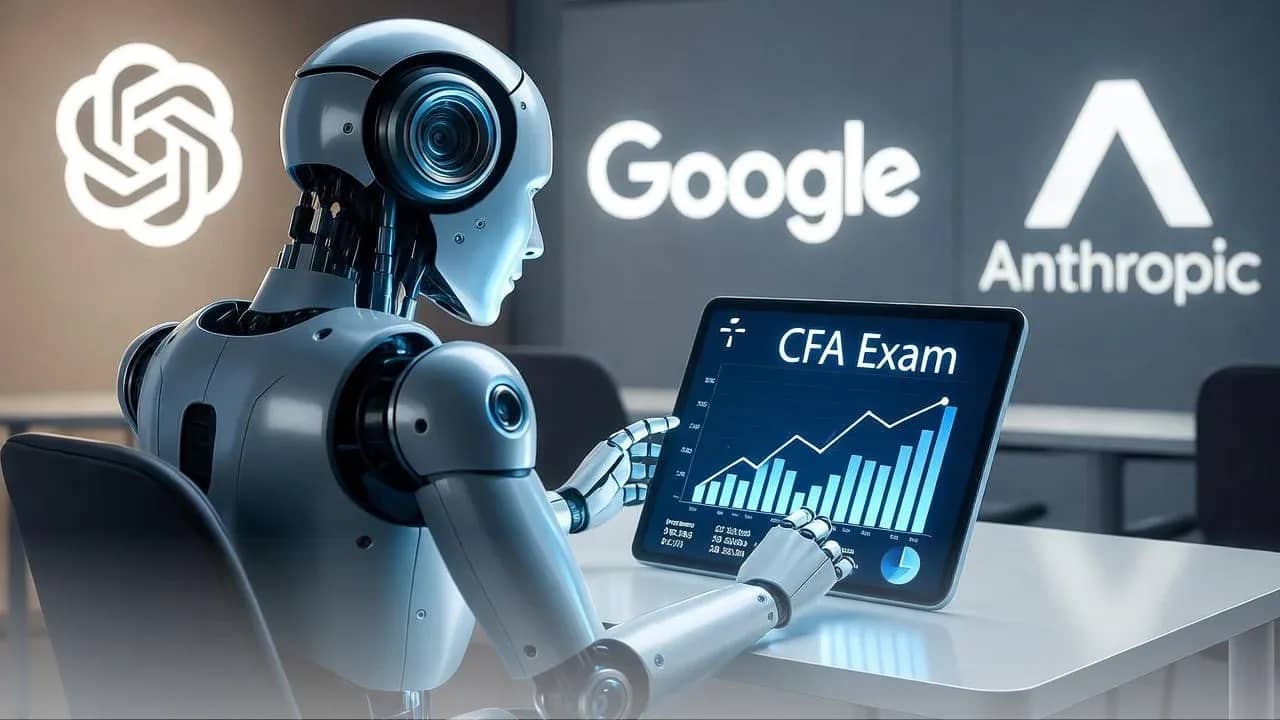
The Day Machines Conquered the CFA Exam
In September 2025, researchers from NYU Stern School of Business and GoodFin revealed something that shocked both technologists and financial professionals. Leading AI models from OpenAI, Google, and Anthropic passed all three levels of the Chartered Financial Analyst (CFA) exam, one of the toughest professional certifications in the world.
These AI systems didn’t cheat, memorize, or browse the web. They relied purely on their reasoning abilities. While human candidates spend over 1,000 hours preparing across several years, models like OpenAI’s o4-mini completed the exam in minutes, earning scores that surpassed the human passing threshold of 63 to 70 percent.
For the first time, machines achieved what even seasoned finance experts often struggle to do.
“Passing the CFA Level III exam without specific training shows that these models are beginning to demonstrate deep generalizable intelligence,” said Professor Srikanth Jagabathula of NYU Stern. “With the right design and oversight, this opens the door to a future where sophisticated financial expertise can be delivered far more broadly and affordably.”
Fast Facts
- Date of Study: September 2025, Conducted by NYU Stern and GoodFin researchers.
- Breakthrough: AI models from OpenAI, Google, and Anthropic passed all three levels of the CFA exam.
- Performance: OpenAI’s o4-mini scored 79.1% on Level III, finishing in minutes instead of years.
- Significance: Marks a new milestone in financial reasoning and AI’s capacity for professional-level cognition.
- Limitations: Models still struggle with ethics, judgment, and emotional understanding.
Why the CFA Exam Is So Hard
The CFA is not just another finance test. It is considered the gold standard of investment expertise, testing candidates on ethics, portfolio management, quantitative methods, and economics. The exam has three levels:
- Level I focuses on core concepts and quantitative tools.
- Level II requires analytical application in asset valuation.
- Level III demands synthesis, writing essay responses on real-world portfolio management cases.
Each level takes about 300 to 400 hours of preparation, and only about 45–50 percent of candidates pass. The Level III essay portion, long feared even by professionals, requires clear reasoning, judgment, and human-like insight.
That was the part AI models used to fail. Until now.

How AI Pulled It Off
The NYU–GoodFin team tested 23 large language models, including OpenAI’s o4-mini, Google’s Gemini 2.5 Pro and Flash, and Anthropic’s Claude 4 Opus. The exams were conducted using mock CFA materials from reputable providers like AnalystPrep, ensuring the tests matched real difficulty levels.
Models answered both multiple-choice and essay-style questions without calculators, plug-ins, or external data. Human and automated graders assessed their responses based on CFA standards.

Each model completed all three levels in a fraction of the time a human would. Their essays, written using chain-of-thought reasoning, displayed structured logic, portfolio synthesis, and accurate analysis, traits that define financial intelligence.
“We started by thinking about the capabilities of LLMs in specialised, high-stakes domains,” explained Jagabathula. “Passing the CFA Level III exam was the test of whether reasoning power extends to financial domains.”
Yet, even these “genius” AIs had limits. They occasionally faltered on ethics and ambiguous judgment calls, where human intuition still matters.
“There are things like context and intent that are hard for the machine to assess right now,” said Anna Joo Fee, CEO of GoodFin. “That’s where a human shines, in understanding your body language and cues.”
Reactions: Awe, Anxiety, and Skepticism
Jagabathula described the result as “a significant step forward in AI’s ability to reason in highly specialized, high-stakes domains.”
The financial world split between admiration and concern.
GoodFin’s CEO, Anna Joo, called it a “milestone in financial reasoning,” but stressed that AI lacks the emotional intelligence required for real-world decision-making.
Industry analysts agreed that while AI can process data at lightning speed, it cannot yet replace human advisors who interpret client goals, risks, and ethics.
On social media, reactions were mixed.
- Finance professionals on LinkedIn called it “inevitable but unsettling.”
- Reddit’s r/CFA users debated fairness: “We spend years studying, AI did it in minutes.”
- X (formerly Twitter) users simply said: “Crazy times.”
“These results are more than academic,” Joo Fee noted. “They point to a very immediate future where AI will drive transformation, but we still need human oversight to ensure those systems act ethically.”
The CFA Institute itself has not officially commented on this study. However, it hinted in past statements that exams may evolve to test judgment, ethics, and adaptability, skills machines still lack.
More details and interviews can be found in the Financial Times and InvestmentNews coverage of the study.
What It Means for Finance Professionals
This breakthrough doesn’t make CFAs obsolete, but it changes what the credential means.
AI can already automate financial modeling, risk assessment, and compliance checks, tasks once reserved for analysts. Entry-level jobs could shrink, while demand grows for professionals who can supervise, interpret, and guide AI systems responsibly.
Future CFA candidates may need to master AI literacy as much as financial theory. Employers are expected to value “hybrid professionals”, those who combine human judgment with technological fluency.
Still, trust remains the biggest barrier. Financial advice affects lives, and regulators will likely insist that humans remain accountable for ethical oversight.
Related Insight: Discover how AI is quietly reshaping the future workforce before students even graduate.
Beyond Passing Exams: Can AI Be Trusted With Money?
Passing the CFA exam shows reasoning ability, not wisdom.
AI’s accuracy depends on its training data. It can misread context, ignore moral nuance, and misjudge uncertainty, critical flaws in markets shaped by emotion and unpredictability.
Even the study’s authors warned that AI’s logic is mechanical. While models demonstrated brilliant reasoning on structured problems, they struggled with gray-area ethics and client-based decisions that require empathy.
Jagabathula noted that even when LLMs were used as graders, they often evaluated essays “more strictly than humans,” revealing that AI consistency doesn’t necessarily equal human understanding.
Regulators will have to answer hard questions:
- Should AI be licensed or certified to provide financial advice?
- Who is responsible if an AI makes a harmful investment decision?
The study’s takeaway is clear, AI can analyze, but it cannot care.
A New Era of Financial Intelligence
This moment marks more than a technical victory. It’s a cultural shift.
As Jagabathula put it, “We’re now seeing reasoning that once required years of specialized training emerge naturally in machines. That challenges what we’ve always defined as expertise.”
Just as Deep Blue beating Garry Kasparov in 1997 redefined intelligence in chess, AI passing the CFA exam challenges what it means to be “expert” in finance.
Today’s machines can reason, write, and justify decisions that once required human cognition. Yet, they lack emotional depth and long-term accountability, two pillars of true financial stewardship.
For students, this is both a warning and an opportunity. The grind of memorization is losing value, but the ability to think ethically, communicate clearly, and guide technology is rising fast.
For professionals, it’s a reminder that the future of finance isn’t man versus machine, it’s man with machine.
Key Takeaway
AI models like o4-mini, Gemini 2.5 Pro, and Claude 4 Opus didn’t just pass a test. They redefined the frontier between knowledge and reasoning in financial analysis.
Humans once spent years preparing for an exam that only a few could conquer. Now, a machine can do it in minutes, but it still needs us to decide what’s right.
“AI didn’t just pass the CFA exam. It passed a milestone in human history.”
Explore Next: Read how a tragic case sparked the first major lawsuit over AI responsibility.
FAQs
Researchers from NYU Stern and GoodFin used standard CFA-style mock exams to test leading AI models like OpenAI’s o4-mini, Google’s Gemini 2.5 Pro, and Anthropic’s Claude 4 Opus. These models relied on their built-in reasoning and financial knowledge, no fine-tuning, browsing, or external data were used. They completed all levels within minutes, proving how far general reasoning in AI has advanced.
Not yet. While AI can analyze data, model portfolios, and generate insights faster than humans, it still struggles with ethics, empathy, and real-world judgment. Financial advising requires emotional intelligence, regulatory awareness, and moral reasoning, areas where humans remain essential. Experts suggest the future will favor “hybrid professionals” who combine human judgment with AI tools.
The CFA Institute has not officially commented on this specific study. However, it has acknowledged AI’s growing influence in finance and hinted that future CFA exams may evolve to test ethics, adaptability, and human judgment more rigorously. The organization continues to emphasize that ethical reasoning and trust remain irreplaceable in financial decision-making.
References
- Shetty, P. et al. Advanced Financial Reasoning at Scale: A Comprehensive Evaluation of Large Language Models on CFA Level III. FinLLM@IJCAI, 2025.
- CFA Institute, CFA Level III Exam Overview, 2025.
- GoodFin–NYU Joint Research Release, 2025.
Disclosure: We may earn a commission when you make a purchase through the ads.
The weekly question
From obsession to clarity — one original question every week.
We answer one noisy topic at a time, in full. No daily roundup, no thread bait — just the question, the principles, and the system.