
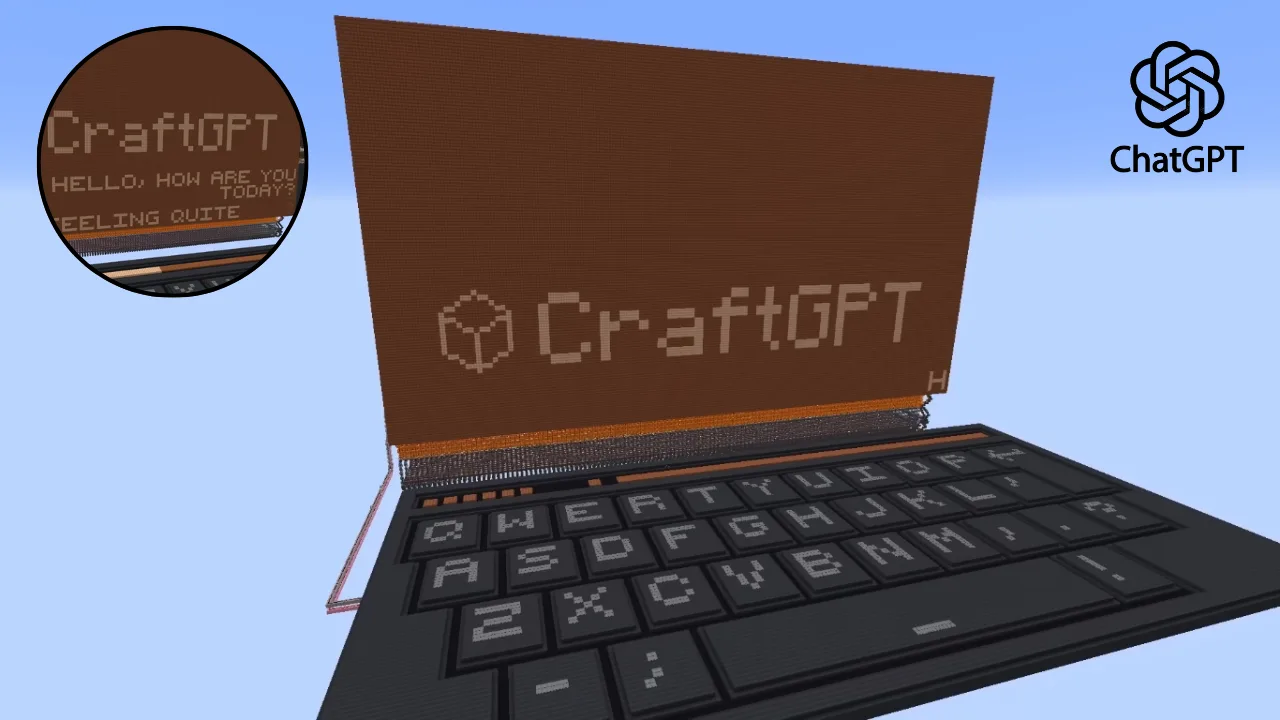
In late September 2025, a Minecraft video spread across YouTube with a claim that sounded impossible. Sammyuri, a well-known Minecraft redstone engineer, had built a working 5 million parameter transformer-based AI model entirely inside the game. The project, called CraftGPT, runs on nothing but redstone circuits, Minecraft’s in-game wiring system.
The build spans an area of 1,020 by 260 by 1,656 blocks, totaling more than 439 million blocks. It includes tokenizers, attention layers, feedforward networks, and output decoders, all inside the blocky world. While not the real ChatGPT, it simulates a ChatGPT-style AI model, marking the most complex redstone computer ever made and proving that Minecraft can go far beyond farms and castles.
Fast Facts
How Redstone Became a Supercomputer Inside Minecraft
Redstone in Minecraft works like digital wiring. Dust carries current, repeaters extend signals, and torches invert logic. By combining these elements, players can build logic gates like AND, OR, and NOT. These gates then scale up into CPUs, memory banks, and even entire computers.
Sammyuri has a long history of pushing this idea. In 2021, he built CHUNGUS 2, a redstone CPU that could handle basic graphics. In 2022, he shocked fans with Minecraft in Minecraft, a recursive simulation of the game inside itself. In 2024, he followed with a full-color version. CraftGPT is the next step, turning redstone not just into a CPU, but into a system capable of running a modern transformer model.
The Sheer Scale: 5 Million Parameters, 439 Million Blocks
CraftGPT includes six transformer layers, 240-dimensional embeddings, and a vocabulary of 1,920 tokens. Each weight in the model is hardcoded into Minecraft as a redstone circuit, making the entire AI a giant physical structure inside the game.
- Parameters: 5,087,280
- Vocabulary size: 1,920 tokens
- Layers: 6
- Context window: 64 tokens
- Block count: ~439 million

Without modifications, one token would take about 9 years to process at Minecraft’s standard speed. Using a redstone-optimized server called MCHPRS, the tick rate can be accelerated, cutting generation time to about 2 hours per token. That speed makes it clear: CraftGPT is not practical, but its sheer scale makes it a world-first achievement.
Can It Really Talk Like ChatGPT?
The short answer: no. CraftGPT does not run OpenAI’s ChatGPT. It simulates a ChatGPT-style AI model at a vastly smaller scale. The model was trained externally on a small dataset called TinyChat, which contains simple English conversations.
The results are closer to a toy chatbot than a digital assistant. For example, it can handle short exchanges like:
- “How are you today?” → “I am feeling quite happy today, thank you for asking.”
- “What color is the sky?” → “The sky is bright blue, and the sky looks very beautiful.”
Beyond a few tokens, however, it starts to ramble, repeat itself, or produce nonsense. It cannot write essays, solve problems, or reason like ChatGPT. The goal was not usefulness but demonstration. As Sammyuri put it, “AI is just math on blocks, so why not show it inside Minecraft?”

The Human Effort Behind the Blocks
The project took Sammyuri several months of focused work. After a three-year break from major redstone builds, he returned with CraftGPT, citing a desire to test the limits of what redstone could achieve. He worked mostly alone, using creative mode for block placement and external tools like Python for training the model.
He engineered the circuits by hand, then relied on MCHPRS to run them at scale. Each parameter of the model, over five million in total, was placed as a fixed configuration of redstone blocks, repeaters, and torches. The build demonstrates not only technical mastery but also extreme patience.
Curious about how AI is changing robotics? Read how this AI robot brain learns in real time .
How CraftGPT Compares to Real AI
To put CraftGPT into perspective, here’s a direct comparison to ChatGPT’s latest models:
| Aspect | CraftGPT | ChatGPT (GPT-4) |
|---|---|---|
| Parameters | 5M | ~1.76T |
| Layers | 6 | 120+ |
| Vocabulary | 1,920 tokens | 100K+ tokens |
| Context window | 64 | 128K+ |
| Speed | 2 hours per token | Milliseconds per token |
| Output | Basic small talk | Essays, code, reasoning |
CraftGPT cannot compete with modern AI. Instead, it serves as an educational proof of concept, showing how transformer components, like embeddings and attention, can be mapped into a tangible system anyone can see and explore.
Community Reactions: From Memes to Awe
The community response was explosive. On Reddit, fans called it “the most advanced redstone build ever.” Memes compared its speed to waiting for crops to grow in-game. On YouTube, the reveal video quickly gained hundreds of thousands of views, with comments praising both the absurdity and brilliance of the project.
AI enthusiasts also took notice. On forums like r/LocalLLaMA, users marveled at the patience required and joked about having an “existential crisis” after realizing how universal transformer math is. Tech outlets from PC Gamer to Tom’s Hardware covered it as a cultural crossover between gaming and artificial intelligence. Others framed it as someone built an AI chatbot inside Minecraft, sparking further debates about what creativity in games really means.
What It Means for the Future of Games and AI
CraftGPT shows that Minecraft is more than a sandbox game. It can serve as a laboratory for concepts that shape our digital world. While larger models in Minecraft may remain impractical, the educational potential is clear. Students and hobbyists can visualize how AI works by walking through circuits and gates rather than just reading equations.
The project also highlights the growing overlap between creativity and computation. Games are becoming platforms for exploration in science and engineering. As one fan put it, “Sammyuri didn’t just build an AI, he turned Minecraft into a classroom for the future.”
Final Thoughts
CraftGPT will never replace ChatGPT, nor was it meant to. Instead, it stands as one of the most ambitious and creative feats in Minecraft history. By turning redstone dust into a transformer AI, Sammyuri has shown that technology and imagination can meet in unexpected ways. It is slow, impractical, and flawed, yet it captures the spirit of why millions love Minecraft: turning simple blocks into something extraordinary.
Concerned about AI’s real-world consequences? Read about the lawsuit against OpenAI over a tragic death .
FAQs
Building an AI in Minecraft is important because it makes complex concepts like transformers and machine learning easier to understand. Instead of abstract math or hidden code, players can see how data flows through logic gates and memory in a visible, interactive way. It also shows the versatility of Minecraft as more than a game, it can serve as an educational platform for computer science and artificial intelligence.
In theory, larger AI models could be built in Minecraft by adding more layers and parameters. However, practical limits like game performance, storage requirements, and build time make it unrealistic. Even CraftGPT, with 5 million parameters, takes hours to generate a single token when accelerated. Scaling to tens or hundreds of millions of parameters would require massive server resources and is unlikely to be usable.
Sammyuri’s AI build was only feasible with the help of tools like MCHPRS, a high-performance Minecraft server designed to run redstone at accelerated tick rates. Without it, one token could take nearly a decade to process. Players also use creative mode, schematic editors, and visualization mods to design and manage such large builds. These tools allow redstone engineers to go beyond small circuits and explore advanced projects like CPUs, calculators, and now transformer AI models.