
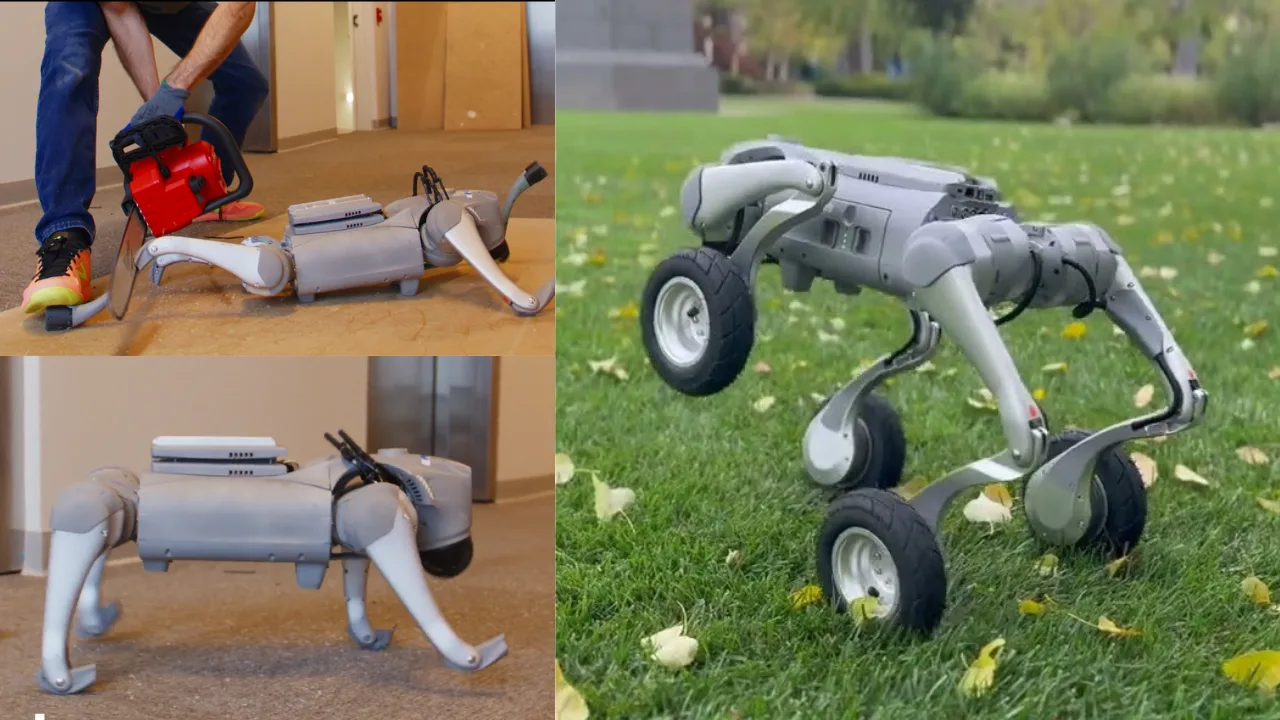
In mid-2025, a demo clip spread quickly across social media. A four-legged robot had one of its legs chainsawed off. Instead of collapsing, it staggered, adjusted, and kept walking. The system behind this resilience was Skild Brain, an AI model from California-based Skild AI.
Traditional robots fail when damaged. They rely on rigid control programs fine-tuned for a single machine. Skild Brain rewrote the rules by showing how robots could survive damage, adapt instantly, and continue moving as if nothing happened. For many, this looked like the start of a new era of machines that refuse to quit.
We built a robot brain that nothing can stop.
— Skild AI (@SkildAI) September 24, 2025
Shattered limbs? Jammed motors? If the bot can move, the Brain will move it— even if it’s an entirely new robot body.
Meet the omni-bodied Skild Brain: pic.twitter.com/DkFXhq3ZbF
How Skild AI’s Robot Brain Actually Works
At its core, Skild Brain is a foundation model for robotics. It is not tied to any one machine. Instead, it processes raw vision from cameras and sends direct commands to motors or joints. The model is based on transformer architectures, the same family of AI systems that power large language models, but redesigned for movement and balance.
The difference lies in scale. Skild trained the brain on a “multiverse” of 100,000 robot bodies in simulation, running the equivalent of 1,000 years of practice. By exposing it to countless variations in gravity, friction, and body design, Skild forced the AI to develop strategies that generalize. It cannot simply memorize. It must adapt.
When deployed in the real world, the brain uses two kinds of memory. Long memory is encoded in its parameters, allowing recall of general skills like walking, balancing, or climbing. Short memory comes from in-context learning, where the model uses the last few seconds of actions as a prompt to refine its next moves. This means a robot can sense when something changes, like a jammed wheel or locked joint, and reconfigure its gait in seconds.
The result is an “off-the-shelf” brain that can be installed on different robots without retraining. A quadruped, a humanoid, or a wheeled platform can all tap into the same intelligence.
Robots That Refuse to Quit
Skild AI’s demos are designed to impress, and they succeed. One shows a robot climbing stairs while balancing a box. Another features a quadruped navigating clutter, stooping to pick up objects without falling. The most dramatic clips highlight damage:
- Loss of limbs: Robots adapt within 7–8 seconds to missing legs, swinging remaining joints with new patterns.
- Broken legs: When knees are locked, robots learn to walk like three-legged creatures.
- Jammed wheels: The brain switches seamlessly from rolling to walking and back.
- Walking on stilts: Even when legs are artificially lengthened, the AI recalibrates balance and stride.
These feats set Skild apart from earlier robotics labs. Boston Dynamics produced stunning backflips, but those machines failed when joints broke or terrain shifted. Skild Brain survives change.
Still, limits remain. Robots cannot recover from total power loss or navigate in total darkness without added sensors. And while lab tests are compelling, no third-party audits have yet confirmed the results outside controlled conditions.
From Warehouses to War Zones
The appeal of such adaptability is obvious. In warehouses, robots often break or collide. Downtime costs money. With Skild Brain, machines could adjust on the fly, saving repairs and reducing accidents. In manufacturing, robots could handle tasks even if parts wear down.
Rescue and disaster response are also strong candidates. A robot that keeps moving after losing a wheel could search rubble where humans cannot. In healthcare, assistive robots might adapt to cluttered home layouts without constant reprogramming.
But the same qualities that make this brain valuable raise serious concerns. Robots that cannot be easily stopped could pose risks in shared spaces. Safety advocates stress the need for clear override mechanisms. Ethical debates also highlight military dangers. An “unkillable” drone, able to limp on after damage, would change the logic of warfare.
Regulators are beginning to react. The European Union’s new AI Act classifies adaptive robots as “high-risk,” requiring transparency and human oversight. U.S. executive orders on AI call for risk assessments of high-impact models. South Korea emphasizes voluntary compliance, especially for dual-use technologies. Skild has added force limits to prevent unsafe pressure, but details on hardware kill switches remain unclear.
Read how a Neuralink patient wrote her name after 20 years using only her thoughts.
Billions Behind the Brains
The business world has taken notice. In July 2024, Skild AI raised $300 million in Series A funding at a $1.5 billion valuation. By mid-2025, it secured $500 million in Series B, led by SoftBank with additional stakes from Nvidia, Samsung, and Amazon. That round pushed its valuation to $4.5 billion in just one year.
Compared to peers, Skild stands out for focusing on software brains rather than hardware bodies. Boston Dynamics builds cutting-edge machines but is limited to its own robots. Figure AI combines humanoids with AI but is more factory-oriented. Agility Robotics focuses on bipedal delivery. Skild wants to be the “operating system” for all of them.
Pilots are underway. LG CNS is testing Skild Brain in industrial automation. Logistics partners are experimenting with adaptability in warehouses. Although no government or healthcare trials have been confirmed, the roadmap points toward broader deployment in 2026.
Awe, Fear, and Debate
Public reaction reflects a mix of wonder and worry. Headlines like “This AI Robot Keeps Going Even if You Attack It With a Chainsaw” fueled viral debate. Videos earned millions of views across X, Reddit, and YouTube.
On Reddit’s r/singularity, users praised the leap toward true general intelligence, while others called it “stomach-turning.” Hacker News threads debated job loss and the danger of machines that can ignore damage. Logistics workers saw promise for safety but also threats to employment.
Experts are similarly divided. Robotics researchers celebrate Skild’s use of large-scale simulation to overcome brittleness. AI ethicists caution that resilience without strict oversight could lead to uncontrollable systems. Military analysts note that adaptive drones may destabilize conflicts.
Could the AI arms race trigger a real-life Terminator scenario? Discover James Cameron’s chilling warning here.
Should We Fear or Embrace Robots That Survive Damage?
Skild AI’s work signals a turning point. Robots are no longer brittle tools that collapse at the first sign of trouble. They are edging toward machines that adapt like living organisms. This adaptability could save lives in disasters, improve safety in factories, and reduce costs in logistics.
Yet the same power demands new safeguards. Society must decide how much autonomy is acceptable, how to enforce human control, and how to prevent misuse. As one ethicist put it, “We are teaching machines the first lesson of biology: survival.”
Whether Skild Brain becomes the backbone of a trillion-dollar robot economy or the start of more troubling machines, its message is clear. Adaptation, once biology’s secret, now belongs to robotics too.
FAQs
Skild Brain uses in-context learning, where it analyzes short logs of recent actions and adjusts behavior without retraining. This allows robots to adapt in seconds to changes like a jammed wheel, broken limb, or altered terrain. Its long-term memory, built from vast simulation data, gives it a foundation of general skills such as walking and balancing.
The first industries likely to adopt Skild Brain are logistics and manufacturing, where machines must navigate cluttered environments and withstand breakdowns. Rescue operations, disaster response, and healthcare robotics are also strong candidates, since adaptable robots can keep working under unpredictable conditions and reduce risk to human workers.
Skild AI has included force limits to prevent unsafe movements, but critics stress the importance of clear kill switches and human oversight. Regulators such as the European Union classify adaptive robots as “high-risk,” requiring strict transparency and safety controls. While the technology is promising, safety standards will play a key role in its adoption.
A U.S. visitor saw 915 robot legs in China, what they witnessed might reshape robotics. Read more here.