Left Field After Shark Tank: What Happened to the Dating App?
Left Field won an on-air deal from Kendra Scott and Alexis Ohanian. Its iPhone listing disappeared weeks later. Here’s what the records show.

A friend introducing two people usually offers a reason. They grew up in the same town, keep going to the same restaurant or both know someone who thinks they would get along. Left Field tried to put that missing sentence back into online dating. An introduction could begin with something two people recognized before either had to think of an opening line.
That idea appealed to Kendra Scott and Alexis Ohanian on Shark Tank. But the question for someone discovering the episode today is simpler: can you still try the app? The iPhone listing that followed the pitch is now archived. Its last recorded update came just five weeks after the broadcast. For prospective users, the news about availability matters more than the size of the offer. For founders, the short gap between those events makes Left Field a case in how much a national audience can, and cannot, tell you about demand in a single neighborhood.
$200,000
Cash offered on air
Samantha Martin and Kate Sieler asked for 5%. Kendra Scott and Alexis Ohanian negotiated 8% plus 4% in advisory shares.
5,000
Users reported at filming
The founders gave this count after the February 2025 launch. They did not report how many were daily active users.
Archived
Original iPhone listing
Two app directories place the listing’s disappearance in early March 2026. A relaunch remains unverified.
Product snapshot
| Field | Detail |
|---|---|
| Product | Left Field Dating App |
| Founders | Samantha Martin, Kate Sieler and technical co-founder Sean Miller |
| Market | Social discovery and dating, initially associated with New York |
| Platform | iPhone, originally listed under app ID 6738966547 |
| Episode | Shark Tank USA, Season 17, Episode 10, January 21, 2026 |
| Status | Original app listing archived. Current operations and any relaunch remain unconfirmed. |
How did Left Field match people?
Left Field suggested people whose lives already overlapped. A shared hometown or favorite neighborhood spot gave the app something more specific to say than a percentage match. The archived developer description promised two rounds of curated introductions each week and a short explanation for each pairing. The format deliberately limited how much browsing a user could do.
The pitch also described neighborhood-level notifications. Two people could learn they were in the same general area without the app giving them a street address or promising that an encounter would happen. Those are different product choices: shared history makes an introduction feel familiar, while proximity can make the prospect of meeting feel immediate. Some viewers welcomed that immediacy. Others asked how much information a stranger could infer. TV Insider’s episode reporting
“We put safety first by only sharing information at a vague neighborhood level.”
— Kate Sieler and Samantha Martin, as reported by TV Insider
The founders’ explanation sets a limit on the precision they said the app disclosed. For a user deciding whether to join, another consideration is how distinctive the other clues are. The same favorite spot can feel like an easy conversation starter to one person and too much information to another. An introduction depends on both people being comfortable with what they learn about each other.
Who founded the Left Field dating app?
Samantha Martin and Kate Sieler pitched Left Field together. Sean Miller joined as technical co-founder. The team drew on frustration with trying to meet people organically in New York. Martin’s launch announcement described the exhaustion of swiping and encountering paywalls while still looking for a connection that felt natural.
That problem shaped their definition of a useful match. Consider two strangers shown the same portrait. Neither has much to work with beyond appearance. Add a detail about a place they both used to live, and each has a question they can ask without inventing a pickup line. Left Field was betting that the explanation accompanying an introduction would change what happened after someone opened it.
The founders had to solve a second problem that rarely shows up in a profile screenshot. One person can complete an attractive profile alone. A matchmaking service only becomes useful when enough other compatible people have also joined, shared information and remained available in the same place. Launching in a large city made it possible to work on that problem one community at a time.
What did the Sharks offer Left Field?
Martin and Sieler asked for $200,000 for 5%, implying a $4 million valuation after investment. They reported about 5,000 users at filming, following the February 2025 launch. The figure describes the scale the founders reported at that point. It does not give the number of paid subscribers, introductions accepted or dates arranged. Global Dating Insights
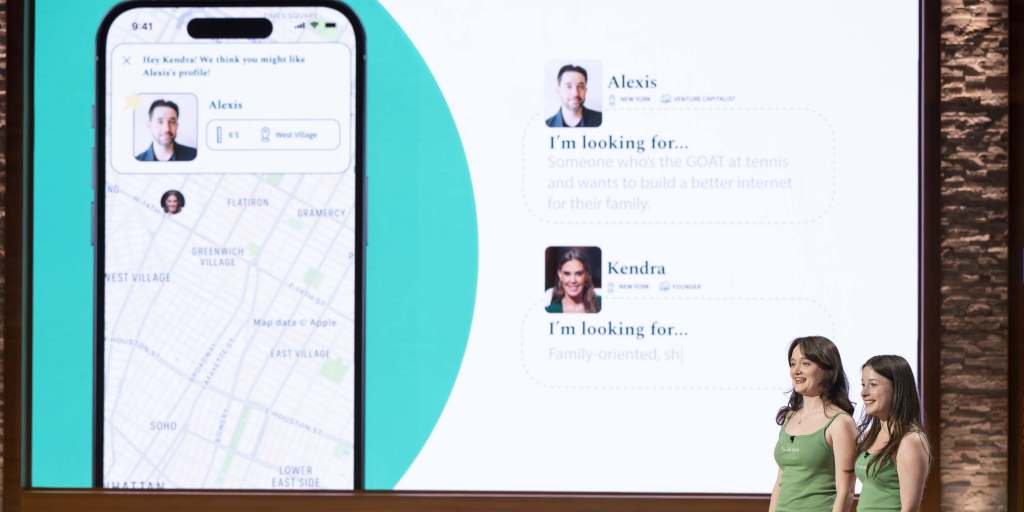
Left Field on Shark Tank Season 17. Source: Shark Tank via Moviedelic.
Scott and Ohanian reached an agreement for $200,000 for 8% equity plus 4% in advisory shares. Keeping the two pieces visible matters. A reader who sees only the 8% misses part of the ownership promised to the investors. A reader who values the entire 12% as a straight cash purchase loses the distinction the parties made between capital and advice.
Deal snapshot
| Stage | Terms | Meaning |
|---|---|---|
| Opening ask | $200,000 for 5% | $4 million implied post-investment valuation |
| Accepted cash terms | $200,000 for 8% | $2.5 million implied on the cash component alone |
| Advisory component | An additional 4% in advisory shares | Separate from the cash component in reports of the televised agreement |
| After filming | No final documents or founder confirmation of disbursement identified in the sources reviewed | The on-air agreement is established. The completed terms remain unclear. |
Fellow Episode 10 company Crowd Compass also sold a way to bring people together. Its customers could buy two devices and choose whom to pair with before going out. Left Field had to supply an introduction between people who did not yet know one another. That difference changes what an investor needs to ask about growth. The two appeared in the Shark Tank Season 17 directory.
How did the business model work?
The archived iPhone listing describes a free app. The sources reviewed do not establish a recurring subscription business or verified revenue. A free download made it easier for a user to invite friends. It also left the founders needing a way to support the cost of matching, customer service and moderation as the network grew.
Business model snapshot
| Question | What the evidence shows |
|---|---|
| Who was it for? | Singles looking for introductions grounded in local or social overlap |
| Why sign up? | A small number of suggestions with an explanation of the connection |
| How did users find it? | The iPhone store, founder outreach, social exposure and national television |
| What was the entry price? | The archived listing identifies it as free |
| What remains undisclosed? | Revenue, paid conversion, retention and the cost of acquiring an active local member |
Two introductions a week is a concrete promise. It also creates an operational test. If suitable people join at different rates across age groups, neighborhoods or dating preferences, an app can have thousands of accounts and still struggle to make two good suggestions for a particular member. The metric an operator would want is the share of eligible people who actually received a relevant introduction each week.
For comparison, Makers Social can host an evening for a group that already knows whom it wants to spend time with. Cabana Boys Events can take a reservation from the person organizing that group. A dating app must help create the relationship before it can demonstrate that its service worked.
What happened to Left Field after Shark Tank?
Latest update — November 12, 2026. The original Left Field iPhone listing is archived. AppBrain records removal on March 1, 2026. AppsHunter last saw the listing on March 6. The records agree on the practical outcome for a new user seeking the original app. No verified replacement download was identified.
That timing is easy to miss if the only source a reader sees is a January episode recap. The app was available around the broadcast, and the archived version history shows another software update in late February. An article written when the episode aired could accurately describe a download that a reader returning several weeks later could no longer obtain. AppBrain listing history
Later coverage also recorded a company notice saying the platform was taking a break and announcing deletion of user data. The disappearance of a store listing supplies evidence about distribution. It does not establish the cause of the pause, whether the legal entity dissolved, what happened to any investment or whether data deletion was completed. Those questions would require different evidence.
Current status evidence
| Evidence | What it establishes |
|---|---|
| Archived developer listing | The original app described curated introductions and was free to download |
| February 26 version history | A software update followed the January broadcast |
| Early-March store tracking | The original public iPhone listing disappeared |
| Contemporary reporting of a pause | The service was reported to have paused. A permanent closure date remains unverified. |
Company timeline
| Date | Milestone |
|---|---|
| February 2025 | The iPhone app launched. |
| At filming | Founders reported about 5,000 users. |
| January 21, 2026 | The episode aired with the joint offer from Scott and Ohanian. |
| February 26, 2026 | The last archived update, version 2.1.7, appeared. |
| March 2026 | App trackers recorded removal or last availability in the first week. |
| November 2026 | The original listing remains accessible as a historical record. |
Can you download Left Field today?
The available archived listing preserves the original screenshots, developer description and version history. It is useful for identifying the product that appeared on television. It does not provide a verified current route to start receiving introductions. The app ID is a more reliable way to identify that product than its two-word name.
What can founders learn from Left Field?
The founders gave users a clear reason to open an introduction. They also chose a design that could be judged quickly: a suggestion either contained a meaningful shared detail or it did not. For a young company, that clarity is valuable. It turns a broad ambition about better dating into a question a user can answer about a particular recommendation.
The harder question is what happened next. A useful study would follow a group of new members through their first several introductions. How many received one? How many started a conversation? Did both people want to meet? None of those answers can be inferred from 5,000 sign-ups. The broadcast established interest from two investors. The surviving store records tell us what customers could obtain afterward. Keeping those two kinds of evidence separate makes the history more useful than a headline declaring the app a success or a failure.
Frequently asked questions
Who pitched Left Field? Samantha Martin and Kate Sieler appeared on the show. Sean Miller was a technical co-founder.
Which Sharks made the deal? Kendra Scott and Alexis Ohanian agreed to the cash and advisory terms on air.
Was it free? Yes. The original iPhone listing identified it as free to download.
Did it show a person’s exact location? The founders said they shared approximate neighborhood information.
Is Left Field still on the App Store? The original listing was archived in March 2026. A replacement listing remains unverified.
The weekly question
From obsession to clarity — one original question every week.
We answer one noisy topic at a time, in full. No daily roundup, no thread bait — just the question, the principles, and the system.