
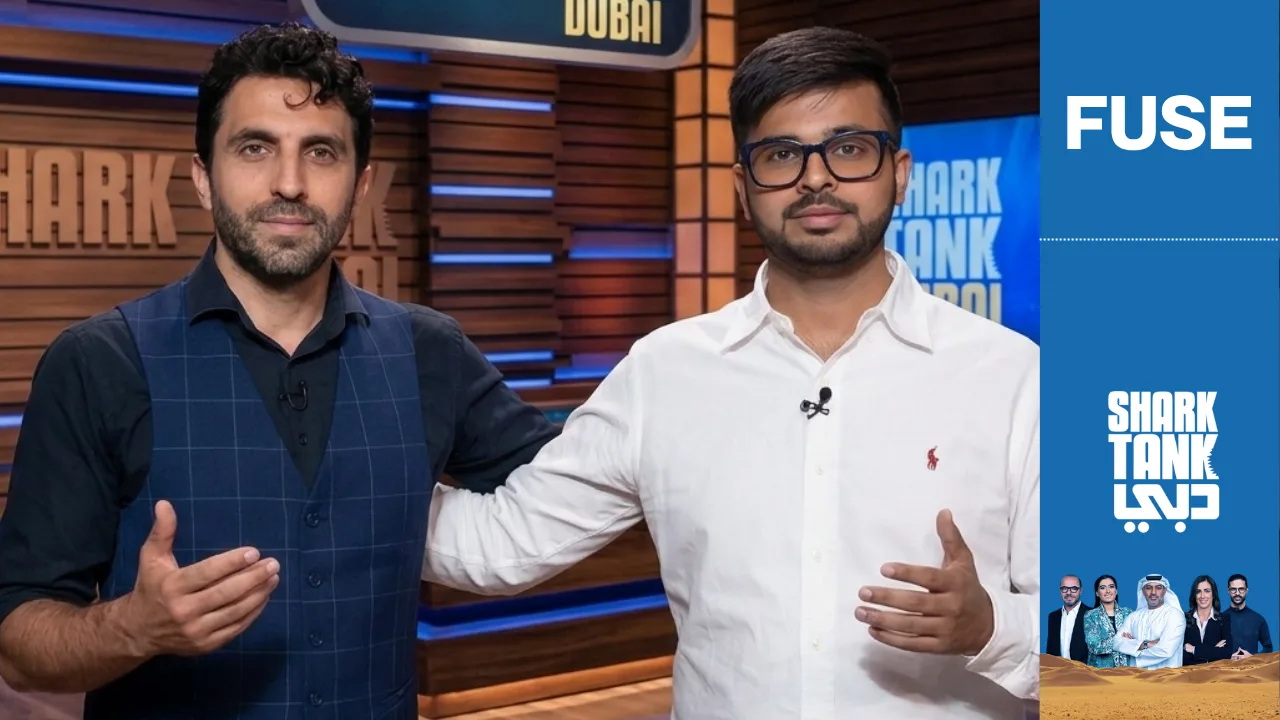
Fuse converts old cars into EVs cheaper than buying new ones. A bold Shark Tank Dubai idea tackling 1.6 billion vehicles. Most conversations about electric vehicles focus on building something new. But the real problem is already on the road.
There are 1.6 billion internal combustion engine vehicles worldwide. Even if every manufacturer switched to EVs today, replacing them would take decades.
That gap between ambition and reality is where Fuse steps in. Instead of joining the race to build new EVs, they are solving a much bigger and more urgent challenge.
Fuse was built by two engineers who refused to follow the usual path. Salman, a mechanical engineer from Imperial College London originally from India, partnered with Mihai, an electrical engineer from Romania.
Together, they questioned the core assumption behind the EV revolution. Instead of asking how to build more cars, they asked a simple but powerful question.
Why are we replacing cars at all?
That shift in thinking led to a completely different solution.
Don’t Replace the Fleet Rebuild It with a Scalable IKEA Model
The traditional automotive model is simple but wasteful. Old cars are scrapped, and new ones are produced. This cycle creates both environmental damage and financial pressure.
Instead of replacing them, they reconstruct them. They keep the body, chassis, and structure, and replace only the engine with an electric system.
The founders explained this clearly during their pitch. “There are 1.6 billion cars on the road today. We can’t just throw them away and replace them with new vehicles.”
This idea transforms a global problem into a practical opportunity. It also aligns with Dubai’s push toward sustainability and smarter infrastructure.
Electric conversion itself is not new. But it has never scaled well due to cost, time, and complexity. Fuse solves this using what can be described as an IKEA model for EV conversion.
They provide a plug-and-play kit and shift the labor to the customer. Instead of building large workshops, Fuse trains the client’s existing technicians.
Fleet owners already have maintenance teams and Fuse simply empowers them with the tools and knowledge.
This approach removes the biggest bottleneck in the industry. It turns a slow, specialized process into something repeatable and scalable.
The 72,000 AED Breakthrough and the Smart Strategy Behind It
In Dubai, every business decision starts with a simple question.
How much does it cost?
Their pricing completely changes the equation for fleet operators. Fuse delivers a clear and surprising answer.
- New Electric Van → 160,000 to 200,000 AED
- New Petrol Van → 120,000 to 140,000 AED
- Fuse Conversion → 72,000 to 100,000 AED
This means businesses can switch to electric for less than buying a petrol vehicle. That is a powerful shift in value perception.
Fuse also claims a 20 percent reduction in total cost of ownership, while maintaining 50 percent gross margins and 20 percent net margins. This shows that sustainability does not have to come at a financial loss.
Another key part of their strategy is less obvious but equally important. They focus on vehicles that are one generation older instead of new models.
This avoids the biggest fear for car owners. Modifying a new vehicle often voids the manufacturer’s warranty. By targeting older vehicles, Fuse eliminates this risk completely.
To build trust, they offer a five-year unlimited kilometer warranty on the new electric system. This effectively gives older vehicles a second life and turns depreciating assets into productive ones again.
Shark Tank Dubai Pitch Summary
| Company | Fuse |
| Founders | Salman Hussain (India), Mihai Stempia (Romania) |
| Core Idea | Convert petrol vehicles into EVs using plug-and-play kits |
| Problem | 1.6 billion ICE vehicles cannot be replaced fast enough |
| Solution | Affordable EV conversion instead of buying new cars |
| Price | 72,000 – 100,000 AED |
| Revenue | 1.5 million AED |
| Ask | 5.8 million AED for 15% equity |
| Valuation | 38.6 million AED |
| Warranty | 5 years, unlimited km |
| Outcome | No deal |
Why the Sharks Said No and Why the Idea Still Fits Dubai
Despite strong numbers and a working product, the Sharks chose not to invest.
The issue was not the technology or the concept. It was timing.
The valuation of 38.6 million AED raised concerns, but the deeper issue was whether the market was ready for this shift.
As one Shark explained during the discussion, “Consumer behavior change always takes time, and that’s a lot more about luck than wisdom.”
This highlights a key reality in business. A great idea can still struggle if the market is not ready to adopt it.
However, the concept fits naturally into Dubai’s ecosystem. People in the UAE show strong buying intent. They quickly search for price, availability, and delivery options. Fuse already provides clear answers to these questions.
Dubai is also a city full of entrepreneurs. Many viewers do not just see a product. They see a business opportunity. Fleet owners immediately think about how they can use or scale this model.
Most importantly, Fuse combines sustainability with profitability. Many green solutions fail because they are expensive. Fuse makes sustainability cheaper, which makes adoption more realistic.
Final Thought The Future Might Already Be Parked Outside
Fuse is not just selling conversion kits. It is challenging how we think about innovation.
Instead of building something new, it improves what already exists. That idea challenges industries built around replacement and consumption.
It also raises an important question for founders and investors.
Is the future about creating new products, or about rethinking the ones we already have?
Most people believe the future of transport is waiting in factories and showrooms. Fuse believes the future is already parked outside.
It is to transform the ones already on the road.
And in a fast-moving, opportunity-driven market like Dubai, that idea may not just be early. It may be exactly what comes next.