
In Dubai’s fast-moving business world, your first impression can open doors instantly. Yet millions still rely on paper business cards that become outdated within weeks.
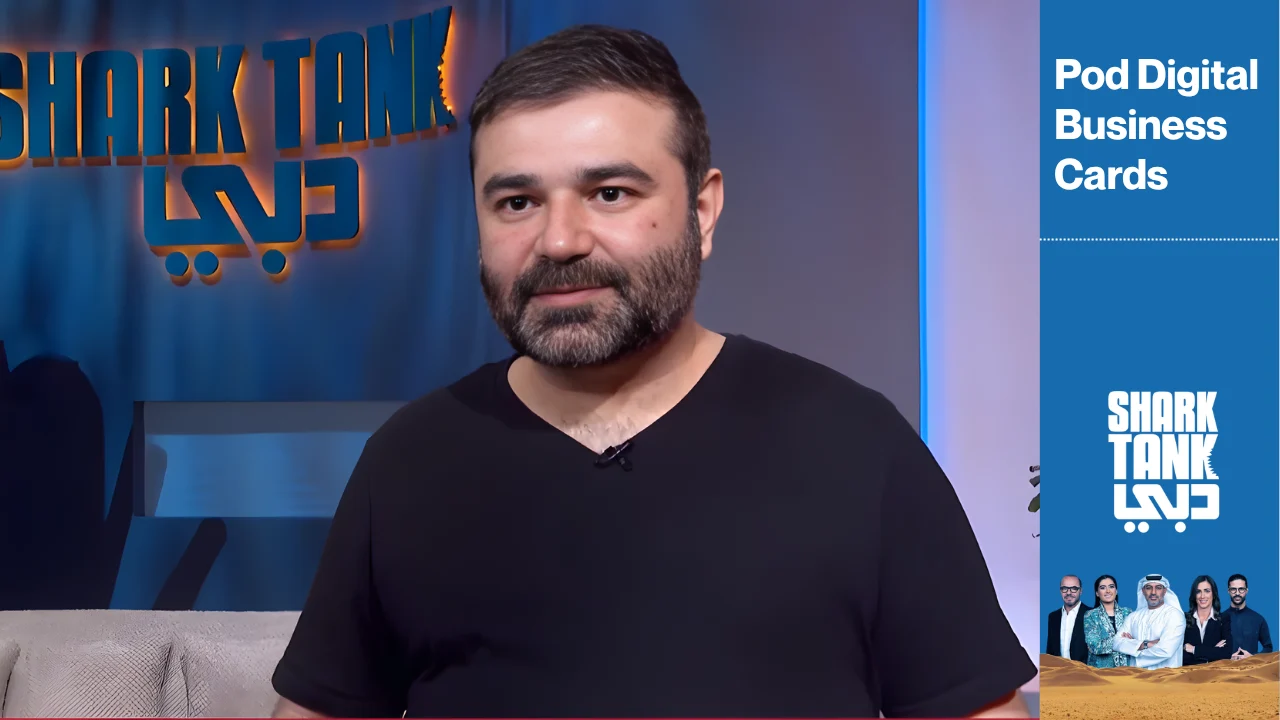
That is the problem Faisal Al Naqbi walked into Shark Tank Dubai to solve with Pod Digital Business Cards. His idea was simple but powerful. Replace outdated cards with smart, trackable digital connections that evolve in real time.
“The outdated card is no longer just a minor inconvenience; it is a data silo that fails to reflect the real-time nature of modern business.”
But this pitch was not just about business cards. It was about redefining how people connect, track, and measure relationships in a digital-first economy.
Shark Tank Dubai Pitch Summary
This pitch stood out because it combined a simple everyday problem with a broader vision for the future of networking. Instead of focusing only on digital cards, Faisal introduced an ecosystem that connects identity, tracking, and business intelligence. The summary below gives a clear snapshot of the opportunity presented to the Sharks.
| Category | Details |
| Company | Pod Digital Business Cards |
| Founder | Faisal Al Naqbi |
| Business | Digital Business Cards + NFC Tags |
| Core Products | NFC Cards, Keychain Tags, Smart Tracking Tags |
| Unique Value | Unlimited updates + real-time sharing |
| Target Market | Middle East & Africa |
| Investment Asked | 500,000 AED |
| Outcome | No deal |
| Shark Concern | “Feature, not a scalable company” |
Why This Problem Matters More in Dubai
In the UAE, networking is not optional. It is the backbone of business growth and opportunity creation. Deals often begin with a simple introduction, but the tools used to make those connections have not evolved at the same pace as the market itself.
Business cards become outdated instantly when employees change roles or companies rebrand. This creates unnecessary waste and weakens valuable connections. In Dubai’s fast-paced environment, this issue becomes even more critical because people actively search, verify, and often buy immediately.
Common user behaviors include searching for product availability, pricing in the UAE, and verifying whether something is real or a scam. This reflects a unique audience that values speed, trust, and clarity when evaluating new solutions.
The Pilot Who Took a Leap Most Avoid
Before entering the startup world, Faisal Al Naqbi had a stable and respected career as a civil pilot. His profession required precision, discipline, and risk awareness. These are qualities that translate well into entrepreneurship, but leaving that stability is never easy.
By resigning from his job, he made a bold and irreversible commitment. This decision reflects the level of conviction investors often look for in founders. In Dubai’s entrepreneurial culture, going all-in signals belief and long-term vision.
“I was a civil pilot and I had to resign from my job. I made this business.”
It also highlights a growing trend where professionals from traditional industries enter tech to solve everyday inefficiencies with fresh perspectives.
From Static Cards to Unlimited Digital Identity
Traditional business cards are static and limited. Once printed, they cannot adapt to changes in a person’s role, company, or contact details. This creates a disconnect between how people operate and how they present themselves.
Faisal’s solution replaces static information with dynamic identity. His NFC-enabled cards and tags allow users to update their details at any time without replacing the physical product. This creates a living digital profile that evolves continuously.
With a single tap, users can instantly share contact details, social media accounts, and websites. This removes friction and ensures every interaction remains relevant, accurate, and useful over time.
The “Tag” That Could Change Everyday Tracking
One of the most surprising aspects of the pitch was not the digital card itself, but the smart “Tag.” This product extends the idea beyond networking into real-world problem solving.
The tag is designed for items like luggage or personal belongings. Instead of relying on expensive GPS hardware, it uses a passive system that connects the physical object to a digital response. When someone scans the tag, it triggers communication with the owner.
The system sends an email that includes the scanner’s location and a direct WhatsApp link. This approach eliminates the need for batteries or costly tracking devices, making it both affordable and scalable across different markets.
Turning Networking Into Measurable Business Data
Al Naqbi’s solution does more than improve convenience. It transforms networking into a measurable business function. Traditionally, companies attend events without knowing the actual return on investment from their interactions.
His platform introduces a corporate dashboard that allows businesses to track engagement in real time. Businesses can measure how many taps each employee generates, how many users visit their website, and how effective their networking efforts are.
This data-driven approach turns networking into a performance metric. For Dubai companies that invest heavily in relationships and events, this creates a powerful advantage in optimizing strategies and improving results.
The Moment That Changed Everything
Every Shark Tank pitch has a defining moment that shifts the conversation. In this case, it came when the Sharks questioned whether the idea could stand as a long-term business.
While they acknowledged the usefulness of the solution, they focused on its scalability and competitive edge.
“I see this as more of a feature than a company. For that reason, I withdraw.”
This moment highlighted the difference between solving a real problem and building a venture-backed company. For viewers and entrepreneurs, this was a critical insight into how investors evaluate opportunities beyond surface-level innovation.
The “Feature vs. Company” Trap
The Sharks identified a key weakness in the business model. They believed the solution functioned more as a feature than a standalone company. This distinction is crucial in the startup world.
If a product can be easily replicated or integrated into existing platforms, it loses its uniqueness. Larger companies with more resources can quickly develop similar solutions internally.
This creates a challenge for founders. Even strong ideas can struggle to secure investment if they lack defensibility. In competitive markets like Dubai, building a unique and scalable advantage is essential.
What This Means for UAE Entrepreneurs
Dubai’s startup ecosystem is growing rapidly, attracting ambitious founders from across the region. However, this growth also increases competition and raises investor expectations.
This pitch highlights three key lessons for entrepreneurs. Solving a problem is only the first step. Building something that cannot be easily copied is equally important. Long-term scalability must also be part of the vision from the beginning.
Investors are not just looking for useful ideas. They are looking for businesses that can grow, defend their position, and dominate their market over time.
Is Paper Networking Really Dead?
The move toward digital networking is clear, but the transition is not complete. In Dubai, personal relationships still play a central role in business success. Face-to-face interactions build trust in ways that technology alone cannot replace.
Digital tools improve speed and efficiency, but they do not eliminate the human element. The future will likely involve a hybrid approach that combines both.
Professionals will continue to value personal connections while using digital tools to enhance and maintain those relationships more effectively.
Final Take: No Deal, But a Powerful Insight
Faisal Al Naqbi did not secure a deal, but his pitch revealed something more important than investment. It highlighted a major shift in how networking works in today’s business world.
Networking is evolving from static exchanges to dynamic systems driven by data and engagement. This transformation is already happening across industries, especially in fast-growing markets like the UAE.
For founders and professionals, the lesson is clear. The future of networking is not just about exchanging details. It is about building systems that create lasting, measurable relationships.
The real question is not whether this change will happen.
It is whether you are ready to adapt before everyone else does.