
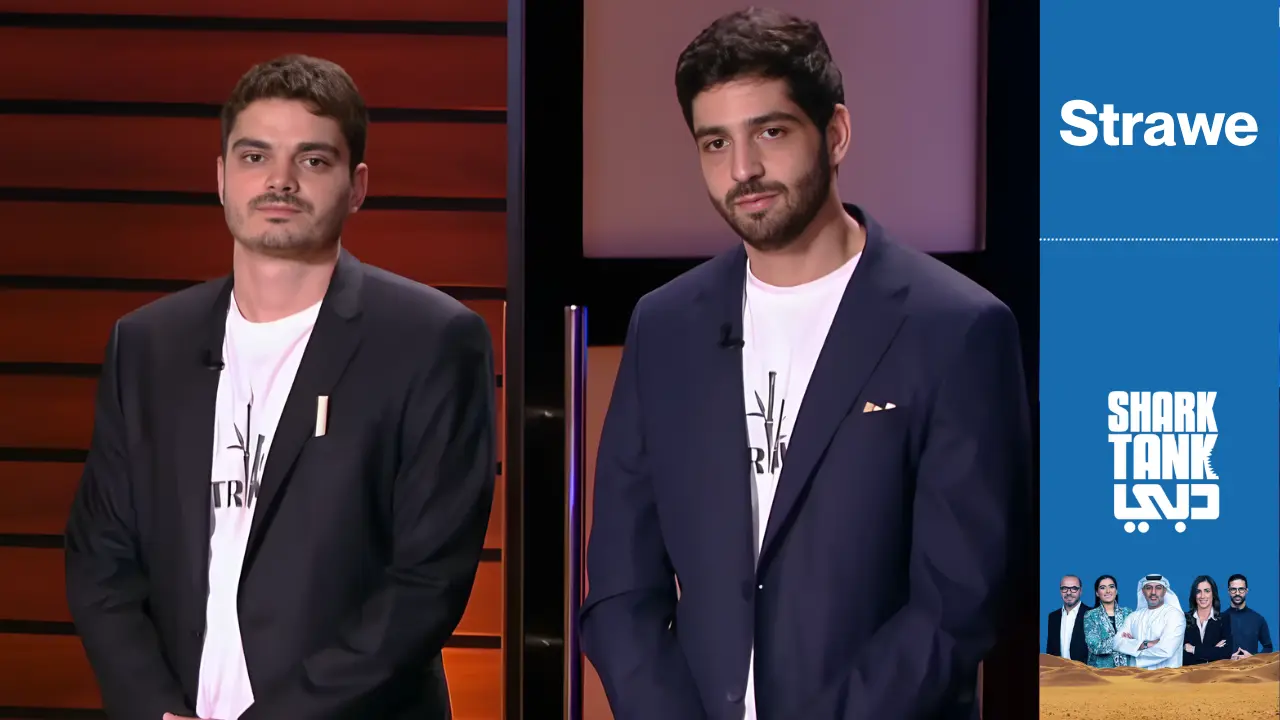
Plastic straws have become one of the most visible symbols of the global waste crisis. Yet most eco-friendly alternatives create a new frustration. They simply do not work well. On Shark Tank Dubai, Lebanese entrepreneurs Patrick Nabih Mubarak and Alain Sharbati walked into the Tank with a solution designed to end the world’s soggy straw problem once and for all.
Their company, Strawe, promised something surprisingly simple. Instead of complex materials or recycled paper, the founders turned to natural reeds called “Qasab.” The result was a straw that stayed strong in hot tea and cold soda while remaining fully natural and biodegradable.
The Sharks admired the product immediately. But admiration alone was not enough to secure an investment. What followed became a powerful lesson about founder commitment, scalability, and the difficult leap from side project to serious startup.
Shark Tank Dubai Pitch Summary
| Category | Details |
|---|---|
| Company | Strawe |
| Founders | Patrick Nabih Mubarak & Alain Sharbati |
| Origin | Lebanon |
| Product | Reusable biodegradable straws made from natural reeds |
| Problem Solved | Paper straws become soggy and unusable |
| Ask | AED 180,000 for 12% equity |
| Deal Outcome | No deal |
The Sustainability Problem Everyone Has Experienced
Most consumers have faced the same problem when using paper straws. At first, the straw works perfectly. But after a few minutes, it softens and collapses, leaving a pulpy mess in the drink.
This simple frustration hides a massive environmental challenge. Globally, over 500 million plastic straws are used every single day, and each one can take more than 200 years to decompose. Governments and businesses are racing to replace them, yet many substitutes fail to deliver a usable experience.
Patrick and Alain saw an opportunity here. Instead of trying to improve paper straws, they decided to rethink the entire material itself.
Nature Already Solved the Soggy Straw Problem
The most surprising element of Strawe’s solution was its simplicity. Rather than manufacturing new materials, the founders relied on Qasab reeds, a natural plant that grows abundantly and requires minimal processing.
This approach creates a circular economy model. The reeds are harvested, cleaned, and cut into straws without the heavy industrial processes typically used in paper or plastic production. Because the product remains close to its natural state, it stays durable while remaining completely biodegradable.
During the Shark Tank pitch, the founders demonstrated the straw’s strength in both boiling tea and freezing soda. Unlike paper alternatives, the reed straw held its shape and structure without degrading.
“Every day around the world, more than 500 million plastic straws are used and thrown away. Each one takes more than 200 years to decompose. Strawe is 100 percent natural, eco-friendly, biodegradable, and reusable.”
The demonstration impressed the Sharks. For a moment, it seemed like the entrepreneurs had solved one of sustainability’s most annoying everyday problems.
The Side-Hustle Trap in High-Stakes Investing
Despite the product’s impressive design, the Sharks quickly discovered a major weakness in the business itself.
Patrick and Alain were not working on Strawe full time. Alain was living in Dubai, while Patrick remained in Lebanon. The business was still being run as a part-time project, which immediately raised concerns among the investors.
Investor Youssef explained that he had seen this situation many times before. In his experience, side projects almost always fail because founders cannot dedicate the energy needed to scale a company.
The tension reached its peak when Faisal offered a potential deal. However, his condition was clear and uncompromising. The founders would need to leave their jobs and commit fully to the startup.
Patrick faced a difficult decision in that moment. As a recent graduate who had only been in his job for a month, he hesitated and said he could not immediately promise to quit.
“It is difficult for any investor to enter into a project where there is no full-time commitment from the founders.”
This single moment shifted the direction of the pitch.
Turning a Straw Into a Premium Brand Asset
While the business model raised concerns, the product itself continued to impress the panel.
Strawe reimagines the straw not as a disposable item but as a durable branded accessory. Because the reed material is strong and reusable, restaurants and hospitality venues can wash and reuse the straws instead of discarding them after one drink.
The founders also introduced another clever feature. The straws can be laser engraved with logos, names, or branding. This transforms a basic drinking tool into a subtle marketing asset for premium restaurants and hotels.
At roughly 25 fils per straw, the price positions Strawe as a high-quality sustainable alternative rather than a cheap disposable product. Luxury hospitality venues, which increasingly prioritize sustainability and brand experience, could become a strong customer base.
Even after other Sharks exited the deal, Faisal continued praising the product, describing it as aesthetically beautiful and superior to many alternatives already on the market.
The 180,000 AED Funding Reality Check
Another issue emerged when the Sharks examined the financial request.
The founders asked for AED 180,000 in exchange for 12 percent equity. At first glance, the valuation appeared reasonable for an early-stage startup. However, the Sharks questioned whether the amount was sufficient for meaningful growth.
Investor Amira raised a critical point. Strawe had only been operating for around two months, and the founders had not yet mapped out the full cost of scaling production, supply chains, or marketing across the region.
Ironically, asking for too little money can signal a problem to investors. It suggests the founders may not fully understand the capital required to build a global brand.
In venture capital, underestimating growth costs can be just as risky as overvaluing the company.
Why the Sharks Ultimately Said No
By the end of the pitch, the Sharks were left with a surprising dilemma.
They loved the product. They praised the sustainability concept. They even admired the design and functionality of the reed straw.
But they did not invest.
The reason was simple. The investors believed the founders themselves were not yet fully committed to the journey required to scale the business. Without full-time dedication, even the best product can struggle to grow.
In the Shark Tank ecosystem, investors often say they invest in people first and ideas second.
The Real Lesson for Founders
The Strawe pitch reveals a powerful lesson for entrepreneurs entering the startup world.
Solving a real problem is only the first step. Building a scalable company requires a level of commitment that often means leaving behind stability and taking significant personal risk.
Patrick and Alain successfully demonstrated a product that could improve sustainability and eliminate the soggy straw problem. However, until they commit to scaling the company full time, the business will likely remain a promising side project rather than a global solution.
Their journey leaves every aspiring founder with a difficult but important question.
Are you building a side project, or are you ready to leave the safety of your job to build something that could truly change the world?