

In April 1999, David Blaine spent seven days buried underground in a transparent coffin beneath a water-filled tank in Manhattan. The stunt was called Buried Alive, and it helped change modern magic by making endurance, risk and public reaction part of the performance.
The image was simple and hard to forget: a young magician lying still in a clear box, six feet down, while strangers stood above him and looked through water to see if he was still there.
There were no dancing assistants, no glittering stage curtains and no quick escape. Blaine made waiting the act. He made discomfort visible. He made the audience wonder not only how a trick worked, but why anyone would choose to do it at all.
Fast Facts
David Blaine, an American magician and endurance artist, spent seven days inside a transparent coffin beneath a water-filled tank on Manhattan’s Upper West Side in 1999. The stunt, known as Buried Alive, helped shift modern magic toward endurance, risk and audience reaction because the idea was simple, visible and emotionally tense.
Who is David Blaine?
David Blaine is an American magician, illusionist and endurance artist. He was born David Blaine White on April 4, 1973, in Brooklyn, New York.
Before he became known for extreme endurance stunts, Blaine broke through as a street magician. His early television work put him close to ordinary people on sidewalks, in shops and in casual encounters. The camera often stayed on the faces of the people watching him. Their shock, silence, laughter and fear became part of the show.
That style mattered. At a time when many people thought of magic as a polished stage act, Blaine made it feel smaller, stranger and more immediate. A deck of cards, a passerby and a quiet performer could be enough.
What happened during Buried Alive?
On April 5, 1999, Blaine entered a transparent coffin in an open pit on Manhattan’s Upper West Side. A large water-filled tank sat above him so people could look down and see him inside.
He stayed there for seven days.
Crowds came to watch throughout the week. Many arrived out of curiosity, while others wanted to see whether he would quit. For some, it felt like a public art event. To others, it looked like a publicity stunt. That mix of fascination and doubt became part of the power of the moment.
When Blaine emerged on April 12, he looked weak but alive. The stunt had done what it set out to do. It made him impossible to ignore.
How David Blaine survived the stunt
The phrase “buried alive” needs context. Blaine was not sealed in a wooden coffin under solid earth. He was inside a transparent coffin placed in a pit, with a water tank above it and safety support nearby.
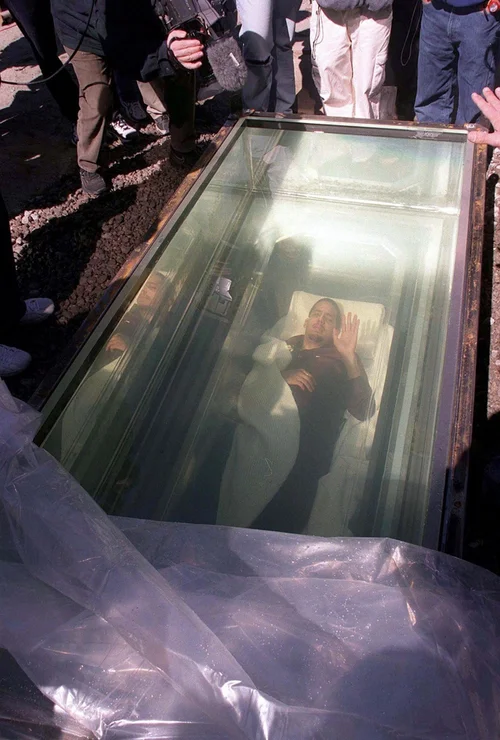
Reports from the time described air being pumped into the coffin, medical personnel on site and emergency equipment available if something went wrong. The performance still carried real physical and psychological strain, but it was not a random act of self-endangerment. It was planned, monitored and staged for public viewing.
The method was less about hidden machinery than controlled endurance. Blaine had to stay confined, visible and largely still while his body dealt with hunger, weakness and discomfort. The audience could come and go. He could not.
That imbalance made the stunt feel personal. The city kept moving above him while he remained underground.
Why Buried Alive was so difficult
The hardest part was not one single danger. It was the accumulation of small pressures.
Blaine stayed confined in a tight space with no normal privacy. He took in only limited liquids and went without regular food. He could not stretch, walk away or reset the scene. People watched him even when nothing seemed to be happening.
That was unusual for magic. A traditional illusion often builds toward a reveal. Blaine’s reveal was survival. The performance asked the audience to sit with time itself: one hour, one night, one day, then seven days.
It also pulled from the mythology of Harry Houdini, who had explored buried-alive ideas but died before completing the kind of feat Blaine wanted to attempt. Blaine was not just copying an old escape theme. He was updating it for television, crowds and a media culture that wanted proof it could stare at.
Why David Blaine’s stunt changed modern magic
People cared because the story was instantly understandable. You did not need to know anything about magic to grasp the stakes. A person was underground. A week had to pass. Something could go wrong.
That is why the stunt traveled so well in public conversation. It was visual, simple and unsettling. It also changed how many viewers understood Blaine. He was not only a card magician. He was turning his own body into the stage.
His broader contribution was the way he blended close-up magic, endurance performance and audience reaction. In his world, the spectator mattered. A stunned face could be as important as the trick itself. That idea helped shape the tone of later televised magic, where realism, street settings and raw reactions became central to the appeal.
The risks and controversy behind the story
The stunt should not be treated as safe or repeatable. Confinement, fasting, dehydration and isolation can be dangerous. Blaine had planning and medical support. Ordinary readers should not attempt anything like it.
There is also missing context in the way the stunt is sometimes retold. Saying he was “buried alive” is memorable, but it can give the wrong picture if readers imagine a sealed coffin covered by dirt. The more accurate description is that he was placed in a transparent coffin in a pit beneath a water-filled tank.
A fuller profile of Blaine should also acknowledge controversy. Major news outlets reported in 2019 that New York police investigated sexual assault allegations against him. Reports at the time said he had not been charged, and representatives for Blaine denied reported accusations. That context does not erase the importance of his work in magic, but it belongs in responsible coverage of a living public figure.
What David Blaine’s stunt teaches us
The lesson is not to copy David Blaine. The lesson is to understand how memorable work is built.
Blaine’s stunt worked because the idea was simple. Anyone could describe it in one sentence. The details felt concrete: a coffin, water, seven days and New York crowds. The stakes felt human: fear, hunger, endurance and public judgment. One question stayed alive the whole time: Can he really last?
That structure applies far beyond magic. Strong stories often begin with a clear image, a real constraint and a reason to care. Blaine understood that mystery does not always come from speed or noise. Sometimes it comes from stillness.
He later described magic in plain terms during his TED talk about breath-holding: “It’s practice, it’s training and experimenting.”
That line is useful because it strips away the fantasy. Behind the impossible-looking moment is repetition, planning and pain management. The spectacle is what people see. The preparation is what makes it possible.
Related Reading
AI helps decode an ancient buried scroll.
Read the Full StoryWhy Buried Alive still matters today
After Buried Alive, Blaine kept pushing the same idea in new forms. He was frozen in ice in Times Square, stood on a high pillar, fasted in a transparent box above the River Thames, lived underwater, held his breath on television and later lifted himself into the sky with helium balloons.
But the 1999 burial remains one of the clearest versions of his artistic identity. It took away almost everything except the body, the clock and the crowd.
That is why the stunt still matters. David Blaine did not change modern magic by making the biggest illusion. He changed it by making the audience watch a person endure something real enough to feel uncomfortable. For seven days, the trick was not a disappearing act. It was the opposite. He stayed exactly where everyone could see him, and somehow that made him harder to look away from.
FAQs
Yes. In April 1999, David Blaine spent seven days inside a transparent coffin beneath a water-filled tank in Manhattan. The stunt was monitored and staged for public viewing.
It was more of an endurance performance than a traditional magic trick. The surprise came from the physical and mental challenge of staying confined for a week, not from a hidden escape illusion.
Blaine became famous because he made risk, stillness and audience reaction central to his magic. His stunts turned the question from “How did he do that?” into “How long can he endure this?”