
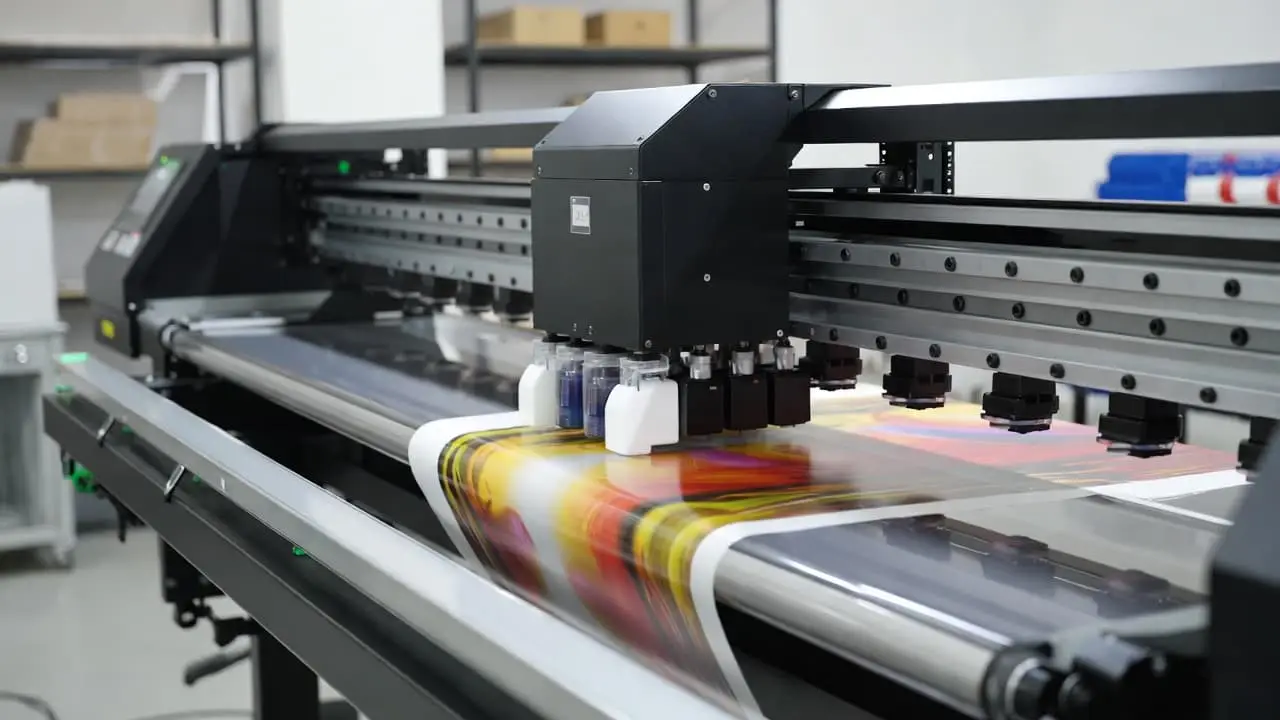
If you have been looking into Direct-to-Film printing, you have probably seen a lot of coverage of the printers themselves — which brands make them, what print heads they use, how wide they print. What gets less attention is the supply side of the workflow: the inks, films, and adhesive powders that actually determine what the finished transfer looks like and how long it lasts on a garment.
This guide breaks down each supply category in detail, explains what the technical terminology means in practical terms, and covers what to look for when sourcing each one.
How DTF Printing Works (Briefly)
Before getting into individual supply categories, it helps to understand the full workflow. A DTF printer prints a design onto a coated PET film — the same design you would see on a finished shirt, but in mirror image. Immediately after printing, adhesive powder is applied to the wet ink surface. The film is then passed through a curing unit that heats the powder until it melts and bonds to the ink layer. The finished transfer is then placed on a garment, pressed with a heat press, and the film is peeled away — leaving the design bonded to the fabric.
Each supply category plays a distinct role in this process, and failures in any one of them produce problems in the final output.
DTF Inks: CMYK Plus White
DTF ink sets consist of five channels: cyan, magenta, yellow, black, and white. The CMYK channels work together to produce the full color range of any design. The white channel functions as an underbase layer printed beneath the color design.
The role of white ink. On white or very light garments, white ink may not be necessary because the fabric itself provides a light base. But on any medium or dark garment — navy, black, gray, red — the white underbase is essential. Without it, the garment color bleeds through the CMYK layer and shifts all the colors, making the design look faded or muddy. A solid, high-opacity white underbase allows the color layers above it to reproduce accurately.
CMYK pigment density. The richness of the colors in a finished print is determined primarily by the pigment concentration in the ink. Higher-quality inks carry more pigment per milliliter, which produces more saturated, vibrant output. Budget inks often sacrifice pigment load to reduce manufacturing costs, which is visible in the final print as washed-out or flat color.
Viscosity and print head compatibility. DTF inks must flow at the correct viscosity for the specific print head in a given printer. Most DTF printers use Epson-style print heads, with the i3200 being the most common in production environments. Inks formulated too thick clog heads. Inks too thin produce uneven layering. Quality suppliers document their viscosity specifications and test for compatibility with common print head configurations.
Ink pricing. Mid-tier DTF inks from reputable US-based suppliers typically run $12 to $18 per liter. DTF Printer USA carries a range of ink options at competitive pricing for shops looking to source CMYK and white inks from a single supplier. Buying ink in multi-liter sets reduces per-unit cost and simplifies reordering.
DTF Films: Hot Peel vs. Cold Peel, Matte vs. Gloss
DTF film is a PET (polyethylene terephthalate) film with a specialized release coating on the printing surface. The design is printed directly onto this coated side. Films come in roll format and in various widths, with 13-inch and 24-inch rolls being the most common.
Hot peel vs. cold peel. This distinction refers to the temperature at which the film is peeled from the garment after pressing.
Hot peel film is removed immediately after pressing while the transfer is still warm. This speeds up production and produces a matte or satin finish on the print surface. Hot peel is the preferred choice for high-volume operations where throughput matters.
Cold peel film requires waiting until the transfer has fully cooled before the carrier is removed. This takes more time but results in better edge definition, sharper fine details, and a softer hand feel. Cold peel is the better option for intricate designs, small text, or any print where precision matters more than speed.
Matte vs. gloss finish. Regardless of peel type, films are available in matte and gloss surface finishes:
Matte finish produces prints with a flat, non-reflective appearance. Colors appear natural and the print blends more seamlessly with the fabric surface.
Gloss finish produces prints with higher visual saturation and a slight sheen under light. Colors appear more vivid and the print has a more noticeable presence on the garment.
Film weight and coating quality. Heavier-gauge films with premium release coatings apply powder more evenly, release more cleanly from the garment, and produce more consistent results across full production runs. Cheap films often produce adhesion failures around design edges where the coating is uneven.
Film pricing. Standard DTF film rolls typically run $18 to $30 per 100-meter roll for 13-inch width, with 24-inch rolls proportionally higher. Premium films sit at the higher end of that range and are worth the additional cost for shops producing customer-facing apparel.
DTF Adhesive Powder: Fine, Medium, and Premium Grades
Adhesive powder — also called hot melt powder — is the binding agent that holds the DTF transfer to the garment. After printing, powder is applied to the wet ink surface (manually or via an automated shaker), and the coated film is passed through a curing unit. The heat melts the powder into a continuous adhesive layer that bonds to the garment during heat pressing.
Particle size and grade. Adhesive powder is classified by particle size, which affects both how finely it applies and how the finished transfer feels on the garment.
Fine powder has the smallest particle size, allowing it to coat intricate design details without obscuring edges. It produces a softer hand feel on the garment and is the standard choice for most applications.
Medium powder sits between fine and premium in particle size and is sometimes used for applications requiring slightly thicker adhesive coverage.
Premium powder offers superior adhesion strength and wash durability. It is formulated for applications where the garment will be laundered frequently or commercially washed.
Curing temperature requirements. DTF adhesive powder melts at temperatures ranging from 230 to 250 degrees Fahrenheit during the curing stage. The heat press application that bonds the transfer to the garment typically runs at 300 to 320 degrees Fahrenheit. Running the heat press below this range produces transfers that peel prematurely. Running above it can damage both the transfer and the garment fabric.
Humidity and powder performance. Adhesive powder is hygroscopic — it absorbs moisture from the air. In humid storage environments, powder that has absorbed excess moisture will not adhere properly to the ink layer, resulting in patchy coverage and adhesion failures. Powder should be stored sealed and in a climate-controlled environment, and opened bags should be used within a reasonable timeframe.
Powder pricing. Standard fine powder typically runs $14 to $18 per kilogram. Premium formulations run slightly higher. DTF Printer USA offers adhesive powders in this range, providing a US-based sourcing option for shops that want to consolidate their supply purchases.
Building a Reliable Supply Chain
The most common mistake shops make when setting up a DTF operation is treating supplies as interchangeable commodities. They are not. Ink, film, and powder all interact within the same workflow, and using mismatched quality levels across categories produces inconsistent results that are difficult to troubleshoot.
The most reliable approach is to source consistently from a supplier that carries all three categories and has tested them together — which is exactly what dedicated DTF supply companies do. DTF Printer USA’s about page provides context on their product focus and why a single-source supply relationship benefits print operations at any scale.
Shops that take the time to understand what each supply does — and why quality matters at each stage — are the ones that produce consistent, durable prints that keep customers coming back.