
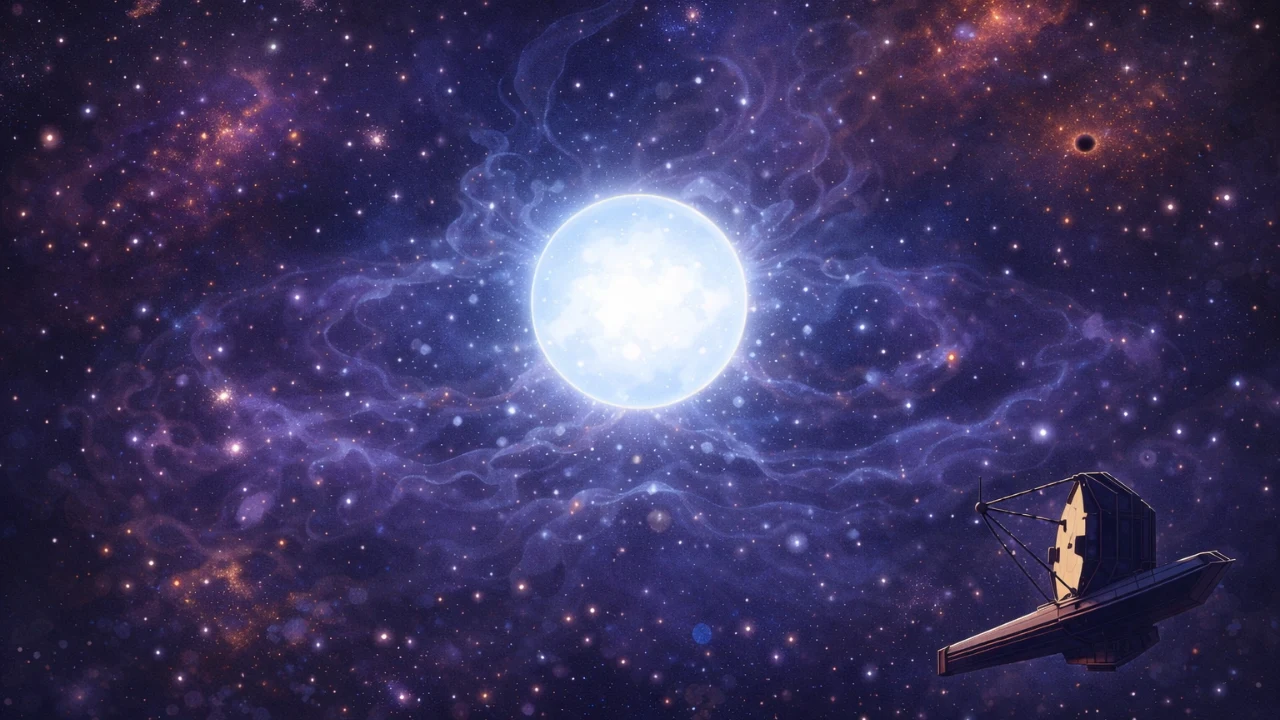
Physicist Cosmin Ilie of Colgate University, working with Jillian Paulin at the University of Pennsylvania, Andreea Petric at the Space Telescope Science Institute, and Katherine Freese at the University of Texas at Austin, suggest a bold explanation for some of JWST’s biggest early-universe surprises. They propose that “dark stars,” powered not by nuclear fusion but by dark matter annihilation, may have lit up the cosmos during its earliest stages.
According to ScienceDaily, JWST has spotted unusually bright blue galaxies, unexpectedly massive black holes, and tiny red objects that standard models struggle to explain. The new theory ties all three signals to small, dense regions called microhalos, where dark matter dominated the environment as the first cosmic structures formed.
How Dark Stars Grow Big in Tiny Realms
The mechanism is simple and radical: in the first million years of the universe, gas collapses inside dark-matter–rich microhalos where repeated dark matter annihilations deposit heat into the gas, inflating the stars and letting them shine far brighter than ordinary protostars. Because the energy source is not nuclear fusion, these dark stars can reach tens to hundreds of solar masses quickly, and their luminosity could seed the formation of the first black holes that later anchor the growth of supermassive black holes.
The team suggests this rapid growth could explain the ultra-bright galaxies, the early appearance of massive black holes, and the pattern of compact, dust-free little red dots JWST is finding. The formal framework appears in their Universe 2025 paper, which lays out the spectral and temporal predictions for comparison with observations.
From Theory to Testable Signals
The model makes clear, testable predictions. The dark-star phase would imprint distinctive spectral features, particularly helium absorption lines, in the light from distant galaxies. As JWST continues to collect data, scientists will compare observed spectra with dark-star simulations to confirm or challenge the idea. For broader context, see the NASA JWST Overview and the ScienceDaily write-up that ties these ideas to real JWST findings.
The Road Ahead for Dark Matter and JWST
If confirmed, dark stars would become a direct probe of dark matter properties and a bridge between JWST’s early-universe data and fundamental particle physics. The story shifts from a narrative of pristine gas to one where dark matter scaffolding shapes starlight, with Colgate’s Cosmin Ilie and collaborators guiding the field toward a new, testable age.
Today, researchers will refine spectroscopic searches for the telltale helium signature and other spectral fingerprints, turning today’s puzzles into tomorrow’s measurements. The era of hunting dark matter in the cosmos is entering a testable age. ScienceDaily and Universe 2025 offer detailed backdrops for these observations.
- Dark stars powered by dark matter annihilation could unify three JWST puzzles.
- Predictions include distinct helium signatures and rapid early growth in microhalos.
- Tests will rely on spectroscopy and continued JWST observations to confirm or dispute the model.
Related Insight
How astronaut Suni Williams endured record-breaking long missions aboard the International Space Station.
Read the full story →