
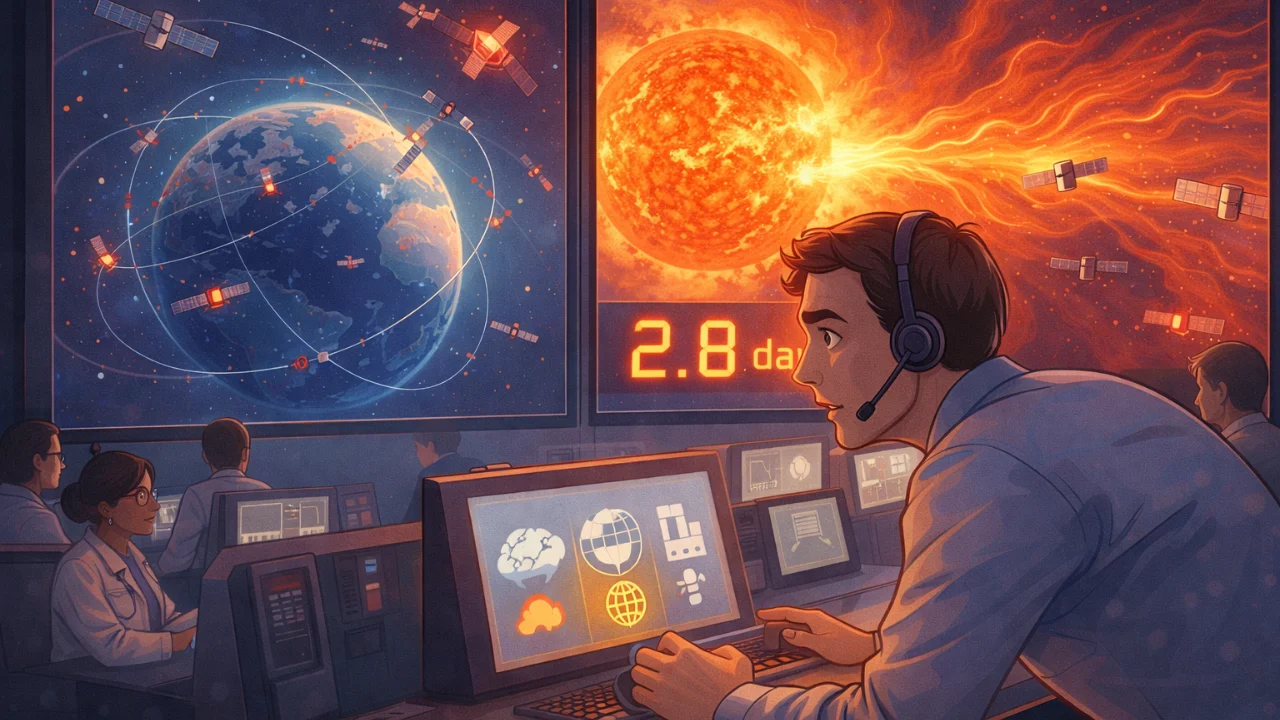
The CRASH Clock is a warning tool built from real solar-storm physics and the crowded conditions created by megaconstellations like Starlink. In June 2025, Dr. Sarah Thiele and her team showed that a strong solar storm could disrupt satellite control networks so severely that operators might lose command within days. If that happens, the system could spiral into a runaway chain of collisions in as little as 2.8 days. ScienceDaily offers a quick overview of the findings for those who want a short briefing.
The Sky Is Not a Safe Parking Lot
LEO is crowded, and during solar storms the upper atmosphere heats and expands, increasing drag on satellites and complicating avoidance maneuvers. The study reframes megaconstellations as vulnerable, interconnected networks that depend on timely ground- and space-based control, especially during rare edge-case events. Coverage has echoed these points in popular science outlets like Universe Today.
The Maverick and the Mechanism
Leading this charge is Dr. Sarah Thiele, formerly a PhD student at the University of British Columbia and now at Princeton. The mechanism centers on the CRASH Clock: a metric that translates solar-storm dynamics and control-link reliability into an estimated timescale for cascading loss of avoidance.
Using historical storm data and current traffic patterns, the authors argue that even a temporary command outage can spark a chain reaction threatening dozens of satellites. The core ideas appear in the arXiv preprint An Orbital House of Cards, with corroborating context in reporting at Universe Today.
From Theory to Action
The practical upshot is clear: operators should bake solar-weather forecasts into daily planning, pre-stage contingency fuel and traffic-management buffers, and push for resilient, autonomous collision-avoidance protocols that can operate even when ground links falter.
The 24-hour loss-of-control scenario carries an estimated ~30% risk of major collision within days, underscoring urgency for proactive measures. Stakeholders include megaconstellation operators, national space agencies, and research labs who must reframe risk thresholds in an era of crowded LEO.
Looking Ahead
If governments and industry take the CRASH Clock seriously, we’ll see more robust cross-constellation coordination, autonomous avoidance, and pre-planned responses to solar-weather windows. The era of the ‘device’ is ending…
- CRASH Clock quantifies time-to-disaster in LEO, now a practical planning metric.
- Solar storms expand the atmosphere, increasing drag and collision risk for satellites.
- Megaconstellations require proactive, networked traffic management and resilience plans.
- Daily solar weather monitoring and contingency planning can reduce exposure to cascading failures.
Deep Space Insight
Discover how an early-universe quasar grew far faster than current theories predict.
Read the full article