
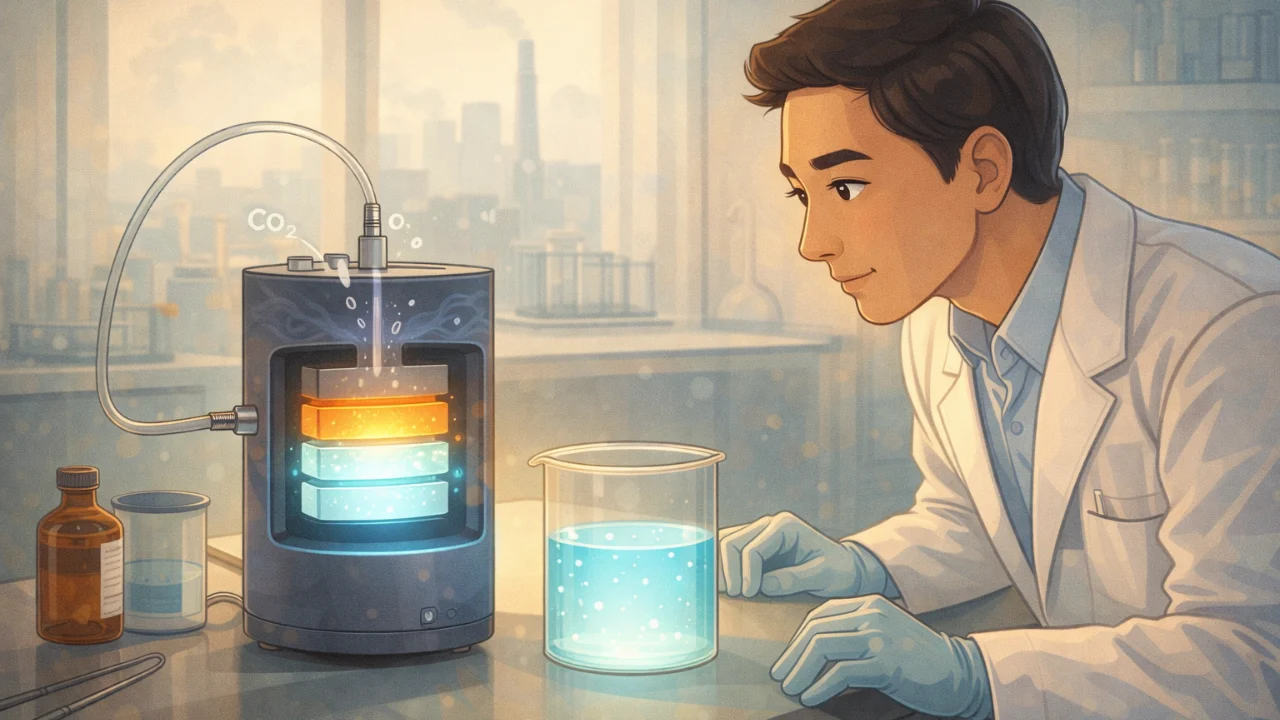
In a single device, Wonyong Choi and his team in Korean labs demonstrate an Integrated Capture and Conversion electrode that pulls CO2 from realistic exhaust gas and converts it directly to formic acid in one step, outperforming older two-step systems in tests that mimic real-world gas mixes (approx. 15% CO2, 8% O2, 77% N2). This breakthrough is detailed in ScienceDaily and rooted in the work published in ACS Energy Letters, underscoring a shift from purified-gas lab tests to field-ready chemistry.
Funded by the National Research Foundation of Korea, the team’s results come with the practical promise that factories could someday install such electrodes to convert waste CO2 on-site into valuable chemicals, reducing emissions and transport costs while creating new value streams.
The End of the “Capture, Then Convert” Era
The device relies on a three-layer electrode architecture that captures CO2 directly from dilute exhaust and reduces it to formic acid, all within a gas diffusion electrode framework that tolerates oxygen, a key hurdle for many carbon conversion systems. The work demonstrates performance under realistic gas mixtures—15% CO2, 8% O2, 77% N2—where traditional approaches falter due to CO2 purity requirements. For a deeper dive, see the ACS Energy Letters paper and a companion explainer in ScienceDaily.
In essence, the team’s approach merges capture and conversion into a single, scalable device, avoiding expensive gas purification steps and enabling modular deployment in industrial settings. This is not just a lab curiosity: it’s a practical blueprint for on-site carbon reuse as industries push toward climate targets.
From Lab Proof to Factory Floor
Designed around an oxygen-tolerant porous carbon modified gas diffusion electrode, the system leverages a gas diffusion electrode with structural porosity and catalytic sites that pull CO2 from real exhaust and reduce it to formic acid at workable currents. If scalable, plants could retrofit lines with these electrodes to convert waste CO2 locally, slashing emissions and cutting transport costs while unlocking new revenue from the produced formic acid. This trajectory—from bench to biomass-scale reality—has crystallized in the work supported by the National Research Foundation of Korea.
For the technical lens, see the original ACS Energy Letters publication Integrated Capture and Conversion of Dilute CO2 Using an Oxygen Tolerant Porous Carbon Modified Gas Diffusion Electrode, which outlines the material choices and reaction pathways that enabled oxygen-rich exhaust to participate in the conversion process.
Key Takeaways
- Integrated capture-and-conversion eliminates the need for pre-purified CO2, simplifying deployment.
- The oxygen-tolerant porous carbon modified gas diffusion electrode enables direct conversion from realistic exhaust gas to formic acid.
- Scale-up could allow on-site CO2 reuse, reducing emissions, transport costs, and unlocking new value streams for industry.
The era of separate capture and conversion is ending—on-site, real-time CO2 reuse is moving from lab bench to factory floor.
Recommended Science Insight
Learn why mismatched blood tests can quietly predict dangerous kidney failure risks.
Read the full article