Coverplay Shark Tank Update: Did Barbara’s Deal Really Close?
Coverplay’s founders confirmed Barbara’s $350,000 investment closed. Explore the deal, dated expansion plans, and current official product catalog.

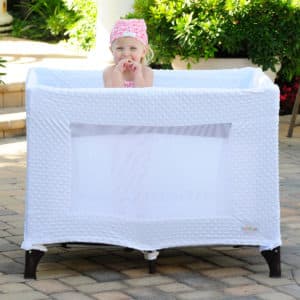
A play yard can travel from room to room or accompany a family on a trip, but its fabric surfaces are not as simple to wash as ordinary laundry. Amy Feldman and Allison Costa built Coverplay around a washable slipcover intended to make that practical problem easier to manage.
The founders brought a defined product to Shark Tank and attracted competing offers. They chose Barbara Corcoran’s proposal, which required less ownership than the alternatives they were considering.
Unlike many early Shark Tank deals, the post-show closing has a direct source. A founder-authored update published in October 2009 explicitly confirms the $350,000 investment.
The business also has a present-day official storefront. That gives this update two separate foundations: a documented completed deal and a visible product catalog. Neither requires an invented net-worth estimate to make the story interesting.
Quick answer: Amy Feldman and Allison Costa asked for $350,000 for 15% of Coverplay and accepted Barbara Corcoran’s offer of $350,000 for 40%. An October 14, 2009 update on the company website confirms that the investment closed. Coverplay’s official store still lists play-yard slipcovers, fitted sheets, and related products. The current ownership split, revenue, and order fulfillment were not independently verified in this review. Current status: official storefront and product listings remain accessible; the historical investment closing is confirmed by a founder update.
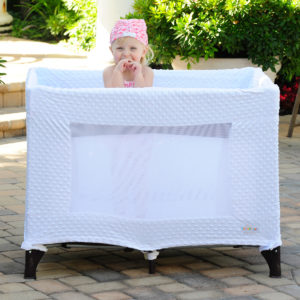
A Coverplay slipcover shown on a play yard. Photo: Coverplay, official website.
What is Coverplay?
Coverplay’s original product was a washable slipcover designed for compatible play yards. It offered a removable fabric layer and a way to change the appearance of the equipment.
| Product snapshot | Details |
|---|---|
| Founders | Amy Feldman and Allison Costa |
| Original product | Play-yard slipcover |
| Main practical feature | Removable, washable fabric |
| Related current categories | Fitted sheets, play yards, and other nursery products |
| Appearance | Shark Tank USA Season 1, Episode 4 |
The official slipcover category describes the covers as machine washable and intended to fit many standard play yards.
That is a manufacturer description, not proof of universal compatibility. Buyers need to check the instructions and fit for their specific equipment. This article does not independently certify product safety or repeat claims about preventing illness.
For the complete season context, see our Shark Tank USA Season 1 guide.
What deal did Coverplay accept?
The founders requested $350,000 for a 15% stake. Barbara’s accepted offer was the same investment amount for 40%.
A founder-authored account dated August 31, 2009 describes the competing proposals and the founders’ concern about giving up control. It records their decision to choose Barbara.
| Deal snapshot | Terms |
|---|---|
| Requested investment | $350,000 |
| Initial equity offered | 15% |
| Accepted investment | $350,000 |
| Equity in the accepted offer | 40% |
| Investor | Barbara Corcoran |
| Post-show closing evidence | Founder’s October 2009 update |
The amount was $350,000, not $35,000.
The request implied a valuation of about $2.33 million. The accepted on-air terms implied $875,000 using the same calculation. Those figures describe the proposed transaction terms; they are not estimates of what Coverplay is worth today.
The founder’s confirmation of closing makes this history clearer than cases where only a televised handshake is documented.
How does Coverplay’s business model work?
The business sells a practical accessory for equipment that customers already use. Related products give the brand additional ways to serve the same category of customer.
Its current site presents both the signature slipcovers and other nursery-product categories. The historical founder updates also describe interest from commercial buyers.
| Route or product | Intended role | Business question |
|---|---|---|
| Slipcovers | Address the original removable-cover use case | Does the product fit the customer’s equipment and needs? |
| Fitted sheets | Serve a related purchasing need | Are dimensions and compatibility clear? |
| Play yards and packages | Offer associated equipment | Can the business manage a broader catalog? |
| Commercial customers | Potential larger orders | Can supply, pricing, and delivery meet buyer requirements? |
This table explains the model. It does not claim a verified share of revenue from any category.
A narrow practical product can provide a clear starting point for a business. Expanding into related items then adds inventory and fulfillment responsibilities, even when the audience is similar.
What happened after Shark Tank?
Latest update — November 17, 2026: Coverplay’s official store lists slipcovers, fitted sheets, and related categories. A founder-authored October 2009 post confirms that Barbara’s investment closed. Current revenue and Barbara’s present ownership percentage are not verified.
The company confirmed the investment closed
The October 14, 2009 founder update explicitly refers to closing the $350,000 deal with Barbara.
That is direct evidence from the company, rather than an inference from the episode. It supports describing the investment as completed historically.
It does not automatically establish that Barbara holds the same percentage today. Ownership can change after an original investment, and no current ownership disclosure was verified for this article.
Early expansion plans need their dates
The same update described stronger orders and prospective retail and hotel arrangements. Its wording included future plans and negotiations still in progress.
Those statements are useful evidence of what the founders were pursuing in October 2009. They should not be rewritten as proof that every prospective agreement was completed, or that the same retail relationships exist today.
That distinction prevents a dated progress report from becoming an unsupported current distribution claim.
The official catalog remains visible
The Coverplay homepage currently links to play yards, slipcovers, sheets, packages, cribs, and blankets.
The slipcover category displays several designs at $64.99, with some sale listings at $50. The fitted-sheet category shows $12.99 listings. These were displayed prices checked for this update, not guaranteed future prices or proof of every item’s stock.
The catalog is meaningful evidence of a continuing commercial presence. This review did not place an order or test delivery.
| Evidence checkpoint | Supported finding | Limit |
|---|---|---|
| August 2009 founder account | The founders accepted Barbara’s offer | An on-air acceptance alone would not prove closing |
| October 2009 founder update | The investment had closed | It does not disclose current ownership |
| Early expansion update | Retail and hotel opportunities were being pursued | Future plans are not completed contracts |
| Current storefront | Product categories and prices are visible | Fulfillment was not independently tested |
| Current financial review | No dependable revenue or valuation found | A net-worth estimate is not justified |
Why Coverplay’s deal should not be labeled “unconfirmed”
A generic statement that Shark Tank offers sometimes fail to close is not a substitute for checking the company’s evidence.
Here, the founders supplied a clear closing confirmation. The uncertainty is about current financial details, not whether the historical investment happened.
By contrast, Stress Free Kids’ founder described a revised private arrangement. Both cases have useful founder evidence, but it supports different conclusions.
Where can you buy Coverplay products?
Start with the official store and review the exact listing for the item you need.
Check dimensions, compatibility, care instructions, stock, delivery, and return terms. Do not assume that a description such as “standard size” makes every slipcover appropriate for every play yard.
This article does not present the cover as a universal safety upgrade. The manufacturer’s intended use and the equipment’s own instructions remain important to the purchase decision.
The storefront’s current listings are also a better source for availability than old reports of products reaching a particular retail chain.
What can founders learn from Coverplay?
Coverplay illustrates the value of a clear product use case and careful attention to ownership terms.
The founders compared proposals involving different levels of control. Their own account shows that the percentage mattered alongside the cash amount.
The later update also demonstrates useful business communication. Confirming a completed investment gives customers and readers a firmer record than leaving them to infer everything from the television episode.
For another Episode 4 business that chose a different ownership path, Graffiti Removal Services’ Paul Watts rejected the majority-control offer. The two decisions should be understood on their own terms rather than reduced to a universal rule about accepting a Shark.
Frequently asked questions
Who founded Coverplay?
Amy Feldman and Allison Costa presented the company and its washable play-yard slipcovers.
What was the Shark Tank deal?
They accepted $350,000 for 40% from Barbara Corcoran after initially requesting the same amount for 15%.
Did the investment actually close?
Yes. A founder-authored post on the official site dated October 14, 2009 confirms closing the $350,000 deal.
Is Coverplay still selling products?
Its official store continues to list products and prices. This review did not test fulfillment or verify every item’s stock.
Does Barbara still own 40%?
Her current ownership was not verified. The historical agreement should not automatically be treated as a current capitalization table.
What is Coverplay’s net worth?
No reliable current valuation was verified. The original pitch calculations are not a present-day net-worth estimate.
The weekly question
From obsession to clarity — one original question every week.
We answer one noisy topic at a time, in full. No daily roundup, no thread bait — just the question, the principles, and the system.