BoxBlayde After Shark Tank: Why Rob Wright Walked Away
Rob Wright declined investment for his electric cardboard cutter. BoxBlayde’s history shows why warehouses mattered before its Shark Tank appearance.
A homeowner with three delivery boxes can flatten them by hand. A distribution center facing the same task hundreds of times has a different purchasing decision to make. That distinction helps explain why Rob Wright could pitch BoxBlayde as a household convenience, walk away from the Sharks and still have a business worth watching.
Wright asked for $200,000 for 5% of the company. The Sharks offered the cash but wanted considerably more ownership. The price gap never closed. What changed after television is harder to quantify than the negotiation: there is a current storefront and a line of accessories, but the company’s own history dates its industrial distribution work to the year before the broadcast. Those accounts cannot be counted as a Shark Tank sales bump.
No deal
Outcome
Wright declined the investment terms.
$200,000 for 5%
Opening ask
The ask implied a $4 million post-money valuation.
2023
Public launch
BoxBlayde first launched on Kickstarter.
Product snapshot
| Field | Details |
|---|---|
| Company | BoxBlayde |
| Founder or founding team | Rob Wright, Rick Spitz, John Spitz and Dan Ginsberg; Wright presented the pitch. |
| Product | Rechargeable tool for cutting down cardboard |
| Industry | Tools and material handling |
| Shark Tank episode | Season 17, Episode 11 • January 28, 2026 |
| Current status | Sells directly and serves business customers |
What makes BoxBlayde different from a utility knife?
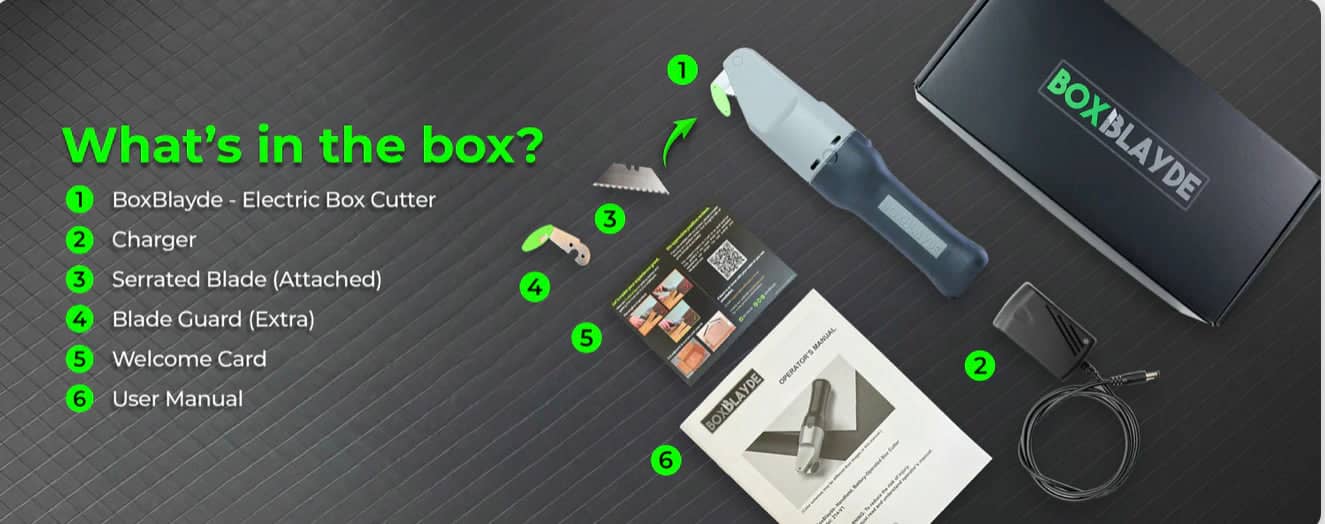
BoxBlayde uses a motor to vibrate a guarded blade. The user guides the tool along cardboard instead of repeatedly drawing an exposed knife toward the end of a cut. The company’s product guide describes a rechargeable tool that accepts compatible standard two-notch utility blades. Replacement blades matter because a powered handle that requires rare consumables could become expensive to keep in service.
There is still a blade, a battery that needs charging and an operating procedure to learn. The maker recommends adult use and explains how to change the blade with the cover removed. A buyer should use the manufacturer’s instructions for the model they receive. A guarded design alone does not establish an injury rate.
Who built BoxBlayde?
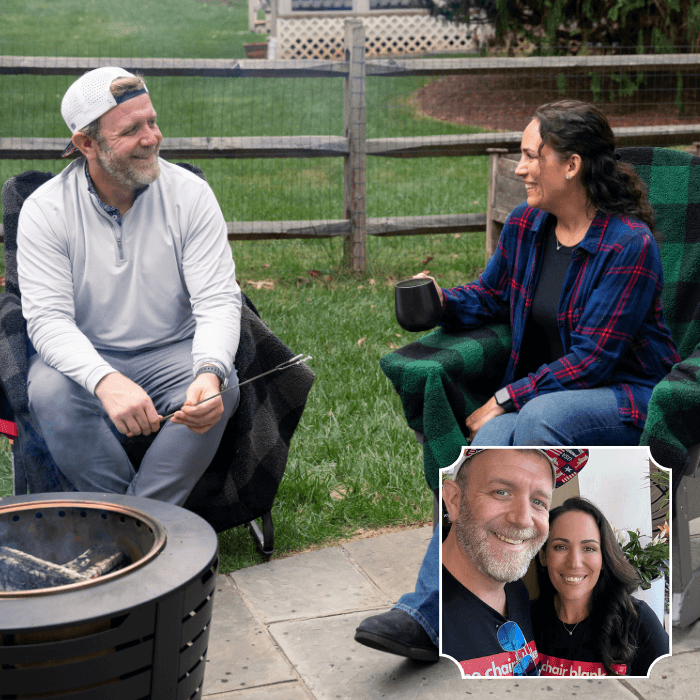
Wright traces the idea to his garage and the pile of delivery boxes waiting for trash day. The founders’ account credits former business partner Rick Spitz and Rick’s son John with design and manufacturing experience from building drones. Dan Ginsberg contributed supply-chain experience. All four belong in the company history even though Wright was the person viewers watched negotiate.
The team formed in 2020 and spent roughly two years developing and testing designs. Its first Kickstarter customers came later. That sequence matters for hardware: a campaign can demonstrate willingness to order, while shipping a working product tests a different set of skills.

BoxBlayde’s founding team. Source: BoxBlayde.
“Non-exposed, vibrating blade” — BoxBlayde’s description of its cutting mechanism.
What happened to BoxBlayde on Shark Tank?
The episode record puts Wright’s ask at $200,000 for 5%. Kevin O’Leary, joined by Chip and Joanna Gaines, proposed $200,000 for 20%. Daniel Lubetzky offered the same amount for 15% before withdrawing. Reporting also describes a royalty-based counter. Wright did not accept an offer.
Keeping the check size constant makes the disagreement easy to see. Under the opening ask, $200,000 bought one twentieth of the business. At 20% it bought one fifth. An investor could reasonably see a niche tool competing against a cheap knife. A founder with industrial distribution already under way could reasonably believe a small ownership stake was enough. Those are ways to understand the disagreement, not claims about anyone’s private reasoning.
Deal snapshot
| Negotiation point | What the evidence supports |
|---|---|
| Original ask | $200,000 for 5% |
| O’Leary and the Gaineses | $200,000 for 20% proposed |
| Lubetzky | $200,000 for 15% proposed, then withdrawn |
| Final result | Wright left without a deal |
Why the warehouse customer changes the math
A household is likely to buy one tool and use it occasionally. A business can test one unit, measure time spent breaking down cartons and decide whether to equip several workstations. That makes the purchase easier to evaluate: the buyer can compare labor time, replacement blades, charging and training against its existing process. The important input is how often the job occurs.
BoxBlayde’s sales channels reflect that distinction. The store lists single tools, multipacks, holsters and blades, with a separate route for business inquiries. The company reports an agreement with industrial supplier Grainger and use in Walmart distribution centers in 2025. That is a statement about industrial distribution; it is not evidence the cutter was stocked on every Walmart retail shelf.
Business model snapshot
| Business question | Answer |
|---|---|
| Core sale | A powered cardboard cutter |
| Additional purchases | Multipacks, replacement blades, guards and holsters |
| Business customer | Operations that repeatedly break down cartons |
| Useful buyer metric | Cost per workstation relative to time saved |
| Financial unknown | Current profit, unit volume and repeat purchase rate |
What happened after Shark Tank?
Latest update — November 12, 2026. The brand maintains a US storefront with individual tools, business inquiries and accessory bundles. Some offers are specifically labeled as presales.
A presale listing is evidence of an offer, not a promise that every configuration is ready for immediate dispatch. Check the delivery estimate beside the specific bundle. The company’s own chronology places Kickstarter deliveries, Amazon availability and the reported distribution agreement before the January 2026 broadcast. No public figure reviewed here isolates sales caused by the appearance.
Current status evidence
| Evidence | What it establishes |
|---|---|
| Store and business inquiry pages | Customers have a direct path to evaluate products and request information. |
| Company timeline | Dates distribution work to before television. |
| Episode coverage | Records offers but no accepted Shark investment. |
Company timeline
| Date | Milestone |
|---|---|
| 2020–22 | The team formed and tested prototypes. |
| October 2023 | Public Kickstarter launch. |
| February–October 2024 | First backer deliveries, then Amazon distribution, according to the company. |
| 2025 | Company reports industrial distribution and overseas expansion. |
| January 2026 | Wright declined the Sharks’ terms. |
| November 2026 | The company continues to list products and accessories. |
Who should consider a powered cardboard cutter?
Start with the pile rather than the price: how often does it accumulate, who breaks it down, and how long does that take? For a household that only needs to slit tape, buying, charging and storing a separate device may add work. A staffed receiving area has a stronger reason to test one. A trial should use the facility’s actual cartons and normal workflow; a fast cut on a demonstration box does not tell a manager how much time a shift will save.
Before ordering, check blade compatibility, the contents of the selected bundle and delivery timing. BoxBlayde lists both tools and accessory kits. A low price attached to a pack of holsters or guards is not the price of a complete powered cutter.
What can founders learn from BoxBlayde?
The strongest part of this case is the order of events. The television demonstration made a repetitive job easy to visualize; the industrial sales effort was already under way. Founders measuring a media appearance should preserve a record of the customers, contracts and channels they had beforehand. Otherwise it becomes easy to mistake work done over several years for the result of a few minutes on air.
The Season 17 episode guide lists the other pitches. Readers following the other businesses that appeared that evening can also find BocceRoll, The Yes Girls, SOMNIA+.
Frequently asked questions
Did BoxBlayde get a deal? No. Wright received offers but accepted none.
Who invented BoxBlayde? Rob Wright originated the idea; the company also credits Rick Spitz, John Spitz and Dan Ginsberg as the founding team.
Does it use proprietary blades? The maker specifies compatible standard two-notch utility blades; check its dimensions before replacing one.
Was Shark Tank its first launch? No. It launched on Kickstarter in 2023 and began shipping to backers in 2024.
Is it only for businesses? No. The brand sells individual tools to consumers and supports business purchases.
The weekly question
From obsession to clarity — one original question every week.
We answer one noisy topic at a time, in full. No daily roundup, no thread bait — just the question, the principles, and the system.