
ZALT After Shark Tank: Kevin O'Leary's Deal, the Zyn Lookalike Problem, and 2026 Update
ZALT sells nicotine-free electrolyte pouches that three Sharks said look too much like Zyn. Kevin O'Leary invested anyway. Here is the deal, the $1 million revenue claim, the regulatory gap around nicotine-free pouches, and where ZALT stands in November 2026.


Kendra Scott looked at the little round tin and said what a lot of viewers were thinking: it looks exactly like the nicotine pouches teenagers are already sneaking into school. Lori Greiner agreed. Daniel Lubetzky went out on the same concern.
Kevin O'Leary wrote the cheque.
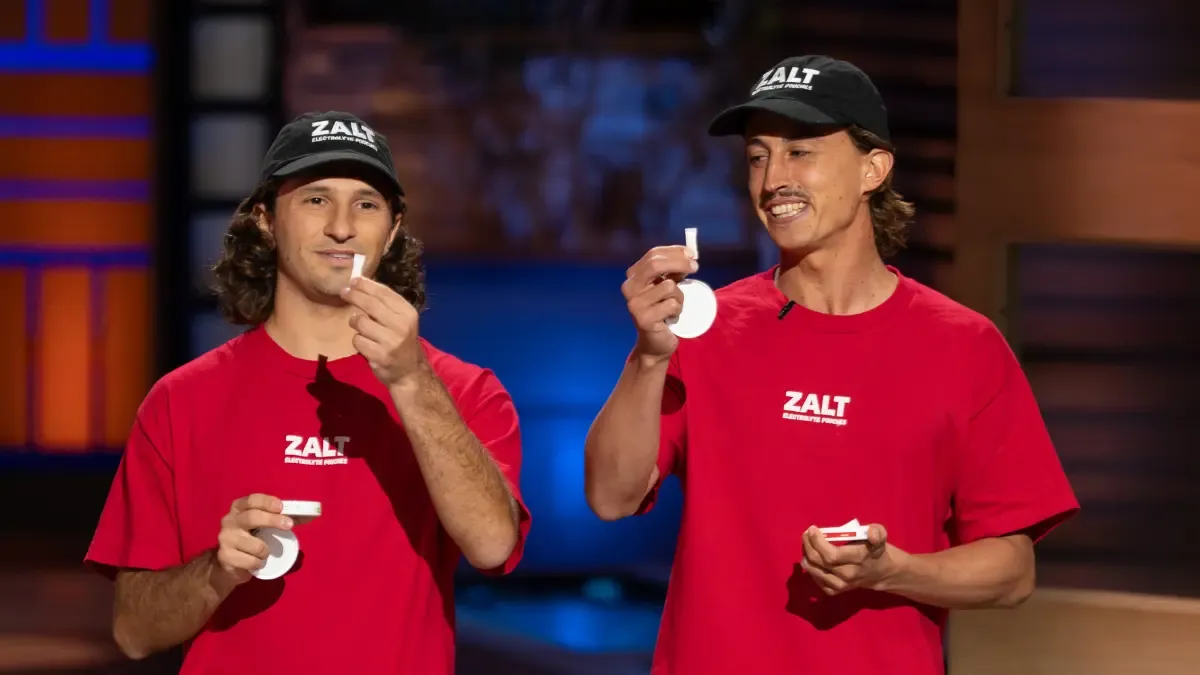
Sam Mitchell and Dominic Gozza pitch ZALT in Season 18, Episode 3. Photo: ABC
ZALT, a San Diego brand of nicotine-free, stimulant-free electrolyte pouches, left Shark Tank Season 18, Episode 3 with $150,000 from O'Leary for 12.5% of the company. Three weeks later it announced it had passed $1 million in revenue and 100,000 cans sold in ten months. It is one of the fastest-moving businesses of the season, and it sits squarely in a regulatory gap that nobody has closed yet.
Here is the deal, the economics, the question the Sharks could not agree on, and what has happened since.
ZALT After Shark Tank: Quick Answer
Short on time? Here is what happened to ZALT after Shark Tank.
Pitch result: Founders Sam Mitchell and Dominic Gozza asked for $150,000 for 5%, a $3 million valuation, on about $400,000 in sales and a roughly $50,000 year-to-date loss. Kendra Scott, Lori Greiner and Daniel Lubetzky went out over the product's resemblance to nicotine pouches; Steven Bartlett went out over the use case. Kevin O'Leary offered $150,000 for 15%, the founders countered at 10%, and they settled at $150,000 for 12.5%, a $1.2 million valuation.
Current status: Active and growing fast. On October 27, 2026 ZALT announced via press release that it had surpassed $1 million in revenue and 100,000 cans sold since its January 2026 launch, and that the O'Leary deal had been finalised. It sells direct, on Amazon, and is moving into retail through wholesale platform Airgoods.
| ZALT at a glance | Details |
|---|---|
| Company | ZALT |
| Founders | Sam Mitchell (creative strategy) and Dominic Gozza (software engineer) |
| Based in | San Diego, California (founders split time with South Florida) |
| Launched | January 12, 2026 |
| Product | Nicotine-free, stimulant-free oral pouches with electrolytes and vitamins B6 and B12; 15 pouches per can |
| Flavors | Watermelon, Cool Mint, Lemon Lime, Strawberry Lemonade |
| Price | From $9.99 per can; three cans $32.97; five cans $44.95 |
| Shark Tank appearance | Season 18, Episode 3 ("Diary of a Shark"), October 7, 2026 |
| Ask | $150,000 for 5% ($3 million valuation) |
| Deal | $150,000 for 12.5% with Kevin O'Leary ($1.2 million valuation) |
| Website | tryzalt.com |
What Is ZALT?
ZALT is a small fabric pouch, placed between the lip and gum, that releases electrolytes while the user drinks water as usual. Each pouch contains about 372 mg of electrolyte compounds (sodium citrate, potassium citrate and sea salt) delivering roughly 55 mg of sodium and 60 mg of potassium, plus vitamins B6 and B12. The base is microcrystalline cellulose with xylitol, MCT oil, stevia and natural flavor. There is no nicotine, no caffeine and no sugar.
The format is identical to a nicotine pouch because that is the point. ZALT's pitch is that millions of people already have the habit of tucking a pouch under their lip, and some of them would rather it delivered salt than nicotine. It is made in FDA-registered, GMP-certified facilities in California and Texas.
$1.90
Cost to make one can
Retails from $9.99
$400K
Sales at taping
About $50K year-to-date loss
$1M+
Revenue by late October 2026
Company press release, 10 months after launch
100K+
Cans sold by late October 2026
$0.42
Lowest price per pouch
Source: Shark Tank Season 18, Episode 3; ZALT press release via BevNET (Oct 27, 2026); Shark Tank Success
A $1.90 can at $9.99 is roughly 80% gross margin before shipping and marketing, and about 55% after shipping by one analyst's estimate. That is a better margin than most beverages in the Tank this season, which is why O'Leary was willing to look past the optics.
Who Founded ZALT?
Sam Mitchell studied construction management at the University of Florida, worked as an assistant project manager at The Haskell Company, co-founded a coffee brand called roo.bru, and sat on the board of the anti-litter nonprofit UNLITTER. He runs ZALT's creative and brand strategy.
Dominic Gozza studied computer science at the University of North Florida and was a staff software engineer at fintech Altruist before ZALT. Both founders surfed competitively in Florida, and the brand's marketing leans on surf, gym and endurance imagery.
The pair launched ZALT on January 12, 2026, selling almost entirely through their own website with Meta ads doing most of the acquisition work.
What Happened to ZALT on Shark Tank?
ZALT appeared in Season 18, Episode 3, the episode that introduced Dragons' Den investor and Diary of a CEO host Steven Bartlett as a guest Shark. The panel was Bartlett, Kevin O'Leary, Lori Greiner, Daniel Lubetzky and Kendra Scott.
Mitchell and Gozza asked for $150,000 for 5%. They disclosed about $400,000 in sales since January, a roughly $50,000 loss year to date, and the $1.90 landed cost against a $9.99 price.
The lookalike objection
Kendra Scott said a pouch that looks this much like a nicotine product could confuse children, and went out. Lori Greiner shared the concern. Daniel Lubetzky, who built KIND Snacks on a health-forward brand, went out on the same grounds: kids picking up the habit of a pouch, whatever is in it.
Steven Bartlett disclosed his ties to electrolyte drink company Cadence, said the pouch made him look like a rabbit, and asked the question the founders will hear for years: why would anyone choose a pouch over a drink or a tablet?
Kevin O'Leary liked the founders' candour about the loss, liked the early sales, and liked the margin. He offered $150,000 for 15%, triple the equity the founders wanted to give. They countered at 10%. The deal closed at 12.5%.
Graphic: Geeks Around Globe
| ZALT Shark Tank deal snapshot | Details |
|---|---|
| Ask | $150,000 for 5% |
| Implied ask valuation | $3,000,000 |
| O'Leary's offer | $150,000 for 15% |
| Founders' counter | $150,000 for 10% |
| Final deal | $150,000 for 12.5% |
| Implied deal valuation | $1,200,000 |
| Sharks out | Kendra Scott, Lori Greiner, Daniel Lubetzky (resemblance to nicotine pouches); Steven Bartlett (use case) |
ZALT shared the episode with Pup Stack, which took a deal with Kendra Scott, UnderWarmer, and Nutcase, the Ninja-backed cashew milk that left with no offers.
The question the Sharks were actually arguing about
Scott, Greiner and Lubetzky were not objecting to salt and B vitamins. They were objecting to a form factor. And on that point the regulatory record is on their side, because nicotine-free pouches currently fall through a gap.
Nicotine pouches are regulated by the FDA's Center for Tobacco Products and cannot be sold to anyone under 21 under federal Tobacco 21 law. Only Zyn has received FDA marketing authorisation, in January 2025, and the agency has since slowed further authorisations over youth-risk concerns. A February 2026 paper in Tobacco Prevention & Cessation found Zyn holds nearly 69% of the youth nicotine-pouch market.
A pouch with no nicotine is not a tobacco product. It is a dietary supplement. That means no federal minimum purchase age, no Tobacco 21 ID check, and no premarket authorisation. Caffeine pouches, the closest cousin, have already drawn attention on exactly this basis: NBC News reported in 2025 that high-school students were using caffeine pouches alongside Zyn, and in June 2026 the FDA added caffeine labelling to its Human Foods Program agenda. ZALT contains no caffeine, which removes the stimulant worry, but not the habit-formation one the Sharks raised.
ZALT's website does not, as far as we can find, state a minimum age or require age verification at checkout. That is legal. It is also the single most obvious thing a critic, a regulator or a school district will point at as the brand grows, and the single easiest thing for the company to fix pre-emptively.
How Does ZALT Make Money?
| Business model element | ZALT's approach |
|---|---|
| Customers | Gym-goers, endurance athletes, surfers, and former or current nicotine-pouch users who want the habit without the nicotine |
| Value proposition | Hands-free, spill-free electrolytes in a format millions already use |
| Revenue sources | Direct website sales and subscriptions, Amazon, wholesale via Airgoods, early retail |
| Unit economics | About $1.90 landed cost per can; $9.99 retail; roughly 55% margin after shipping |
| Marketing | Meta ads, surf and fitness content, now Kevin O'Leary |
| Advantages | High margin, cheap to ship, habitual repeat use, differentiated format |
| Main risks | Nicotine-pouch association, lack of age gating, unproven absorption claims, Bartlett's "why not a drink" problem, fast-follower brands |
Two of ZALT's claims deserve a flag. The company says the pouch works through buccal absorption, through the lining of the mouth. No published study we could find quantifies how much of the electrolyte load is absorbed that way versus simply swallowed with water. And the actual dose is modest: six pouches deliver about 330 mg of sodium, a fraction of what a heavy sweater loses in an hour. ZALT is a convenience format, not a clinical one, and its marketing is careful not to claim otherwise.
What Happened After Shark Tank?
Latest update, November 6, 2026: ZALT is growing quickly. In an October 27 press release distributed via BevNET, the company said it had passed $1 million in revenue and 100,000 cans sold in the ten months since launch, and that the deal with Kevin O'Leary had been finalised. Co-founder Dominic Gozza said the team's expectations had been "blown away." The brand launched a V2 formulation with two new flavors, sells on Amazon, and is onboarding retailers through Airgoods. No profit figures have been released.
January 12, 2026
ZALT launches online with Watermelon and Cool Mint
Mid-2026
About $400,000 in sales and a $50,000 loss at the time of taping
October 7, 2026
Shark Tank Season 18, Episode 3 airs
$150,000 for 12.5% with Kevin O'Leary; three Sharks out over nicotine-pouch resemblance.
October 27, 2026
Press release: $1M+ revenue, 100,000+ cans, O'Leary deal finalised
Q4 2026
V2 formulation with Lemon Lime and Strawberry Lemonade; Amazon and wholesale expansion
| Area | Evidence | Assessment |
|---|---|---|
| Website and subscriptions | Active | Verified |
| Deal closing | Company states finalised (Oct 27 release) | Company-reported, consistent with O'Leary's public comments |
| $1M revenue / 100K cans | Company press release | Self-reported; plausible against $400K at taping and a post-air spike |
| Retail distribution | Airgoods wholesale; store locator live | Early |
| Age verification | None found on site | Gap |
| Regulatory status | Dietary supplement; not FDA-evaluated | Standard for category |
| Business status | Profitable unit economics, rapid growth, one high-profile investor | Strong, with a reputational exposure |
Lessons From ZALT's Journey
Margin forgives optics, up to a point
O'Leary is the Shark most likely to ignore how a product looks if the numbers work, and $1.90 to $9.99 works. The other four were pricing in a risk he was not: that the format itself becomes the story.
Borrowed habits cut both ways
ZALT's genius is that it did not have to teach anyone how to use it. Its exposure is that the habit it borrowed is one regulators, parents and schools are actively trying to break.
Close the gap before someone else names it
An 18+ or 21+ checkout gate would cost ZALT almost nothing in sales and would neutralise the strongest criticism before the brand reaches mass retail. Kendra Scott made the argument for free on national television.
Answer Bartlett's question in the marketing
"Why a pouch and not a drink" has a real answer: you cannot drink during a set, a wave, a long run or a meeting. ZALT's best customers already know that. Its advertising should say it.
Final Take
ZALT is the clearest example this season of a product whose biggest asset and biggest liability are the same thing. The pouch format gave it a ready-made habit, an 80% gross margin and $1 million in revenue in ten months. It also put it in a category that three Sharks would not touch and that federal regulators have not yet caught up with.
Kevin O'Leary's bet is that the economics outrun the optics. The company's October numbers suggest he is winning so far. Whether that holds depends on how ZALT handles the age-gating question before someone else forces the issue.
We will update this piece as the retail rollout and any regulatory developments arrive.
Frequently Asked Questions
Did ZALT get a deal on Shark Tank?
Yes. Kevin O'Leary agreed to invest $150,000 for 12.5% in Season 18, Episode 3. The company says the deal was finalised in October 2026.
Does ZALT contain nicotine or caffeine?
No. ZALT pouches contain electrolytes (sodium and potassium citrate, sea salt) and vitamins B6 and B12, with no nicotine, caffeine or sugar.
Why did some Sharks refuse to invest in ZALT?
Kendra Scott, Lori Greiner and Daniel Lubetzky were concerned that the product looks like a nicotine pouch and could normalise the habit for children. Steven Bartlett questioned why a pouch beats a drink or tablet.
How much does ZALT cost?
From $9.99 per can of 15 pouches; three cans for $32.97 and five for $44.95, with subscription discounts.
Is there a minimum age to buy ZALT?
There is no federal minimum age for nicotine-free pouches, and ZALT's website does not state one or require age verification at checkout as of November 2026.
How much revenue has ZALT made?
The company announced on October 27, 2026 that it had surpassed $1 million in revenue and 100,000 cans sold since its January 2026 launch.
Where is ZALT made?
In FDA-registered, GMP-certified facilities in California and Texas, according to the company.
More Shark Tank Season 18 Case Files
- Nutcase: Ninja's cashew milk and the $10M-to-$500K valuation gap
- Loli-Med: Lori Greiner's deal and what "FDA registered" really means
- Ball 2: the 55% deal MrBeast took on the Season 18 premiere
- Fundelivered: the $600K mystery-box deal
- Donna's Pickle Beer: no deal at a $10M valuation
More Shark Tank Updates
Sources: Shark Tank Season 18, Episode 3 (ABC, Oct 7, 2026); ZALT press release via BevNET (Oct 27, 2026); Shark Tank Success; Shark Tank Blog; Filmifeed Week 2 recap; Gonzalez & Friedman, "Nicotine pouches: A wolf in sheep's clothing," Tobacco Prevention & Cessation (Feb 2026); Vaping360 on caffeine-pouch age rules (Sept 2026); FDA statements on Zyn authorisation (Jan 2025); tryzalt.com. Revenue figures are company-reported.
The weekly question
From obsession to clarity — one original question every week.
We answer one noisy topic at a time, in full. No daily roundup, no thread bait — just the question, the principles, and the system.
More from shark-tank-usa-season-18
All season pitches
Shark Tank USA
Loli-Med After Shark Tank: Lori Greiner's Deal, What "FDA Registered" Really Means, and 2026 Update

Shark Tank USA
Fundelivered After Shark Tank: The $600K MrBeast Deal, What's Really in the Box, and 2026 Update

Shark Tank USA