What Is AI Dreaming? Agent Memory and Compaction Explained
AI dreaming can reorganize saved memories or change model parameters. A simple example separates memory, conversation context and compaction.

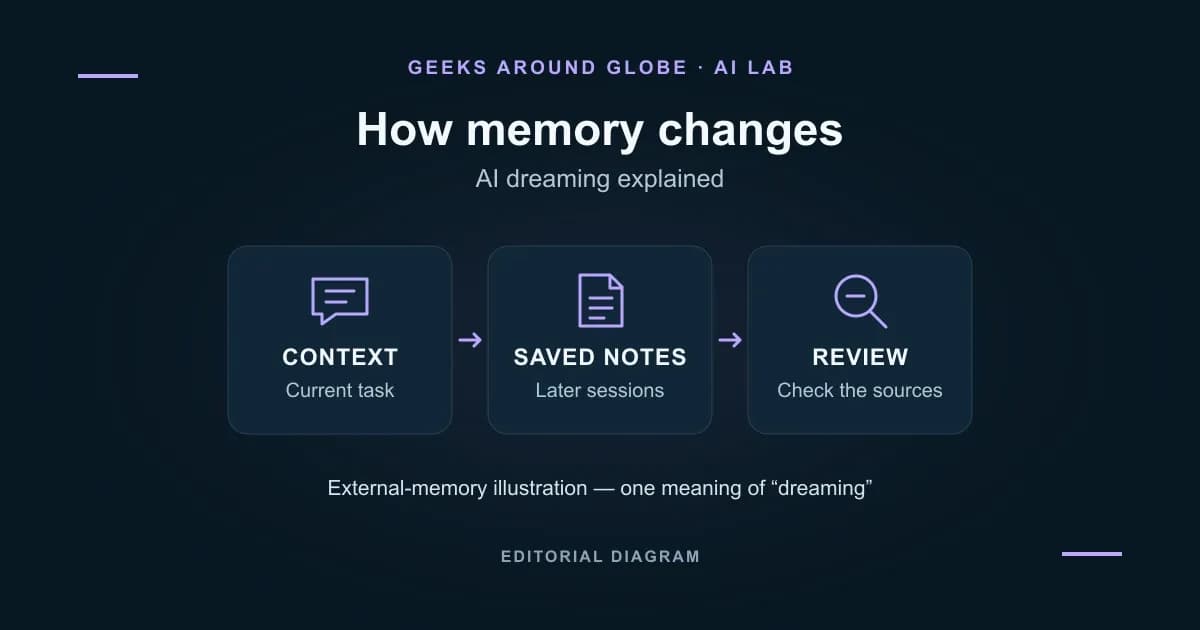
AI dreaming is a metaphor for work an AI system does between interactions to prepare for later ones. In Anthropic’s agent-memory research, that means reviewing past activity to improve saved notes. Google’s sleep research uses a different approach that changes model parameters. The same label can describe different mechanisms; it does not establish that a system experiences dreams. Anthropic’s research, Google’s sleep framework
For a reader trying to understand an assistant that “remembers,” the useful question is concrete: what information changes, where is it kept, and how does it reach the next conversation?
Context, compaction and memory do different jobs
Anthropic’s November 6, 2026 article uses agent memory specifically for information retained between sessions as context that can be read later. It distinguishes this from learning within a conversation and changes to model weights. The components of agent memory
| Term | What it does in this explanation |
|---|---|
| Session context | Supplies information available during the current conversation. |
| Persistent memory | Saves information that can be read in later sessions. |
| Dreaming over memory | Revisits earlier activity to correct or organize saved information. |
| Compaction | Replaces older conversation turns with a shorter summary so work can continue within the context window. |
The first three descriptions follow Anthropic’s research terminology. The fourth comes from its compaction documentation, which describes a conversation-management operation rather than a promise of permanent recall. Memory research, Compaction documentation
A worked example: an assistant prepares a reading list
This is a fictional illustration created for this article, not a hands-on product test. The editor, documents, messages and saved notes below are invented. They show the differences without implying that a particular chatbot would produce these exact results.
Imagine an editor named Maya asks an assistant to prepare a weekly science reading list.
1. The current conversation holds the task
Maya provides two sample documents and these instructions:
Prepare three recommendations. Include sources and label estimates. Today’s list should contain free-to-read articles only.
Later, she adds:
Correction: free-to-read only applies to today’s list. In future lists, paid articles are fine if you label them.
Both messages are part of this session’s context. The distinction between “today” and “future lists” matters as much as the words “free-to-read.”
2. Compaction preserves the unfinished job
Suppose the conversation becomes long. A useful compacted summary for our example could be:
Task: finish today’s three-item science reading list. Use free-to-read articles today. Include sources and label estimates. Future lists may include paid articles if labeled. Two candidates selected; one remains.
This summary helps continue the current assignment. It deliberately omits the earlier back-and-forth. It is not, by itself, our fictional assistant’s permanent profile of Maya.
3. A saved memory carries something forward
A suitable persistent note might instead say:
Reading-list preferences: include sources; label estimates; label paid articles. Reference: Maya’s correction in the reading-list session.
Notice what is absent: today’s temporary restriction and the unfinished third recommendation. Those belong to the task, not necessarily every future interaction.
Now imagine the assistant had saved a bad note before Maya’s correction:
Maya never wants paid articles.
That sentence is short and easy to reuse. It is also wrong for future lists.
4. A later review repairs the note
In our illustrative dreaming pass, the assistant compares that saved sentence with the original conversation. It proposes:
Replace “never wants paid articles” with “paid articles are acceptable when labeled.” Keep today’s free-only restriction with today’s task. Preserve the correction’s source reference.
The useful outcome is a specific repair. Simply merging both statements into “Maya prefers free and paid articles” would conceal the contradiction rather than resolve it.
This example also exposes a limit: if the original correction is unavailable, the assistant cannot establish the intended preference from the bad note alone. A sensible response would be to mark the preference uncertain and ask Maya before relying on it.
What has actually been demonstrated?
Anthropic reports a Pokémon experiment in which reviewing a transcript corrected a mistaken location note, changing the agent’s subsequent navigation. It also reports that building a memory wiki did not clearly improve every task it tried. These are vendor-reported experiments; Geeks Around Globe has not independently reproduced them. They support a narrower conclusion than “dreaming makes every assistant better.” Anthropic’s experiments and limitations
Google’s October 27, 2026 research describes a different system: an offline phase consolidates information into longer-term model parameters, and a dreaming stage uses generated practice examples for further training. It explicitly operates within a fixed architecture and human-defined rules. That is a research framework, not evidence that a consumer Gemini account automatically trains itself on each conversation. Google Research
The broader idea also predates those November headlines. The April 2025 Sleep-time Compute paper explores processing context before future questions arrive, shifting some work ahead of the answer itself. This is related research, not a single universal feature shared by all assistants. Original paper
Can you turn AI dreaming on?
There is no single instruction in these sources that switches on the same capability across every chatbot.
As checked on November 21, 2026, Anthropic documents Dreams in Claude Managed Agents as a research preview. A job takes an existing memory store and past sessions, then produces a separate reorganized store. The original stays unchanged, allowing the output to be reviewed or discarded. That documentation concerns Managed Agents; it does not establish a universal switch in the consumer Claude app. Managed Agents Dreams documentation
If you are evaluating an assistant’s memory, use the reading-list example as a small diagnostic exercise: give it a temporary instruction, correct it, and later inspect what it retained. Treat any observed result as specific to that product, account and session.
Look for three useful controls: a way to inspect saved information, a way to correct a mistaken preference, and an explanation of which information reaches future conversations. An assistant that can explain those operations gives you something more useful to assess than the word “dreaming.”
Explore more emerging concepts in Geeks Around Globe’s AI coverage.
The weekly question
From obsession to clarity — one original question every week.
We answer one noisy topic at a time, in full. No daily roundup, no thread bait — just the question, the principles, and the system.