MiroFish: Fact or Hype? The 84,000-Star AI That Claims to Predict Anything
MiroFish went viral on TikTok and GitHub as a swarm-AI engine that "predicts anything." The star count is real. The predictions are another story.


If you've been on AI TikTok lately, you've seen it: a dark GitHub page, a cursor hovering over a repo called 666ghj/MiroFish, and a voiceover saying it "already has over 80,000 stars." The pitch is simple and huge — an open-source AI that builds a miniature digital society, lets thousands of agents argue in it, and tells you what happens next.
So we did what Geeks Around Globe always does. We went back to the origin question: can you actually predict a crowd by simulating one? And then we checked every claim.
Short answer: the project is real, the popularity is real, and the "predict anything" part is not proven. Here's the full breakdown.
84.2K
GitHub stars
As of November 2026
12.7K
Forks
88
Open issues
10 days
Reported build time
¥30M
Reported incubation funding
From Shanda Group's founder, per Chinese press
0
Published accuracy benchmarks
Source: GitHub, intnews.it, Pedaily
What MiroFish actually is
MiroFish describes itself as "a simple and universal swarm intelligence engine, predicting anything." In practice, it works like this:

MiroFish's start screen: upload a report, describe what you want to predict. Screenshot: MiroFish / GitHub
- You upload seed material — a news article, a policy draft, a report — plus a plain-language question ("How will people react to this announcement?").
- It builds a knowledge graph from that document, pulling out people, organisations and relationships.
- It spawns AI agents based on those entities, each with a persona, memory and behaviour rules.
- It runs a simulated social network where the agents post, reply, persuade and shift opinions over many rounds.
- It writes a prediction report based on what emerged, and lets you chat with individual agents afterwards.
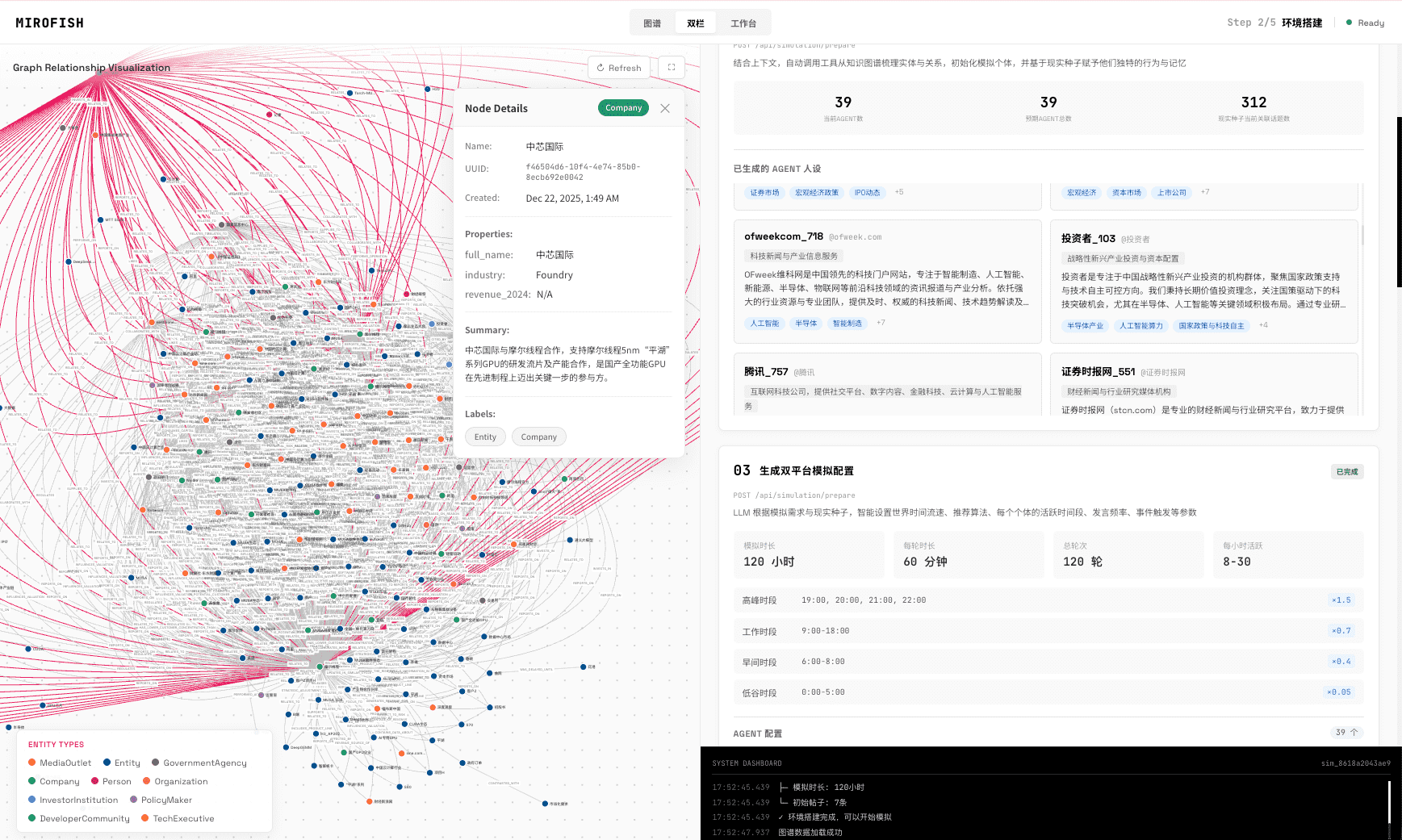
Step 2: the knowledge graph extracted from the seed document (left) and the agent personas and simulation parameters generated from it (right). Screenshot: MiroFish / GitHub
The simulation core isn't built from scratch. It runs on OASIS, an open-source social-simulation framework from the CAMEL-AI research community, published in late 2024 and designed to scale to a million agents.
The developer behind the 666ghj account is a Chinese student developer (reported as Guo Hangjiang) who previously hit GitHub's #1 trending spot with BettaFish, a multi-agent public-opinion analysis tool. MiroFish is the sequel: where BettaFish analysed what people had said, MiroFish tries to simulate what they will say.
The origin question: can you simulate your way to the future?
This idea is much older than LLMs. In 1971, economist Thomas Schelling showed that you could place simple "agents" on a grid, give them one mild rule about their neighbours, and watch a whole city segregate itself — a big pattern nobody programmed directly. That became the foundation of agent-based modelling, later pushed forward at places like the Santa Fe Institute for economics, epidemics and traffic.
The catch has always been the same: a simulation is only as good as its agents. Schelling's agents were deliberately dumb so researchers could understand them. MiroFish swaps in large language models that sound like real people. That makes the output far richer — and far harder to validate.
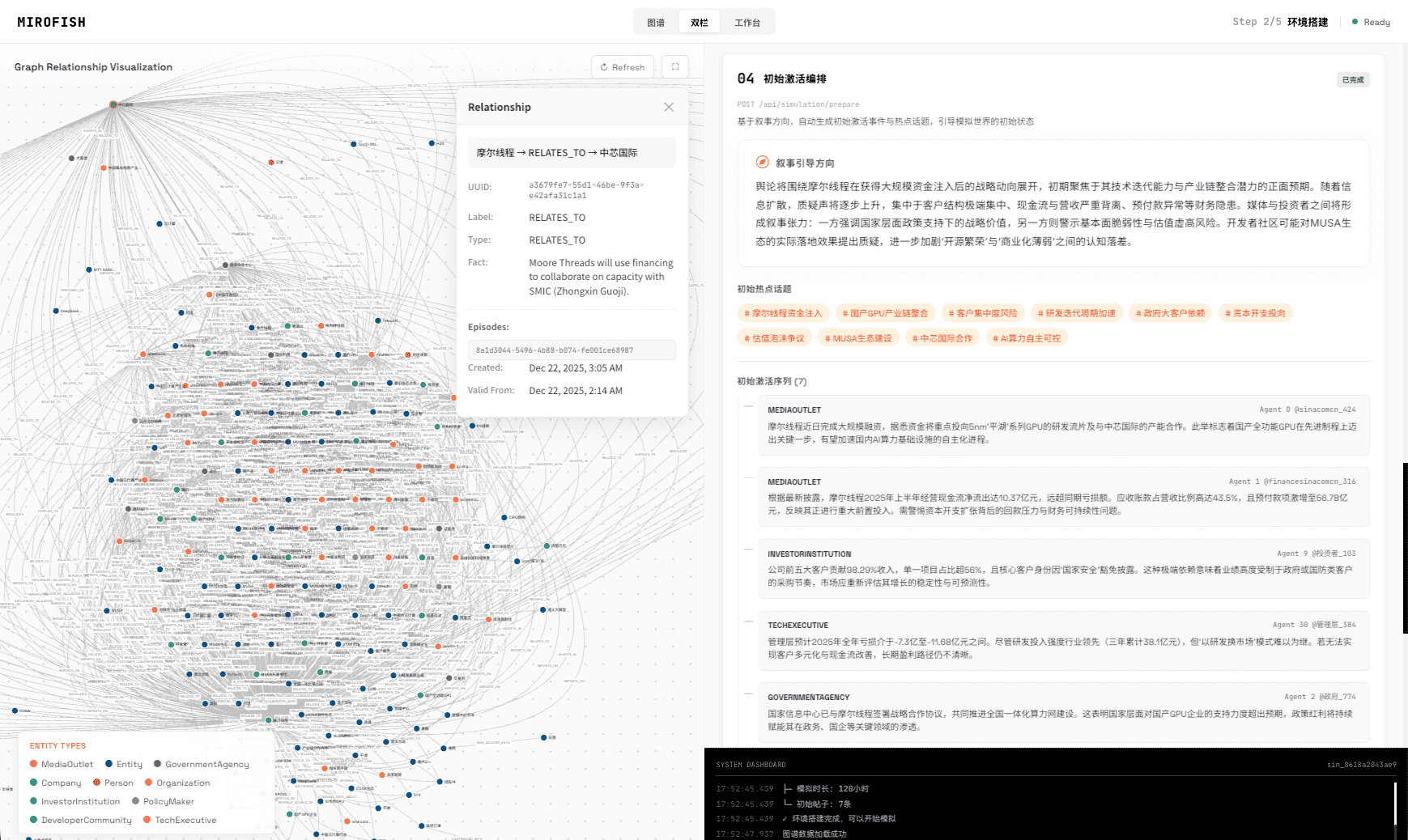
The simulation kicks off: agents playing media outlets, investors and officials post their opening takes. Every one of them is the same language model in a different role. Screenshot: MiroFish / GitHub
Here's the key problem that the hype skips: every agent is the same language model wearing a different costume. A thousand agents is not a thousand independent opinions; it's one model role-playing a thousand times. And OASIS's own researchers found that LLM agents follow the majority opinion more readily than real humans do. A crowd of agreeable clones can produce a very convincing — and very wrong — consensus.
Claim-by-claim verdict
| Claim | Verdict | Why |
|---|---|---|
| It has over 80,000 GitHub stars | FACT | The repo shows about 84,200 stars and 12,700 forks as of November 2026. |
| It hit #1 on GitHub's global trending list | FACT | It topped global trending on 7 March 2026, roughly three months after launch. |
| It's backed by a major Chinese tech company | FACT | The README credits incubation by Shanda Group. The ¥30M figure comes from Chinese press, not the project. |
| It was built in about 10 days | LIKELY FACT | Widely reported by Chinese media and repeated by the developer, but not independently verifiable. |
| It runs thousands (or even a million) agents | MOSTLY HYPE | The README says thousands and the app's own start screen talks about million-scale agent worlds. Real-world tests ran around 25 to 52 agents, because the count depends on how many entities your document contains. |
| It can "predict anything" | HYPE | There is no published backtest, no accuracy rate and no comparison against real outcomes. |
| It can predict the stock market | HYPE | The one public head-to-head test got the market direction wrong and picked zero of the top five gainers. |
| It's useful for exploring how opinion might unfold | PARTLY FACT | Reviewers say it produces interesting narrative scenarios that a single prompt struggles to match. |
The star count is real — but stars aren't proof
The TikTok claim checks out. MiroFish's growth has been remarkable for a project that only went public at the end of November 2025.
| MiroFish GitHub stars over time | |
|---|---|
| Mar 2026 | 18K |
| Apr 2026 | 51.7K |
| Aug 2026 | 70.8K |
| Oct 2026 | 76.9K |
| Nov 2026 | 84.2K |
Source: LinkedIn, PyShine, Zentor, Pasquale Pillitteri, GitHub (snapshots at different dates)
But a GitHub star is a bookmark, not a review. People star a repo because it looks interesting, because a viral video told them to, or to try it later. 84,000 stars tells you MiroFish has world-class attention. It tells you nothing about whether its forecasts are right. The repository's 88 open issues and a backtesting proposal that, as of October, was still open on GitHub tell that second story more honestly.
What happened when people actually tested it
Two independent trials stand out.
The WPP / Satalia stock test. A data scientist at WPP's Satalia ran MiroFish before the US market open and asked whether the S&P 500 would close up or down, and which five stocks would gain most. As a control, the same seed and question went to a single Gemini call — no swarm, no memory, no tools. On the reported day, both predicted a decline; the index actually rose 0.77%. Neither picked any of the real top five gainers. The swarm cost about a dollar, ran roughly 25 agents instead of the 100 the team wanted, and the authors concluded it added complexity without adding information — while fairly noting that one day is not a verdict.
They also hit practical walls: an outdated Chinese-only Docker image, output truncation when switching away from the recommended model, and the free tier of Zep Cloud (a required memory service) running out after three runs.
The sspai long-run review. Chinese tech publication sspai ran a bigger simulation: 40 rounds, 52 agents and 157 entities, taking about forty minutes. The reviewer found token use very heavy, results that changed on every run, and advised against using it for trading. Their summary was essentially: it can sketch a trend, not design the next iPhone.
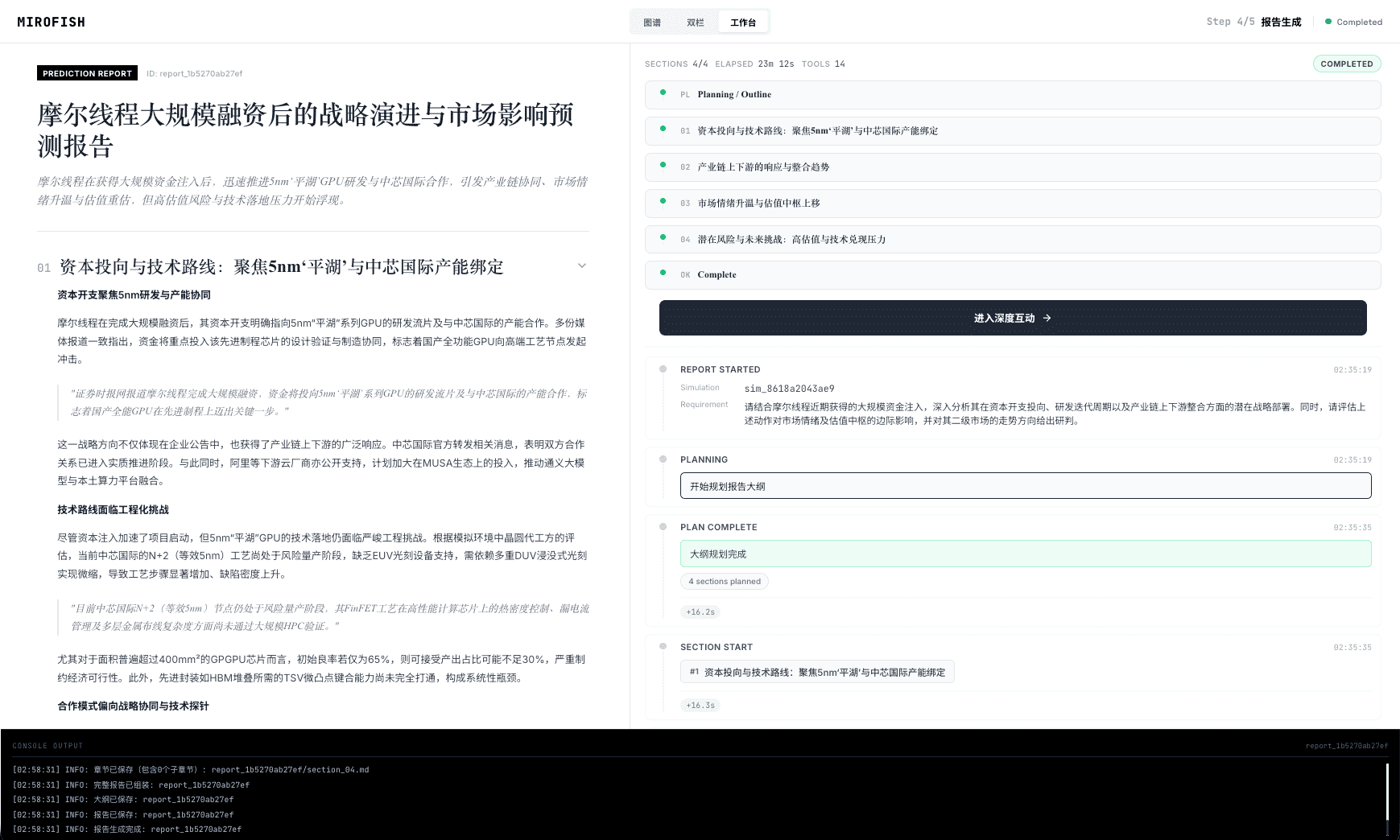
The end product: a polished, confident-sounding prediction report. Polish is not the same as accuracy. Screenshot: MiroFish / GitHub
That last screenshot is the heart of the hype problem. MiroFish's reports look like analyst research — structured sections, quotes from "stakeholders", clear conclusions. But nothing in the output tells you how likely any of it is to be right.
Late 2025
BettaFish hits #1 on GitHub
The same developer's public-opinion analysis tool goes viral first.
26 Nov 2025
MiroFish repo goes public
7 Mar 2026
#1 on GitHub global trending
Around 18,000 stars within days of the spike.
May 2026
WPP / Satalia stock test
Swarm and single-LLM control both miss the market direction.
Aug 2026
Passes 70,000 stars
Nov 2026
Passes 84,000 stars
Viral TikTok clips push the 80K-star claim.
Watch out for the copycats
Viral repos attract clones, and MiroFish is no exception. The official homepage listed on GitHub is mirofish.ai, and the official source is github.com/666ghj/MiroFish. Other sites using the name are not necessarily the project. One investigation found that mirofish.my — which charges monthly subscriptions and advertises "1M+" agents per run — is not run by the MiroFish team. If you want to try it, start from the GitHub repo.
Two more things worth knowing before you self-host:
- License: MiroFish is AGPL-3.0. If you modify it and offer it as an online service, you must share your source code with users.
- Data: the default example configuration points to Alibaba Cloud's Qwen models, and memory runs through Zep Cloud. If your seed documents contain personal or confidential information, check where that data goes.
So, who should actually use it?
Good fit:
- Developers and researchers curious about multi-agent simulation who want a working, polished example to learn from.
- PR, policy and marketing teams who want to brainstorm how a message might spread or backfire — treating the output as a scenario, not a forecast.
- Writers and game designers exploring "what if" narratives (the README even demos simulating a lost ending of the Chinese classic Dream of the Red Chamber).

MiroFish's official demo: simulating the lost ending of the classic novel Dream of the Red Chamber. Creative scenarios are where it shines. Image: MiroFish / GitHub
Bad fit:
- Anyone making trading, betting or election calls.
- Anyone who needs repeatable, measurable accuracy.
- Anyone on a tight API budget — token use is heavy.
The verdict: real tool, unproven oracle
MiroFish is about 40% fact, 60% hype.
The fact part is genuinely impressive: a young developer shipped a polished, open-source swarm-simulation engine fast, got serious backing, and captured more developer attention than almost any AI project this year. The 80,000-star claim in that TikTok is true.
The hype part is the word predict. No one — including the project itself — has shown that MiroFish's forecasts beat a coin flip, a single chatbot prompt, or a human analyst. Until someone publishes a proper backtest, treat it as a sophisticated scenario generator, not a crystal ball.
Fifty years after Schelling's grid, the lesson still holds: simulations are brilliant for asking better questions. They are not, on their own, answers.
Sources: GitHub (666ghj/MiroFish), intnews.it, Pasquale Pillitteri, sspai (via Pillitteri), Zentor, PyShine, LinkedIn, Pedaily (via intnews.it). Star counts are snapshots and change daily. Images: MiroFish official README on GitHub.
The weekly question
From obsession to clarity — one original question every week.
We answer one noisy topic at a time, in full. No daily roundup, no thread bait — just the question, the principles, and the system.