
For anyone who spends even twenty minutes bent over a phone or gripping a controller, the “gamer lean” is painfully familiar. Rounded shoulders, a tense neck, and elbows floating in mid-air create a posture that feels normal in the heat of a match, but it slowly pushes the spine toward long-term damage. This problem now affects over 3 billion gamers, along with students, readers, and desk workers who sit for hours every day.
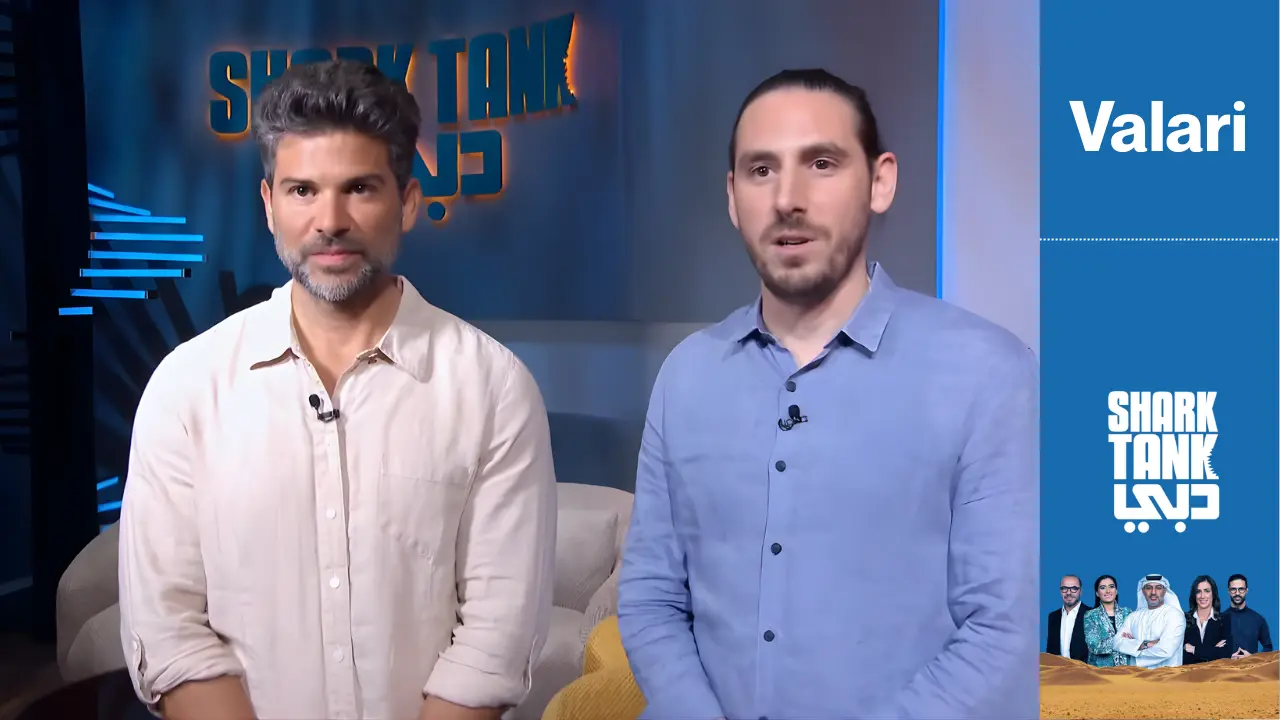
That is the pain point Nadim Makarem and Hilal Kanafani walked into Shark Tank Dubai to solve. The Beirut-born founders presented Valari, a simple cushion with a surprisingly powerful effect on posture. In less than a year, their tiny ergonomic idea grew into an international health-tech brand. Their pitch wasn’t only about selling a product. It became a clear lesson in how founders can use data, valuation discipline, and manufacturing strategy to build a defensible business in a crowded global market.
Shark Tank Dubai Pitch Summary (At a Glance)
| Founder(s) | Nadim Makarem & Hilal Kanafani |
| Ask | 950,000 AED for 5% equity |
| Valuation | 19 million AED |
| Product | Ergonomic elbow-support device improving posture |
| Sales to Date | 15,000 units in <12 months |
| Revenue | 700,000 USD (AED 2.5 million) |
| ROAS | 4.0 (high efficiency and scalability) |
| Offer Received | 950,000 AED for 20% equity |
| Outcome | Founders declined and walked away |
| Why They Walked | Offer undervalued current traction and future projections |
Ergonomics Is Becoming a Global Commodity
Valari’s value proposition is simple but powerful: support the elbows and shoulders so the spine can realign itself naturally. The surprise is how universal this solution actually is. Valari isn’t designed only for gamers. It targets what the founders call the “modern sitter” anyone who reads, scrolls, studies, or works with their arms unsupported.
Their demo explained the core insight in concrete terms:
“When your elbows aren’t supported, they hang, putting immense pressure on the shoulders and creating a bottleneck of tension in the neck. Your back rounds, and your posture collapses. Valari supports the shoulders so they drop, the tension vanishes, and the spine aligns naturally.”
This framing moves Valari from a niche gaming accessory into the global health-tech category. It turns posture correction into an accessible consumer product rather than a medical intervention. That mental shift massively expands the Total Addressable Market and helps explain the brand’s rapid traction worldwide.
The “Kickstarter to Global” Blueprint That Actually Works
Valari’s rise began with a $100,000 Kickstarter campaign, which acted as a low-risk R&D phase and real-world validation of product-market fit. The founders used these early signals to build investor-ready momentum before meeting the Sharks.
In just 12 months, they delivered:
- 15,000 units sold
- $700,000 (AED 2.5M) in revenue, driven mostly by the U.S.
- Strong growth through their website and a strategic Amazon US launch
- A consistent 11% month-over-month growth rate
Crowdfunding gave them credibility. U.S. traction gave them scale. But their Shark Tank Dubai appearance signaled a strategic expansion into the GCC where gaming culture is accelerating faster than almost anywhere in the world.
This “prove first, pitch later” model gave the founders powerful negotiation leverage inside the Tank. Their numbers were real, their demand was visible, and their market thesis was already validated.
High-Margin Manufacturing Is the Unseen Power Move
Behind the scenes, Valari’s economics are unusually strong. The company sells two main models:
- “Gen” (premium, ~300 AED) accounts for 70% of sales
- “Air” (lightweight, ~200 AED)
The surprising twist is that these premium-feeling products cost only $8 to $12 to manufacture.
Their manufacturing strategy reveals discipline:
- Production hubs in Delhi and Mumbai, balancing cost efficiency with quality control
- A high perceived-value product with extremely low unit cost
- A defensible IP moat, including ongoing work with legal firms to protect design and method
- A proactive stance toward “China clones,” instead of treating them like an existential threat
This combination of low cost, high demand, and strong branding creates a classic “moat” that protects Valari from copycats and makes it attractive to future investors whether or not a Shark invests today.
The Valuation Standoff A Masterclass in Knowing Your Worth
The most dramatic moment in the pitch came during valuation. The founders requested:
950,000 AED for 5% equity.
Most Sharks dropped out, citing concerns about ease of replication. One Shark finally offered:
950,000 AED for 20% four times the equity they wanted to give.
Many founders might fold under pressure. But Nadim and Hilal stood firm.
Why?
Because their 4.0 ROAS proved their acquisition funnel was efficient. Because their three-month projections demonstrated strong growth. And because giving up 20% this early would be unnecessary dilution for a company already performing at a high level.
Their counteroffer 7% reflected not ego, but math.
When the final offer stayed at 20%, they walked away.
A Shark left them with a telling message:
“You will succeed; you have the ingredients. My offer was based on the risks, but I am an investor in people… you should continue to develop yourselves and your products.”
They left without a deal, but with something equally important: narrative power. They showed the region what disciplined valuation looks like.
Valari and the Future of Human-Centric Design
Valari’s Shark Tank Dubai pitch proves that the next generation of consumer products will be shaped by digital lifestyles and physical pain points. The brands that succeed will be those that blend biomechanics, design simplicity, and digital-first scaling.
As sitting becomes the new smoking, ergonomic tools like Valari may force companies to rethink everything from office chairs to gaming setups. The question is no longer whether posture matters it’s whether we will redesign our daily environments to support healthier digital habits.
The Final Power Takeaway
When you have 15,000 units sold, a 4.0 ROAS, and a global customer base, you are not chasing investors. You’re choosing partners.
If the terms don’t respect the data, walking away isn’t a risk. It’s strategy.