
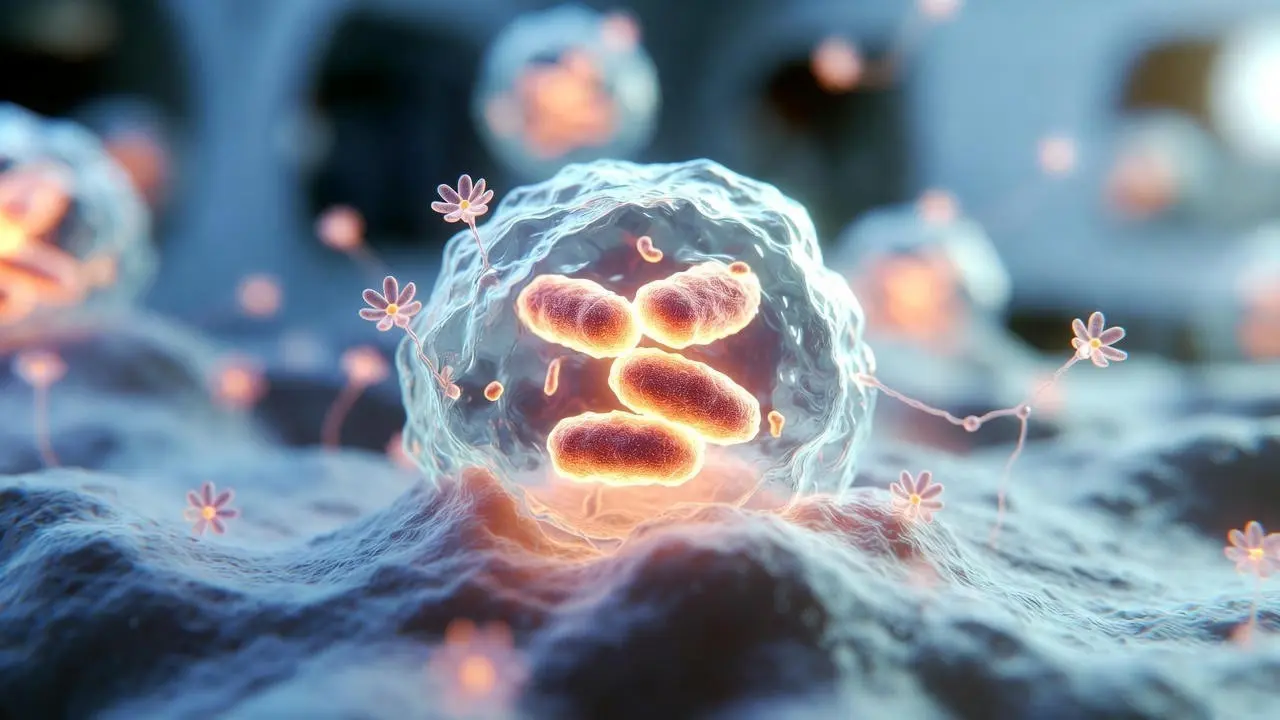
New lab research shows nanoflowers make stem cells produce double the usual number of mitochondria. This could lead to better energy delivery in aging or sick tissues. Early results point to possible new therapies for aging and disease.
TL;DR: What was found: Researchers showed that tiny nanoflowers added to human stem cells can nearly double their mitochondria, the cell’s energy producers. How it works: The particles trigger a natural process that helps stem cells make and share extra mitochondria with weaker cells. Why it matters: Many aging tissues and diseases fail because cells run out of energy, so boosting cellular power could improve healing and recovery. What’s next: Scientists plan animal studies to test safety, durability, and real world benefits.
Researchers found that adding microscopic flower-shaped particles called nanoflowers to human stem cells turned those cells into tiny energy factories. The stem cells made far more mitochondria, the parts of cells that act like tiny batteries. When those boosted stem cells were placed near old or damaged cells, they passed extra mitochondria to the weaker cells and helped them recover energy.
To test this, scientists grew human mesenchymal stem cells in the lab. They added the specially designed nanoflower particles. The nanoflowers entered the cells and triggered a natural program that makes mitochondria. The researchers counted mitochondria and found nearly twice as many in treated cells. They then put these energized stem cells close to cells that had low energy, and watched the transfer of mitochondria through tiny bridges between cells.
This finding matters because many diseases and aging problems come from cells that can no longer make enough energy. Tissues like muscles, the heart, and even the brain need steady energy to stay healthy. If doctors can use enhanced stem cells to donate extra mitochondria, they might boost healing after injury or slow some effects of aging. It could change how medicine approaches conditions linked to low cellular energy.
Lead researcher Dr Robert Smith said that seeing stem cells pass on functioning mitochondria to weaker cells was “like watching a team donate spare batteries to a failing device.” He also noted this does not yet mean a cure for aging but opens a new research path. Not all experts agree it will work the same way in people, and more testing is needed to be sure it is safe and effective.
This discovery also links to broader science. It touches on aging research, regenerative medicine, and nanotechnology. Better mitochondrial support could help not only diseases like Parkinson or heart failure but also help astronauts keep muscle and bone strength in space where energy production changes. The work also shows how tiny engineered particles can influence biology without harmful side effects.
Next, the team plans to test their approach in animal models. They want to check how long the energy boost lasts and whether it helps whole organs recover after injury. Researchers also must figure out the best dose of nanoflowers and whether there are risks, such as immune reactions or unexpected changes in cells.
This study shows a new way that tiny nanostructures could make stem cells better helpers inside our bodies. If future research confirms these results in real tissues, doctors may one day use energized stem cells to treat aging, injury, and maybe even some chronic illnesses.
Story Source:
Materials provided by Proceedings of the National Academy of Sciences. Content may be edited for style and length.
Journal Reference:
Full Author List. Nanoflower-enhanced stem cells double mitochondrial output and boost energy transfer. Proceedings of the National Academy of Sciences, 2025. Volume 122. DOI: 10.1073/pnas.2506130122