This Musician Saved an Image File to a Live Bird, and Now the Bird Sings It
What happens when a musician teaches a bird to sing a drawing, and it actually works?
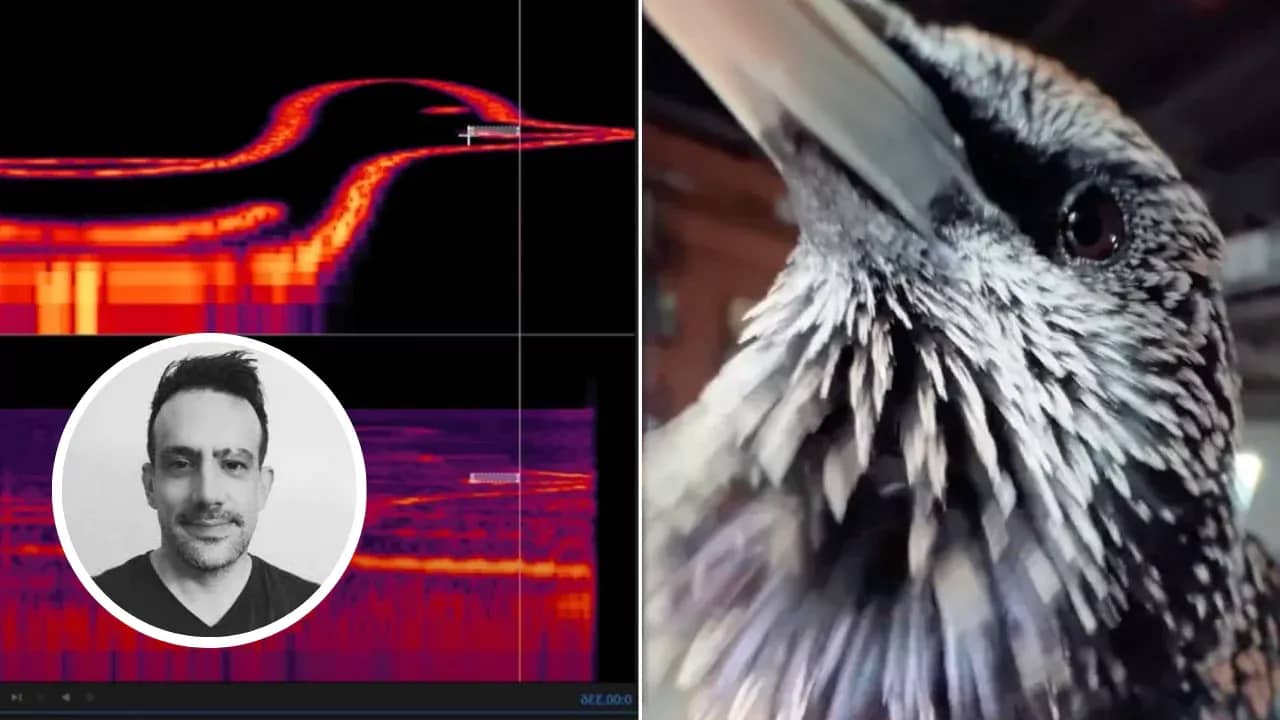
Most people store images in phones, clouds, or hard drives. But Benn Jordan, a musician and science enthusiast, did something very different. He saved an image file to a living bird. Yes, really.
It might sound like a joke or a sci-fi story, but it is a real experiment that amazed the internet and got scientists talking. Let’s break down what happened, how it worked, and why it matters.
Fast Facts
- Project: Stored an image file as sound in a starling’s memory
- Creator: Benn Jordan, musician and sound experimenter
- Bird: A rescued European starling named “The Mouth”
- Technology: Spectral synthesizer, ultrasonic recorder, spectrogram analysis
- Viral Moment: Over 100K+ views in days; covered by The Verge, PC Gamer, and others
Meet the Musician Behind the Magic
Benn Jordan is a musician and tech explorer from the United States. He is also known online by the name “The Flashbulb.” Over the years, he has combined music, science, and sound experiments in fascinating ways. His YouTube channel features videos that mix creativity with technology. This bird experiment is just the latest example.
Jordan is not a bird trainer or a computer engineer. He is simply someone who loves to ask weird questions and chase surprising answers.
So, What Did He Actually Do?
Jordan took a black-and-white drawing of a bird and ran it through a tool called a spectral synthesizer. This tool turns images into sounds by translating shapes into sound frequencies. In simple terms, he made a sound that looked like a bird when visualized.
He then played this sound to a rescued starling named The Mouth. Starlings are special birds because they can copy and repeat sounds they hear, much like parrots.
After playing the sound several times, Jordan recorded the starling’s singing. Later, when he looked at the sound recording using a spectrogram (a tool that shows what sound “looks like”), he saw the original bird image appear again. That means the bird learned the sound and sang it back. In a strange way, it memorized the image.
How It Worked
Here is the step-by-step process:
- Jordan drew a simple bird image.
- He used a spectral synthesizer to turn that drawing into sound.
- He played the sound to the bird several times over several days.
- He recorded the bird’s singing using special high-quality microphones.
- He looked at the bird’s singing as a picture using a spectrogram.
- The same bird drawing appeared in the sound recording.
Jordan estimated that the bird remembered around 176 kilobytes of uncompressed image data, and possibly more if compression methods were applied.
“This little bird successfully learned and emulated the sound in the exact same frequency range… effectively transferring about 176 kilobytes of uncompressed information,”
— Benn Jordan
Source: Tom’s Hardware
What Tools Did He Use?
Jordan used the following tools for his experiment:
- Spectral synthesizer software like MetaSynth or PhotoSounder
- Zoom F3 audio recorder
- Sonorous S04 microphone for high-quality sound recording
- Spectrogram software to visualize the bird’s singing
He recorded at 192 kilohertz and 32-bit audio, which is far better than standard recording quality. This helped capture all the tiny details of the bird’s song.
Can You Try This at Home?
Not easily. This is not a beginner-level project. You would need:
- A bird that can mimic sounds, like a starling or parrot
- A way to create and visualize sound from images
- Ultrasonic recording gear
- Time, patience, and understanding of how birds learn
Still, the idea has inspired many creators and tech hobbyists to think about new ways sound and memory can be explored.
Why Did It Go Viral?
The internet loves weird and smart stuff. As soon as Jordan posted the video titled “I Saved a PNG Image to a Bird”, people on Reddit, YouTube, and tech news sites were amazed.
Headlines popped up everywhere. Some called it a real-world “bird drive.” Others joked that it was the start of using birds to store data. The Verge, PC Gamer, PetaPixel, and IFLScience all covered the story within days.
The reason this experiment went viral is simple. It is strange, true, and makes you smile. It is also a little poetic. In a world full of cloud storage and computer chips, a bird singing back a drawing is both funny and beautiful.
Read more : Swedish Startup Trains Wild Crows to Pick Up Cigarette Butts in Exchange for Food
Is It Real or Just a Fun Trick?
Yes, it’s real. The bird truly copied the sound. But we should not think of this as a new way to store data, like a USB stick or SSD.
Experts say that while it is a cool example of mimicry, it does not mean birds are useful for real-world storage. They cannot store files reliably, and they certainly cannot download data.
Still, this moment shows how smart and flexible birds are. It also reminds us how far human curiosity can go.
“The experiment is not about storage speed or practical data recovery. It’s about seeing how far the idea of memory and mimicry can stretch,”
— Audio tech analyst David T. Jones
What Happened Next?
Jordan has not announced any big follow-up yet, but fans are waiting. Some people have even asked if he will try this with other shapes, sounds, or bird species. For now, he continues to post creative science content on YouTube.
Why This Matters
This is more than just a quirky experiment. It is a reminder that science and art can work together. It shows us that even in a world full of screens and code, there is still room for wonder. A bird can remember a song, and that song can hold a picture.
That’s not just geeky. That’s kind of magical.
The weekly question
From obsession to clarity — one original question every week.
We answer one noisy topic at a time, in full. No daily roundup, no thread bait — just the question, the principles, and the system.