Terence Tao Became UCLA's Youngest Full Professor at 24
Terence Tao went from child prodigy to Fields Medalist by connecting ideas across number theory, analysis, and combinatorics.
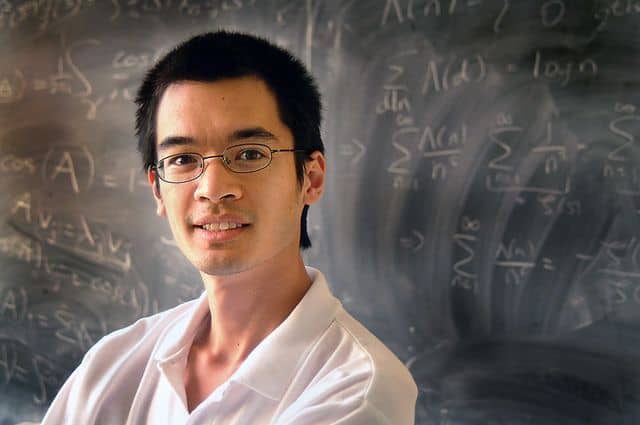
Terence Tao was solving university-level mathematics before most children had finished primary school.
He completed bachelor's and master's degrees at 16, earned a doctorate around age 20, and became UCLA's youngest full professor at 24.
In 2006, he received the Fields Medal for work spanning partial differential equations, combinatorics, harmonic analysis, and additive number theory.
Yet Tao's most distinctive strength may not be speed or a single score. It is his ability to connect distant areas of mathematics and turn difficult problems into collaborative, structured work.
The Prodigy Who Kept Expanding
Tao grew up in Adelaide, Australia, in a family that encouraged learning without treating mathematics as a performance.
He entered international mathematics competitions unusually young and won bronze, silver, and gold medals at the International Mathematical Olympiad.
His academic rise continued rapidly.
Childhood
Studies advanced mathematics years ahead of his age group
Age 16
Completes bachelor's and master's degrees
Around age 20
Earns a Ph.D. from Princeton
Age 24
Becomes UCLA's youngest full professor
2006
Receives the Fields Medal
UCLA's profile of Tao describes a career that moved from prodigy to one of the world's broadest mathematical researchers.
Why the “IQ 230” Claim Needs Caution
Tao is frequently described online as having an IQ of 230.
That number is repeated in popular lists, but major institutional biographies from UCLA, the Royal Society, and the Institute for Advanced Study do not present it as a verified measure.
IQ tests also become difficult to compare at extreme ranges because different tests use different ceilings and statistical methods.
The documented achievements are more informative: advanced study in childhood, international medals, a doctorate at an unusually young age, a record-setting UCLA professorship, and major research across many fields.
Tao's reputation does not need an uncertain number.
What the Fields Medal Recognized
The Fields Medal is awarded every four years to mathematicians under 40 for outstanding achievement and future promise.
Tao received it in 2006.
His citation reflected work across several areas rather than one isolated theorem. He had contributed to nonlinear partial differential equations, harmonic analysis, combinatorics, and number theory.
16
Age when he completed bachelor's and master's degrees
24
Age when he became a UCLA full professor
2006
Year he received the Fields Medal
30+
Collaborators noted in a UCLA profile
Source: UCLA and Institute for Advanced Study
This range has led colleagues to describe him as a mathematical bridge-builder.
The Green–Tao Theorem and Hidden Order in Primes
One of Tao's best-known results came with British mathematician Ben Green.
They proved that the prime numbers contain arithmetic progressions of any finite length.
An arithmetic progression is a sequence with a constant gap, such as 5, 11, 17, 23, 29, where each term increases by six.
Prime numbers become less frequent and appear irregularly as numbers grow. The Green–Tao theorem showed that within that apparent disorder, arbitrarily long evenly spaced patterns must exist.
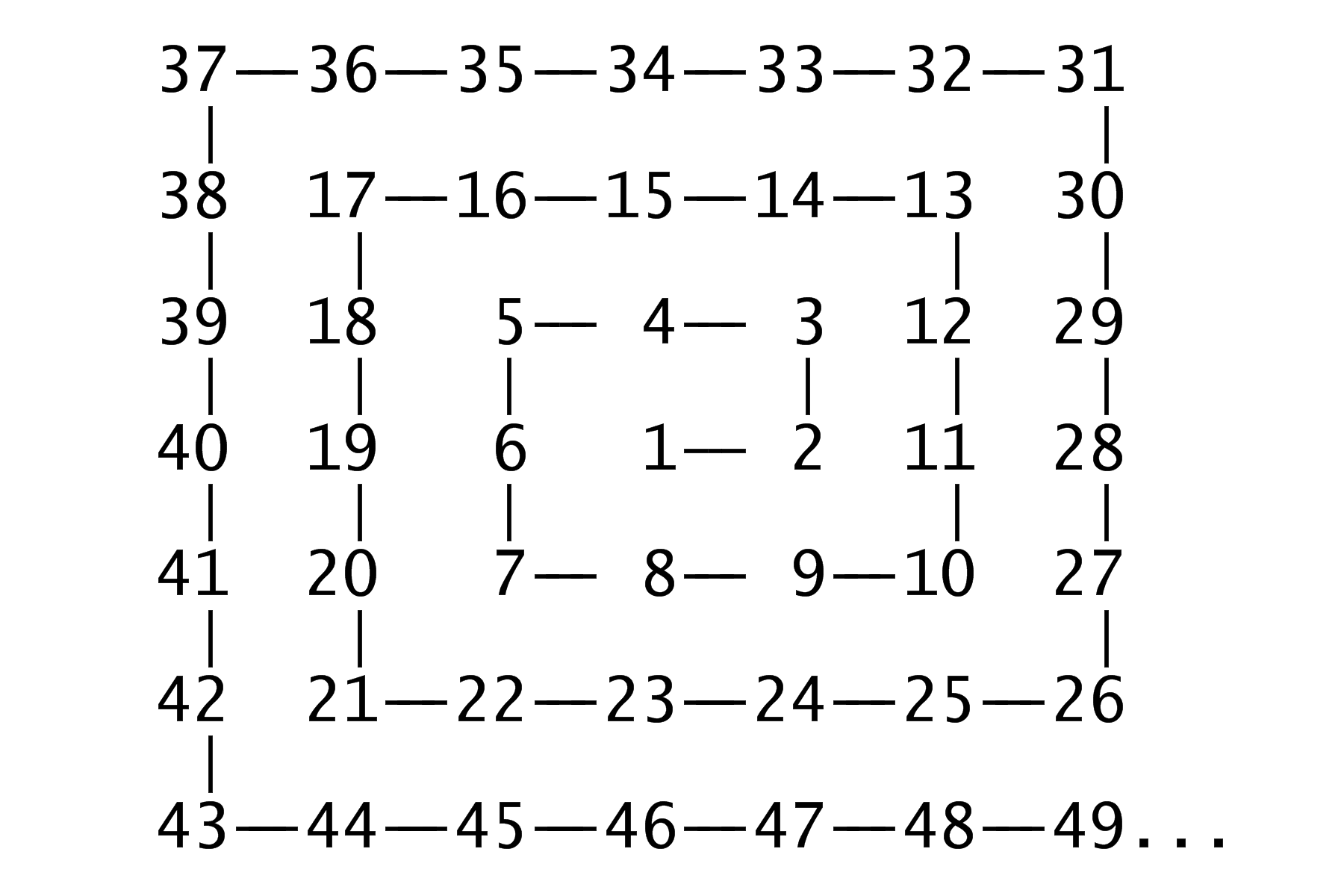
Visual arrangements such as the Ulam spiral reveal striking patterns among prime numbers. Source: Wikimedia Commons, CC BY-SA 3.0.
The proof combined ideas from number theory, combinatorics, and ergodic theory—exactly the kind of cross-field connection associated with Tao's work.
How Tao Approaches Difficult Problems
Tao has written extensively about mathematical problem solving.
His public explanations emphasize breaking a large problem into manageable components, testing simpler versions, learning from failed approaches, and moving between intuitive and rigorous thinking.
He also resists the myth that mathematics arrives as effortless inspiration.
Research involves wrong turns, partial results, collaboration, and revision.
Tao's blog and collaborative projects have helped make that process visible. Instead of presenting mathematics only as polished final proofs, he shows the scaffolding behind them.
From Solitary Genius to Collaborative Mathematics
The popular image of a mathematician is a lone genius working in silence.
Tao can work deeply on his own, but his career also demonstrates the power of collaboration.
He has worked with researchers across analysis, combinatorics, number theory, and applied mathematics. He has helped organize online efforts where many mathematicians contribute pieces to a shared problem.
That style matters because modern mathematical questions often exceed one person's expertise.
The ability to translate between fields can be as valuable as technical mastery within one field.
Mathematics, AI, and the Future of Proof
Tao has also engaged publicly with the changing role of computers and artificial intelligence in mathematics.
Computational tools can test cases, search for patterns, and help formalize proofs. But they do not eliminate the need for judgment.
A mathematician must still decide which questions matter, which patterns are meaningful, and how a result fits into a larger theory.
Tao's career makes him a natural figure in this debate because he combines classical proof technique with openness to new collaborative tools.
What Terence Tao's Story Teaches About Mathematical Talent
Terence Tao's childhood achievements were extraordinary.
But his adult career is not merely the continuation of a prodigy story.
He kept learning new fields, building collaborations, explaining methods, and choosing problems whose solutions required more than speed.
The unverified IQ number attached to his name reduces a complex career to a ranking.
The more useful lesson is visible in his work: deep ability grows through curiosity, flexibility, patience, and the willingness to connect ideas that others keep separate.
Featured image: Terence Tao at UCLA, via UCLA's Undergraduate Mathematics Students Association.
The weekly question
From obsession to clarity — one original question every week.
We answer one noisy topic at a time, in full. No daily roundup, no thread bait — just the question, the principles, and the system.