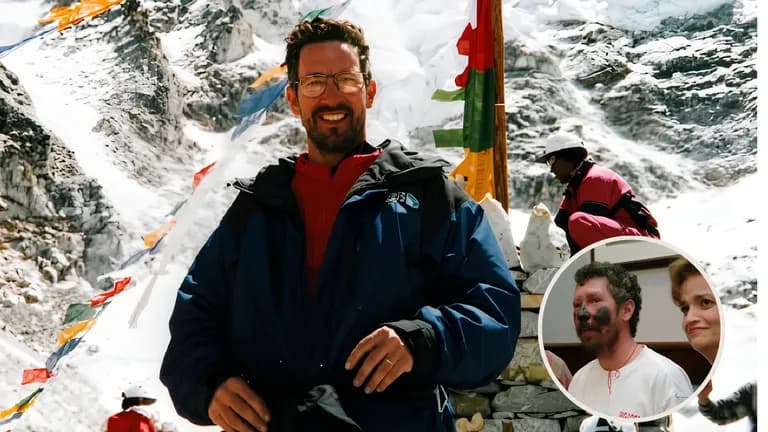
Dominic O’Brien Trained His Memory to Win Eight World Championships
Dominic O’Brien turned vivid mental journeys into eight world titles and proved that elite memory can be trained.

In 1987, Dominic O’Brien watched a man memorize a shuffled deck of cards on television in under three minutes. When O’Brien tried it himself, he could hold only a handful of cards. Four years later, he won the first World Memory Championship.
That victory was not a one-off. The British mnemonist eventually won eight world titles by turning numbers, cards and words into vivid mental scenes. His story is less about being born with a perfect memory than about building a repeatable system for recall.
Fast Facts
- Who:
- A British mnemonist, author and pioneer of competitive memory.
- Geek Obsession:
- Turning cards, numbers and words into vivid images arranged along familiar mental journeys.
- Notable Feat:
- Won the overall World Memory Championship eight times between 1991 and 2001.
- Key Number:
- Recalled 2,808 playing cards, equal to 54 shuffled decks, in sequence after one viewing in 2002.
- How It Worked:
- His methods convert abstract information into memorable people, actions and locations.
- Reality Check:
- His results came from trained mnemonic strategies, not a verified photographic memory.
A card trick he could not explain
O’Brien was 30 when he saw psychiatric nurse Creighton Carvello attempt the televised card feat on Record Breakers. In a 2023 interview with The Naked Scientists, O’Brien described sitting down with his own deck and discovering how ordinary his recall initially was.
“I sat down with a deck of cards and I couldn’t remember more than about half a dozen.”
Source: Dominic O’Brien’s interview with The Naked Scientists
The failure became an obsession. O’Brien began experimenting with imagination, associations and routes through familiar places. Within weeks, he could handle a complete deck. By 1991, after about four years of practice, Tony Buzan invited him to the inaugural World Memory Championship in London.
Only seven people competed that year. O’Brien won. The card trick that had exposed the limits of his untrained memory had become the entry point to a new sport.
Eight titles built one of memory sport’s first dynasties

The World Memory Sports Council’s championship record lists O’Brien as overall champion in 1991, 1993, 1995, 1996, 1997, 1999, 2000 and 2001. Those eight wins came during the formative decade of organized memory sport.
Competitors were tested across different kinds of information, including cards, numbers, words, names, faces and dates. Success required more than one dazzling trick. A champion needed techniques that could survive changing material, strict timing and the pressure of recall.
That makes O’Brien’s record part of a broader family of practiced mental performance. Scott Flansburg’s rapid mental calculation uses a different skill, but both stories show how specialized methods can make a human mind appear almost mechanical.
How the Dominic System turns data into scenes
Raw information is hard to grip. O’Brien’s answer was to stop treating cards and numbers as lifeless symbols. The technique now known as the Dominic System assigns number pairs to memorable people and actions. Longer strings can then become compact scenes instead of a blur of digits.
Order comes from location. O’Brien combines those images with the Journey Method, a form of the ancient method of loci. A memorizer chooses a familiar route, places each imagined scene at a fixed point along it and later mentally walks the same path to retrieve the information in sequence.
“Picture a journey, say, around your own house, and in each room, you can imagine between four and six items.”
Source: O’Brien explaining the Journey Method to The Treasurer
The images work best when they are active, exaggerated or strange. A person performing a distinctive action at the front door is easier to recall than two abstract digits floating without context. The route preserves order, while the people and actions give the mind something concrete to see.
This is different from stories about unusually detailed visual recall, such as Stephen Wiltshire’s city drawings from memory. O’Brien’s competitive results rested on deliberately constructed codes that he practiced and reused.
The 54-deck test made the method visible
O’Brien’s most arresting demonstration came in 2002. The Treasurer reports that he recalled 2,808 playing cards, the equivalent of 54 shuffled decks, in sequential order after viewing every card once. The feat earned a Guinness World Record.
The number sounds superhuman because people usually imagine memory as passive storage. O’Brien treated it as active translation. Each card could become a prepared image, several images could become a scene, and every scene could be placed at the next stop on a mental route.
That does not make the task easy. The code must be familiar enough to appear quickly, the journeys must remain distinct, and attention must hold for long stretches. Mnemonics reduce the burden of abstract information, but competition still demands speed, accuracy and sustained concentration.
The science supports training, not photographic memory
O’Brien has spoken openly about struggling academically and being diagnosed with dyslexia. His championship record therefore should not be explained with the vague label “photographic memory.” He describes learning a set of strategies and practicing them until encoding became fast.
Modern research on elite memorizers supports that general picture. A 2017 study of 23 top-ranked memory athletes found that they attributed their skills to deliberate mnemonic training. In a separate training group, six weeks of method-of-loci practice changed functional brain-network patterns in ways that resembled those seen in memory athletes.
The study did not show that everyone can become an eight-time world champion. It did show that high-level recall is not adequately explained by a mysterious memory organ or an untouched inborn gift. Strategy and practice can change performance substantially.
For ordinary readers, the useful lesson is modest but real: convert information into images, connect those images to familiar places and practice retrieval. The technique can help with a speech, a list or a sequence, even if the goal is never to memorize a deck at speed.
A comeback turned the record into a lesson about age
O’Brien later retired from top-level competition, but he returned in 2017 at age 60. The World Memory Championships reported that he won the senior world title and broke two senior world records.

By then, his larger role had shifted from collecting titles to teaching. Through books, talks and training, he shared the systems that had once begun as his private attempt to solve a televised mystery.
That is the lasting surprise in O’Brien’s eight championships. The results looked like evidence of a different kind of brain. His own route to them began with forgetting most of a deck, asking how someone else had done it and spending years turning imagination into a practical tool.
The weekly question
From obsession to clarity — one original question every week.
We answer one noisy topic at a time, in full. No daily roundup, no thread bait — just the question, the principles, and the system.