Tail Lightz After Shark Tank: What Happened?
Tail Lightz left Shark Tank without a deal. Here is what is verified about Kyle Rainey’s light-up accessory brand and its status after the show.

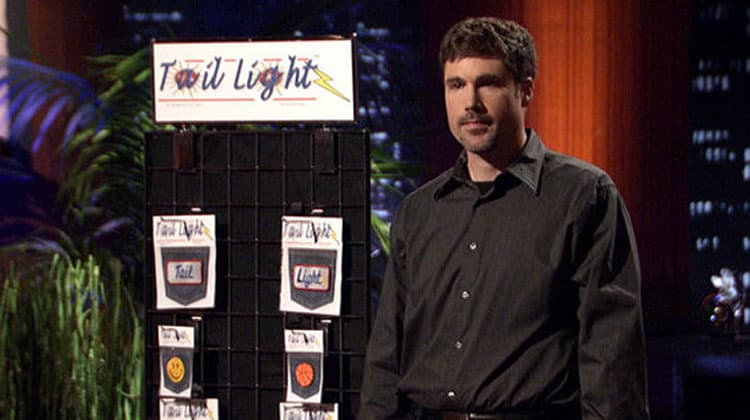
Kyle Rainey brought a simple visual idea to Shark Tank: removable light-up designs that could make jeans, bags and other accessories stand out after dark. Tail Lightz did not receive an investment, and the original brand no longer has a retail operation that we could verify.
Quick answer: Tail Lightz left Shark Tank without a deal after Rainey asked for $50,000 for 50% of the business. Later reporting connected the product to the name Blinkerz and to licensing efforts, but a precise closure date and verified sales figures are not publicly established.
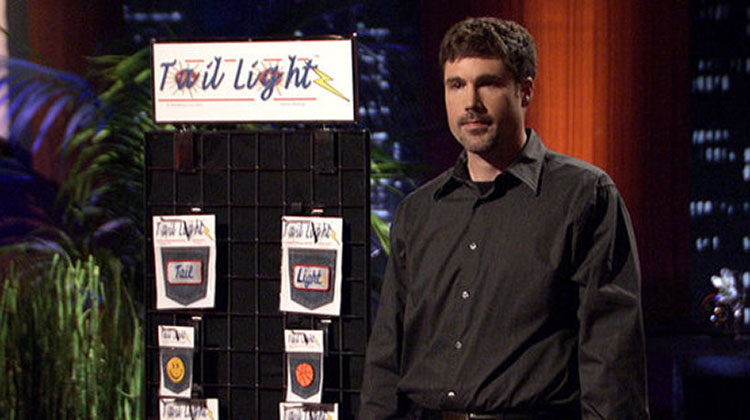
Kyle Rainey presents Tail Lightz on Shark Tank. Photo: ABC via Shark Tank Blog
Tail Lightz at a glance
| Detail | Verified information |
|---|---|
| Founder | Kyle Rainey |
| Product | Illuminated designs for clothing and accessories |
| Shark Tank season | Season 3 |
| Ask | $50,000 for 50% equity |
| Implied valuation | $100,000 |
| On-air result | No deal |
| Current status | No verified original-brand retail operation |
The $100,000 figure is the valuation implied by the ask, not the founder's net worth and not a confirmed value for the company after the show. No reliable public source provides Tail Lightz's lifetime revenue or Rainey's personal wealth.
For the complete season, see our Shark Tank Season 3 products, deals and updates guide.
What was Tail Lightz?
Tail Lightz was designed to add an illuminated decorative element to clothing and accessories. The pitch materials showed light-up designs attached to items such as jeans, giving customers a way to personalize an outfit with a visible glow.
The concept sat between fashion accessory and novelty product. It was easy to understand on television: attach a design, turn it on and make the clothing more noticeable. That clarity was useful for a demonstration, but a memorable demo does not by itself prove demand, margins or repeat purchases.
Rainey's challenge was to convince the Sharks that Tail Lightz could become a scalable consumer brand rather than remain a niche accessory.
What happened in the Shark Tank pitch?
Rainey asked the Sharks for $50,000 in exchange for 50% equity. That offer implied a $100,000 valuation for the whole business at the time of the pitch.
The Sharks did not invest. Tail Lightz therefore left the Tank with no on-air deal and no Shark partner. That makes its outcome different from a handshake agreement that later collapses during due diligence: there was no accepted investment to close.
The episode also featured other Season 3 businesses, including ChordBuddy and Liquid Money. Comparing the pitches shows how strongly the Sharks weighed a clear route to a larger market, not merely an eye-catching demonstration.
| Pitch figure | Result |
|---|---|
| Amount requested | $50,000 |
| Equity offered | 50% |
| Implied valuation | $100,000 |
| Final result | No deal |
What happened after Shark Tank?
Public information after the appearance is limited. Shark Tank Blog's Tail Lightz coverage reports that the concept later appeared under the name Blinkerz. A 2018 report from 2Paragraphs said the Tail Lightz website was still online at that time, but products were not available to buy and the concept was being offered for licensing through RainCo.
Those reports provide useful historical signals, but they do not establish a complete business timeline. We could not verify a primary company announcement giving a final operating date, a documented acquisition, or audited sales results.
For that reason, statements that Tail Lightz definitively “closed in 2015” should be treated cautiously. The safer conclusion is that the original brand's retail availability had disappeared by the time of the later reporting, while the precise date and circumstances were not publicly documented.
Is Tail Lightz still in business?
We could not verify an active Tail Lightz store, current product catalogue or ongoing original-brand sales. That means shoppers should not assume the product is currently available simply because an old website, image or marketplace reference remains online.
There is also no verified public evidence of a Shark investment after the show. The most specific later report describes licensing availability rather than normal retail sales.
Current assessment: Tail Lightz does not have a verified active retail operation under its original name. The product's exact legal or corporate status is unclear, so we do not label a particular year as its confirmed closure date.
Did Tail Lightz become Blinkerz?
Secondary coverage connects Tail Lightz with the name Blinkerz. That appears to have been an effort to continue or reposition the illuminated-accessory concept after the show.
However, a rename does not automatically mean that a new business achieved sustained sales. We found no dependable public figures for Blinkerz revenue, distribution or customer volume. The later licensing reference suggests that the intellectual property or concept may have remained available even when direct product sales were not.
The distinction matters: a product idea can survive as a brand name, prototype or licensing opportunity without operating as a regular consumer store.
Tail Lightz valuation and net worth
Tail Lightz is sometimes described online as having a $100,000 “net worth.” That wording is misleading. The amount comes from Rainey's pitch: offering 50% for $50,000 mathematically implies a $100,000 business valuation.
It does not tell us:
- what the business was worth after the episode;
- how much revenue or profit it generated;
- whether its intellectual property was later licensed;
- or Kyle Rainey's personal net worth.
Without financial statements, a sale record or a verified funding announcement, a current valuation would be speculation. We therefore leave it unestimated.
What entrepreneurs can learn from the pitch
Tail Lightz demonstrates the gap between a product that looks good in a television demo and a business that investors can confidently scale.
First, novelty products need evidence of repeatable demand. A founder should be ready with unit costs, selling price, margins, sales channels and customer reordering behavior.
Second, a broad licensing idea is not the same as a signed licensing agreement. Investors want to see who owns the design, how it is protected and which partners have committed to distribution.
Third, current-status reporting needs careful sourcing. An inactive shop may suggest that sales stopped, but it does not prove an exact closure date or explain why the business changed course.
Frequently asked questions
Who founded Tail Lightz?
Kyle Rainey founded and presented Tail Lightz on Shark Tank.
What did Tail Lightz sell?
The product added illuminated decorative designs to clothing and accessories, including jeans and bags.
How much did Tail Lightz ask for?
Rainey asked for $50,000 for 50% equity, implying a $100,000 valuation at the time of the pitch.
Did Tail Lightz get a Shark Tank deal?
No. None of the Sharks invested in Tail Lightz.
Is Tail Lightz still available?
We could not verify an active original-brand store or current retail catalogue. Later reporting described the product as unavailable for purchase and offered for licensing.
Did Tail Lightz change its name?
Secondary reports connect the concept to the name Blinkerz, but verified financial results for that later version are not publicly available.
What is Tail Lightz worth today?
There is no reliable public evidence supporting a current company valuation or founder net-worth figure.
The weekly question
From obsession to clarity — one original question every week.
We answer one noisy topic at a time, in full. No daily roundup, no thread bait — just the question, the principles, and the system.