Spain vs Belgium Prediction: Match Analysis, Winner Probability and Score Forecast
Spain enter the quarterfinal with stronger defensive control, but Belgium’s attacking momentum makes this a dangerous knockout test.

FIFA 2026 Quarterfinal Prediction
Spain have the cleaner defensive record and stronger control profile, but Belgium’s 4–1 win over the United States shows they have enough attacking power to make this quarterfinal dangerous.
Prediction transparency: This article uses the FIFA 2026 Prediction Machine methodology. Probabilities are editorial model estimates, not official FIFA numbers and not guarantees.
Quick Prediction
Spain are slight favorites, but Belgium have real knockout danger
Our model gives Spain the edge because of defensive control, midfield rhythm, clean-sheet momentum and a more stable route through the knockout stage. Belgium stay close because they have major attacking experience, strong transition options and a confidence boost after scoring four against the United States.
Advance prediction: Spain. Confidence: Medium. Belgium have enough quality to score and push this late, but Spain’s control, clean-sheet form and midfield structure give them the stronger route to the semifinal against France.
Latest match context
Spain reached the quarterfinals after beating Portugal 1–0. That result matters heavily in the model because Spain have now reached this stage without conceding, giving them the strongest defensive signal among the remaining quarterfinal teams.
Spain coach Luis de la Fuente called Belgium their toughest World Cup test yet, even with Spain’s clean-sheet run and balanced team form. Spain’s key attacking names remain Lamine Yamal and Mikel Oyarzabal, while the team’s strength is still the collective rhythm around midfield control and pressure resistance.
Belgium reached this point after a 4–1 win over the United States. Their route has been less controlled than Spain’s, but their attack has grown through the tournament. Romelu Lukaku remains a major weapon, Kevin De Bruyne gives them passing range, and Jeremy Doku offers pace and one-v-one disruption if Belgium need to break Spain’s structure.
Why Spain are slight favorites
Spain’s best advantage is control. They can hold the ball, slow Belgium’s transition rhythm, defend with structure and force opponents into lower-quality attacks. Their clean-sheet run gives the model confidence that Belgium will need a high-quality moment, not just open-play volume.
How Belgium can beat Spain
Belgium need to turn the game into moments instead of rhythm. Quick switches to Doku, early passes into Lukaku, De Bruyne finding runners before Spain settle, and set-piece pressure are the most realistic upset routes. If Belgium score first, Spain’s patience will be tested.
Model Methodology
How the prediction was calculated
The prediction combines team strength, recent form, chance creation, defensive control, player availability, tactical matchup, venue and travel factors, pressure handling, extra-time fatigue, penalty resilience and bracket difficulty.
| Model factor | Spain | Belgium | Edge |
|---|---|---|---|
| Recent form | Beat Austria 3–0, then Portugal 1–0 | Beat Senegal 3–2, then United States 4–1 | Even |
| Defensive control | No goals conceded in the knockout route so far | Improving, but more open game state | Spain |
| Midfield rhythm | Better control and tempo management | Strong creators, but more transition-based | Spain |
| Finishing threat | Oyarzabal, Yamal, wide combinations | Lukaku, De Bruyne, Doku, Tielemans | Even |
| Pressure handling | Controlled a tight rivalry match vs Portugal | Responded strongly with 4 goals vs USA | Even |
| Overall model lean | Cleaner structure, stronger control, better defensive signal | Higher chaos threat and proven attacking punch | Spain, slight |
Tactical analysis
Spain’s key task: stop Belgium’s transitions before they start
Spain can dominate possession, but careless losses in midfield would create exactly the type of game Belgium want. Spain need clean rest-defense behind the ball, quick counter-pressure after turnovers and smart spacing around De Bruyne so Belgium cannot release Doku or Lukaku early.
Belgium’s key task: make Spain defend wider than they want
If Belgium allow Spain to defend narrow and control the centre, the match will tilt toward Spain. Belgium need fast switches, direct wing carries and early service into the box. Doku’s dribbling and Lukaku’s penalty-box presence are especially valuable if Belgium cannot build slowly through midfield.
The decisive zone: Spain’s left side vs Belgium’s right-sided pressure
Spain’s left side can control the ball and pin Belgium back, but Belgium can also target that channel on breaks. If Spain’s fullback and midfield cover manage that space well, Belgium may struggle to create enough clear chances. If Belgium win those transition moments, the match becomes much more even.
Key players to watch
Spain
Lamine Yamal: His wide threat and maturity give Spain a direct route when Belgium sit deep.
Mikel Oyarzabal: Spain’s most important finishing signal in the current tournament model.
Pedri: Spain need his tempo control to stop Belgium from turning the game into a transition battle.
Belgium
Kevin De Bruyne: Belgium’s best passer into dangerous spaces. His early service can stop Spain from settling.
Romelu Lukaku: A major goal threat, especially if Belgium use him as a late-game power option.
Jeremy Doku: His pace and dribbling are Belgium’s clearest one-v-one disruption weapon against Spain’s defensive structure.
Match scenarios
This is Spain’s best route. Belgium would need to open up, which gives Spain more passing lanes and more chances to control the final 30 minutes.
Belgium’s upset probability rises sharply. They can defend deeper, use Lukaku as an outlet, and force Spain to break down a compact block under pressure.
The match becomes a bench and nerves contest. Spain’s control still matters, but Belgium’s experienced attackers become more dangerous as one moment can decide the tie.
Final prediction
Spain vs Belgium is a narrow prediction, not a comfortable one. Spain have the better defensive profile and more reliable control, which makes them the model favorite. Belgium have enough individual quality to punish one mistake and enough attacking confidence to make Spain uncomfortable. The model lean is Spain, but the draw probability is high enough to keep extra time in play.
Prediction Machine Verdict
Spain 2–1 Belgium
Spain advance. Belgium should create dangerous moments and may score, but Spain’s defensive record, midfield control and tournament balance give them the slight overall edge.
FAQs
Who is predicted to win Spain vs Belgium?
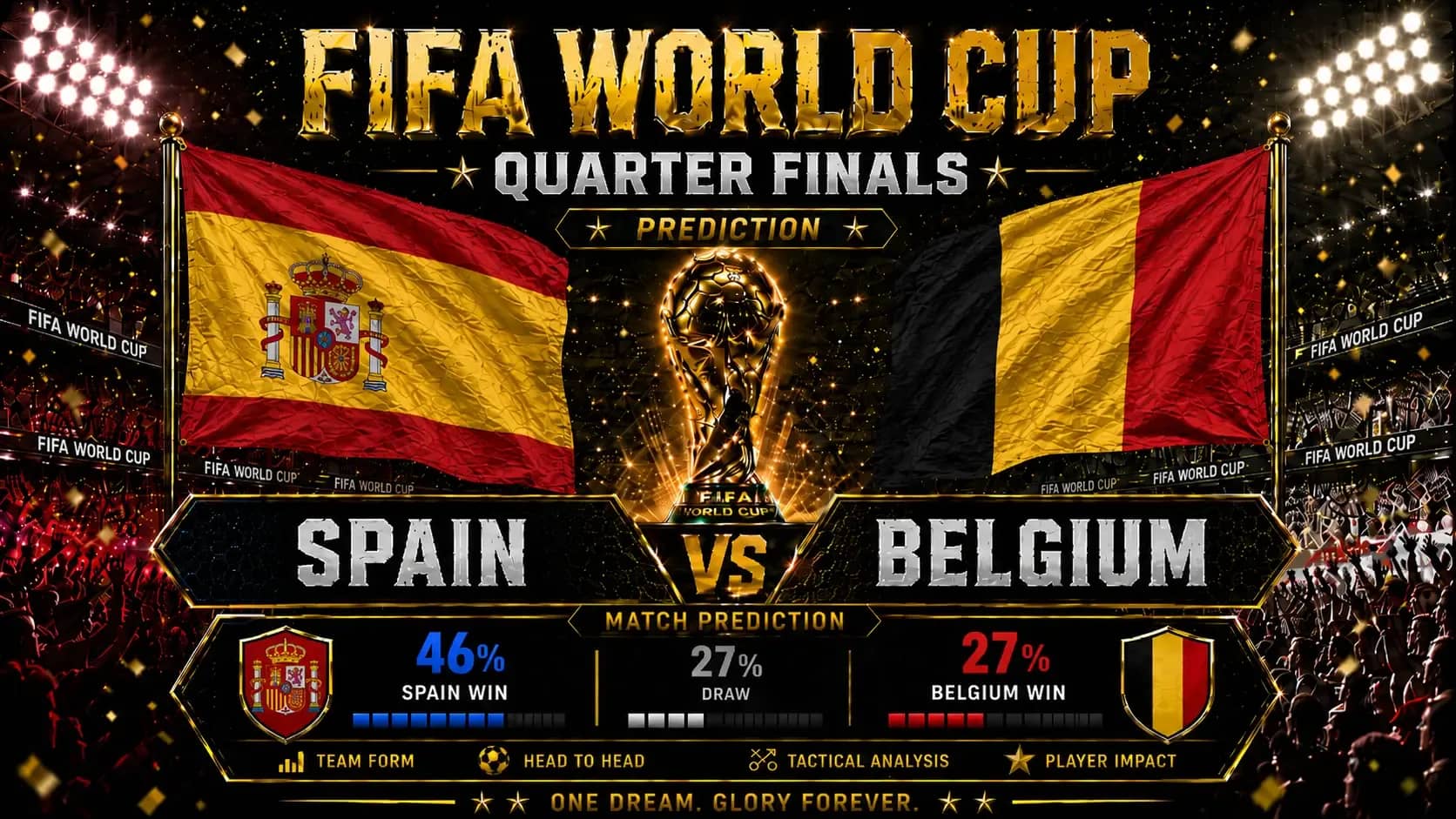
Spain are predicted to win, with the model giving them a 46% chance of winning in 90 minutes, compared with 27% for Belgium and 27% for a draw.
What is the predicted score?
The predicted score is Spain 2–1 Belgium.
Can Belgium beat Spain?
Yes. Belgium can win if they score first, use Doku’s speed to create transition chances and get strong penalty-box impact from Lukaku or late runners.
Why are Spain favorites?
Spain are favorites because they have stronger defensive control, better midfield rhythm and a cleaner knockout route after beating Portugal 1–0 without conceding.
Sources and editorial standards
Confirmed match facts are separated from prediction-model estimates. Match results, schedule information and player-performance context were checked against current reports before publication. Probabilities are editorial forecasts from the FIFA 2026 Prediction Machine and are not official FIFA figures.
The weekly question
From obsession to clarity — one original question every week.
We answer one noisy topic at a time, in full. No daily roundup, no thread bait — just the question, the principles, and the system.