How Our FIFA 2026 Prediction Machine Turns Football Data Into World Cup Probabilities
Our FIFA 2026 prediction methodology combines team strength ratings, expected goals, score modelling, Monte Carlo simulations, lineup news, and match context to produce transparent World Cup probabilities.

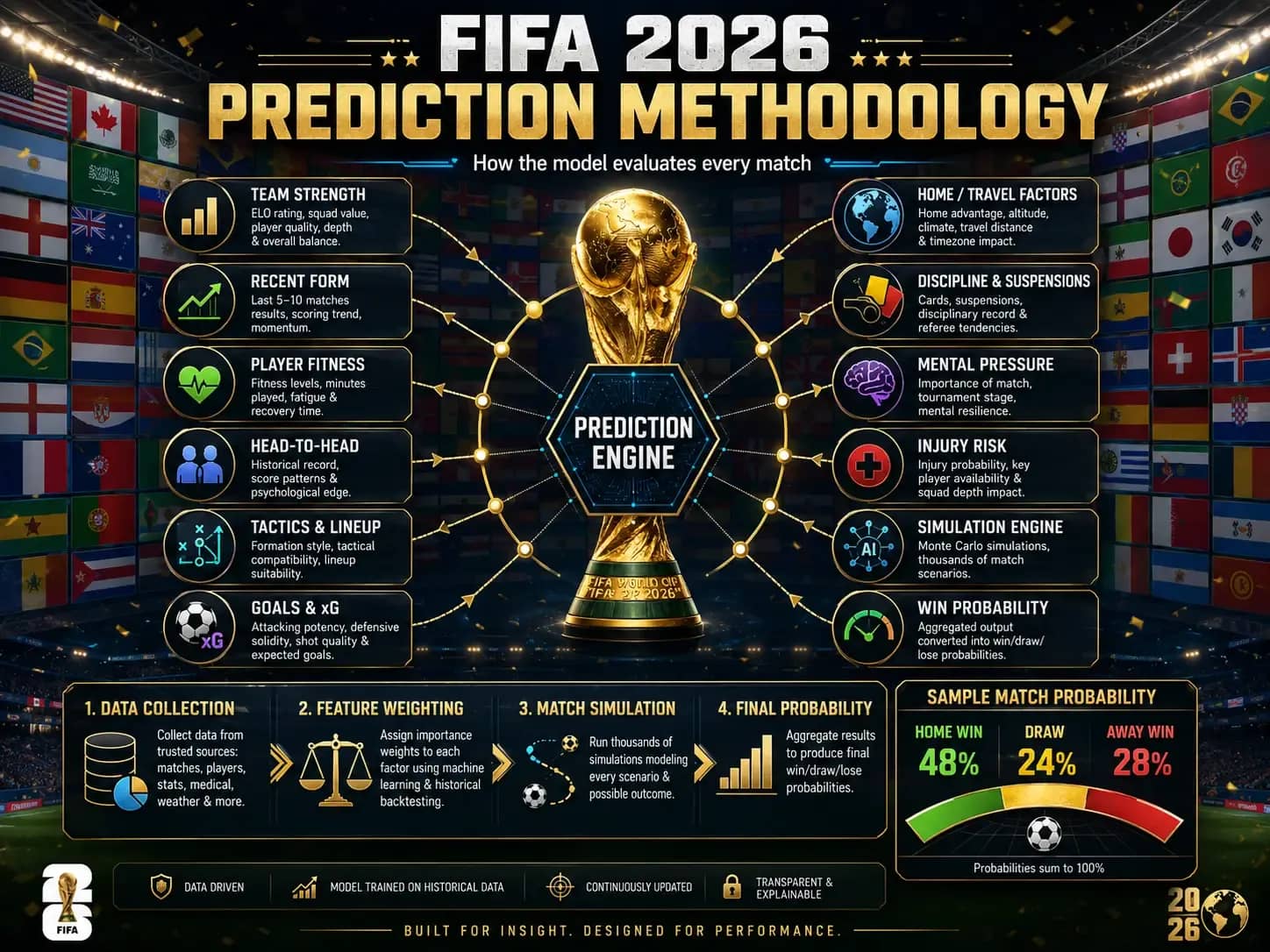
FIFA 2026 Prediction Methodology
Our FIFA 2026 prediction methodology combines team strength ratings, expected goals, score modelling, Monte Carlo simulations, lineup news, and match context to produce transparent World Cup probabilities. The goal is not to claim certainty. The goal is to explain why one team is favored, how an underdog can win, and what changes after every result.
Editorial note: This methodology page explains how our football predictions are produced. It is designed for readers who want to understand the model, not for betting or gambling advice. All probabilities are editorial estimates based on football analysis, public match information, and statistical modelling.
Transparency note: Prediction numbers can change after goals, injuries, confirmed lineups, suspensions, weather updates, venue conditions, and completed matches. When the tournament changes, the model is recalculated.
Why we use probabilities, not guarantees
Football is a low-scoring sport. A stronger team can dominate possession, create better chances, and still lose because of one counter-attack, one red card, one goalkeeper performance, or one penalty shootout. That is why our system does not publish predictions as certainties.
Instead, every match is treated as a probability distribution. A team may be favored, but that does not mean the opponent has no chance. For example, a 70% win probability means the favorite should win more often than not across many similar match situations. It does not mean the result is already decided.
This approach helps readers understand the match more clearly. It separates the strongest likely outcome from the range of possible outcomes, which is especially important in a knockout tournament where extra time and penalties can change everything.
Method Overview
The six layers behind every prediction
Each prediction is built in layers. No single number decides the result. We combine long-term team strength, recent form, chance quality, likely scorelines, team news, match context, and tournament path.
Team strength rating
A baseline rating estimates how strong each team is before match-specific factors are added.
Chance quality
Expected goals and shot-quality signals help measure whether a team is creating real danger.
Scoreline model
Score models estimate realistic outcomes such as 1–0, 1–1, 2–1, or 2–0.
Tournament simulation
The remaining bracket is simulated many times to estimate path difficulty and title probability.
Match context
Lineups, injuries, suspensions, weather, travel, venue, rest days, and tactical matchups adjust the forecast.
Post-match recalibration
After every result, eliminated teams are removed and all remaining probabilities are recalculated.
1. Team strength: the base rating
Every forecast begins with a team-strength estimate. This is the model’s starting point before player availability, venue, tactics, and recent match data are added.
The concept is similar to Elo-style ratings. In football, Elo systems adjust team ratings after matches based on the result, the strength of the opponent, match importance, and sometimes goal margin or venue effects. FIFA’s modern ranking system also uses an Elo-style points-exchange formula, where team points change after each match based on the actual result and the expected result.
In our model, team strength is not treated as permanent. A team can rise after beating a strong opponent, holding a top side under pressure, or showing repeatable attacking and defensive quality. A team can fall after poor performances, injuries, defensive weakness, or elimination.
2. Recent form: what has changed now?
World Cup predictions cannot rely only on old reputation. Tournament football changes quickly. A team that looked strong before the tournament may struggle with injuries, tactical problems, or poor finishing. A lower-ranked team may become more dangerous because of confidence, chemistry, or a favorable tactical matchup.
Recent form is weighted carefully. The model gives more value to current tournament matches, especially knockout matches, but it does not overreact to one lucky result. A 1–0 win with few chances is not rated the same as a 3–0 win with repeated high-quality attacks.
This is why a team can win a match and still not rise dramatically. The model asks how the result happened, not only what the final score was.
3. Expected goals and chance quality
Goals are the final output, but they do not always tell the full story. A team can score from a rare long-range shot or miss several clear chances. To understand performance more deeply, we use chance-quality thinking similar to expected goals, or xG.
Expected goals assigns a probability to a shot based on how likely similar shots are to become goals. Shot location, angle, body part, assist type, defensive pressure, and match context can all affect the estimate. A tap-in close to goal receives a higher value than a difficult shot from distance.
Our prediction model uses chance quality to separate sustainable attacking performance from random finishing. A team that repeatedly creates good chances is usually more reliable than a team that depends on one low-probability shot.
4. Scoreline modelling: why 1–0 and 1–1 matter
Football is a low-scoring game, so a useful model must think about realistic scorelines. It is not enough to say one team is stronger. The model also needs to ask whether the match is more likely to be 1–0, 1–1, 2–1, 2–0, or something else.
Poisson-style score models are commonly used for football because they estimate the number of goals each team is expected to score. The Dixon-Coles approach is a well-known football-specific extension that adjusts low-score outcomes such as 0–0, 1–0, 0–1, and 1–1, which are especially important in football.
This matters in knockout football. A favorite may have the better team-strength rating, but if the most likely score cluster includes many low-scoring outcomes, the draw-after-90 probability rises. That increases the chance of extra time or penalties.
5. Monte Carlo simulation: playing the tournament thousands of times
A World Cup forecast is not only about the next match. It is also about the path. A team’s chance of winning the tournament depends on its own strength and on the opponents it is likely to face in later rounds.
To estimate this, the model simulates the remaining tournament many times. Each match is played as a probability event based on the current forecast. After thousands of simulated tournament paths, we can estimate how often each team reaches the quarter-finals, semi-finals, final, or wins the World Cup.
This is why a team’s title probability can change even when it has not played. If another strong team is eliminated from its side of the bracket, its path may become easier. If a dangerous opponent advances, its path may become harder.
What goes into a match prediction?
Every match preview on Geeks Around Globe follows the same model checklist. The exact weight of each factor changes by match, but the structure remains consistent.
Team strength and ranking baseline
Long-term national team strength, current tournament performance, opponent quality, and knockout record.
Attacking and defensive quality
Chance creation, shot quality, chance prevention, defensive spacing, set-piece threat, and transition danger.
Player availability
Confirmed lineups, injuries, suspensions, player fatigue, goalkeeper form, and returning stars.
Tactical matchup
Pressing style, defensive block, midfield control, wide overloads, counter-attacks, and set-piece matchups.
Match environment
Venue, travel, rest days, heat, humidity, crowd energy, and pitch conditions where reliable information is available.
Bracket path
Next-round opponent, quarter-final route, side of the draw, and title-probability impact.
How confidence levels are assigned
Every match prediction includes a confidence level. This is not the same as the win probability. Confidence tells readers how stable the prediction is.
The favorite has a clear team-strength edge, stable lineup, strong recent form, and a favorable tactical matchup.
One team is favored, but the match has meaningful uncertainty from tactics, finishing, lineups, or transition threat.
The match is unstable because of unclear lineups, injury uncertainty, evenly matched teams, or strong penalty/extra-time risk.
Why predictions change after every match
The prediction table is live because the tournament is live. A result changes more than one team’s position. It changes the bracket path for everyone around that team.
When a team is eliminated, its title probability becomes 0%. The winning team moves forward, its next opponent becomes clearer, and every simulation of the remaining tournament changes. Teams that did not play can rise or fall because their future path has become easier or harder.
This is why the model recalculates after every completed match, confirmed injury update, suspension, lineup release, or major match-condition change.
What our prediction numbers mean
A match probability is an estimate of how often that result would happen across many similar situations. For example, if a team has a 60% win probability, the model believes that team would win about six times in ten comparable versions of the match.
A draw-after-90 probability is especially important in knockout football. It means the match is expected to be level after normal time, sending it to extra time or penalties. A team can have a lower 90-minute win probability but still have a realistic path to advance if it is strong in penalties or well suited to low-scoring matches.
Title probability is different from match probability. It is based on the full remaining bracket, not just one match. It estimates how often a team wins the tournament across simulated paths.
Model limitations
No prediction model can remove uncertainty from football. The model can estimate the most likely outcomes, but it cannot know the future.
This is why the model publishes probabilities and confidence levels, not absolute claims.
Sources and editorial standards
Our match predictions are based on publicly available match information, official competition context, team news, statistical football methods, and editorial football analysis. When a prediction relies on current news, such as lineups or injuries, the article should cite the source and update the timestamp when the information changes.
The statistical foundation follows widely used football-analytics ideas: Elo-style strength ratings, expected goals, Poisson-style score models, Dixon-Coles low-score adjustments, and Monte Carlo tournament simulation.
For transparency, every prediction should clearly separate verified facts from model estimates. A confirmed result is a fact. A probability is an estimate. A tactical interpretation is analysis.
How to read our match articles
Every match article follows the same structure. First, it explains the match context. Then it gives the prediction snapshot, including win probability, draw probability, most likely score, advancement pick, and confidence level.
After that, the article explains why the favorite is favored, how the underdog can win, which tactical battles matter, and what the model is watching before kickoff. The final prediction then summarizes the most likely match script.
This structure keeps the prediction clear for casual readers while still giving enough detail for readers who want to understand the model.
Final word
The FIFA 2026 Prediction Machine is built to make World Cup forecasting more transparent. It does not ask readers to accept a prediction blindly. It shows the logic behind the numbers.
A good prediction should answer three questions: who is favored, why are they favored, and how could the other team prove the model wrong? That is the standard we use for every FIFA 2026 match analysis.
FAQs
What is the FIFA 2026 Prediction Machine?
It is an editorial forecasting system that estimates World Cup match probabilities, title chances, team movement, and bracket paths using football data and statistical modelling.
Are the predictions official FIFA numbers?
No. The probabilities are independent editorial estimates. They are not official FIFA rankings, official FIFA forecasts, or guaranteed outcomes.
Why do probabilities change after every match?
A result changes the bracket, removes eliminated teams, confirms future opponents, and updates each remaining team’s tournament path.
Can the model be wrong?
Yes. Football contains uncertainty. The model gives probability estimates, not guarantees. A low-probability outcome can still happen.
Source links for further read
The weekly question
From obsession to clarity — one original question every week.
We answer one noisy topic at a time, in full. No daily roundup, no thread bait — just the question, the principles, and the system.