
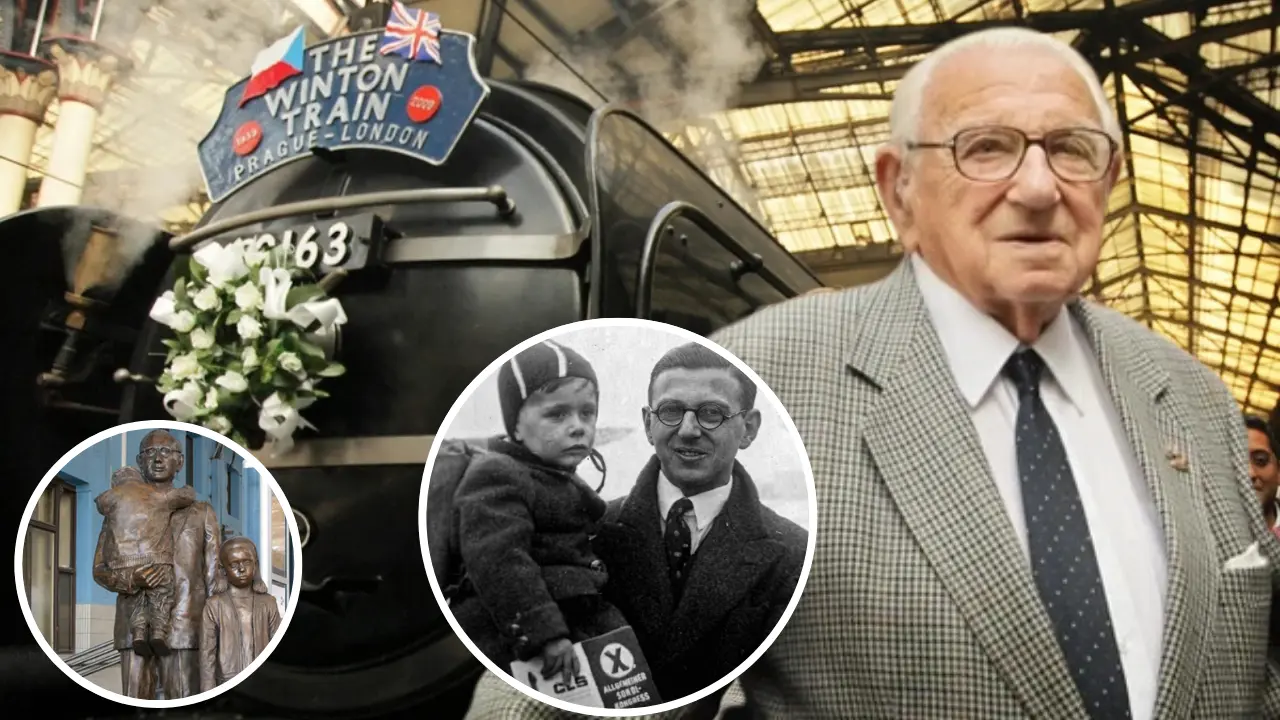
In the winter of 1938, a young London stockbroker canceled a ski holiday and quietly changed history. His name was Nicholas Winton, and for the next fifty years, almost no one knew what he had done.
This is not the story of a trained humanitarian or a public hero. It is the story of an ordinary man who saw an urgent need and chose to act, without recognition or reward.
“If something isn’t blatantly impossible, then there must be a way of doing it.”
Sir Nicholas Winton
Fast Facts
Who: Sir Nicholas Winton, a British stockbroker. What: Organized the rescue of 669 children from Nazi-occupied Czechoslovakia. When: 1938–1939. Why It Matters: He never spoke of it for 50 years, proving quiet courage can change generations.
Who Nicholas Winton Was Before Anyone Knew His Name
Before the war, Nicholas Winton lived a life that looked unremarkable. Born in London in 1909 to parents of German Jewish descent, he grew up in a stable middle class home. His family converted to Christianity and later changed their surname to reduce antisemitic and anti German prejudice.
Winton attended Stowe School, where he developed strong principles and discipline. After school, he trained in international banking in Hamburg, Berlin, and Paris. He later settled as a stockbroker on the London Stock Exchange.

Image Credit: nicholaswinton.com
Politically, he leaned left and joined the Labour Party in the 1930s. He followed European news closely and understood the danger of rising fascism. Still, he had no background in activism or refugee rescue. By all accounts, he was competent, thoughtful, and socially engaged, but not someone destined for headlines.
He was preparing for a skiing trip, not a rescue mission.
The Choice He Made When Time Was Running Out
In December 1938, Winton canceled his holiday and traveled to Prague at the request of a friend working with refugees. What he saw there disturbed him deeply.
Following the German annexation of the Sudetenland and the violence of Kristallnacht, refugee camps overflowed with displaced families. Parents feared deportation. Children faced immediate danger.
Winton learned about the Kindertransport, which helped Jewish children escape Germany and Austria. Czech children, however, had no such system. He decided they deserved the same chance.
With no authority or official backing, Winton set up a small office in his hotel room. Later, he created a Children’s Section to register families. Thousands of parents queued, hoping to save their sons and daughters.
Back in London, Winton worked his stockbroker job by day and the rescue by night. He raised funds, found British foster families, and navigated strict Home Office rules, including a required financial guarantee for each child. At times, he forged permits to move faster.

“There is a difference between passive goodness and active goodness, which is the giving of one’s time and energy to reduce suffering.”
Sir Nicholas Winton
Between March and August 1939, eight trains carried 669 children from Prague to safety in Britain. A ninth train, scheduled for September 1, 1939, never left. War was declared that day, borders closed, and 250 children were lost.

Copy of Report B Transports from the scrapbook, dated 2 October 1939. This details the transports and number of children on each, plus the finances involved.
Image Credit: nicholaswinton.com
The Cost of Carrying It Alone
After the war, Winton returned to ordinary life. He served in the Royal Air Force, worked with postwar refugees, married Grete Gjelstrup in 1948, and raised a family.
He never spoke about the children.
“I was in the right place at the right time.”
Sir Nicholas Winton
Colleagues never heard the story. His wife remained unaware. Even his own children learned the truth decades later.
Winton believed others in Prague faced greater danger than he did. The failure of the final train weighed heavily on him, and he may have felt the effort remained incomplete.
Above all, he did not see his actions as extraordinary. He believed that anyone decent would have done the same.
“Every child saved with my help is the justification of my existence on this Earth, and not a title to glory.”
Sir Nicholas Winton
The personal cost was quiet but real. He carried the memory alone for fifty years, locked away in a forgotten scrapbook.
The Moment the World Finally Found Out
In 1988, Grete Winton discovered an old briefcase in their attic. Inside lay the scrapbook. It contained names, photographs, and detailed transport lists of the children.
Shocked, she showed it to a Holocaust researcher. Soon after, Winton received an invitation to sit in the audience of the BBC program That’s Life.
During the broadcast, host Esther Rantzen revealed the scrapbook and introduced several of the children he had saved, now grown adults. Weeks later, she asked a simple question to the audience.
Is there anyone here who owes their life to Nicholas Winton?
One by one, people stood up around him.
Winton wiped away tears but remained quiet, almost embarrassed. For the first time, he saw the scale of what his single decision had created.
Why This Story Still Restores Faith in Humanity
Today, an estimated six to seven thousand people are alive because of those eight trains. They are children, grandchildren, and great grandchildren of the 669.
Yet the power of this story does not rest on numbers alone. It rests on silence.
“I never thought what I did so many years ago would have such a big impact.”
Sir Nicholas Winton
In a world that often measures goodness by visibility and applause, Nicholas Winton reminds us of something older and deeper. Moral courage does not need an audience. Goodness does not require recognition to matter.
He acted because something needed to be done. He asked for nothing in return.
And perhaps that is why, even decades later, his story still restores faith in humanity.
Related Reading
Desmond Doss refused to carry a weapon in World War II, yet saved dozens of soldiers on the battlefield through courage and conviction.
Read the Full Story