
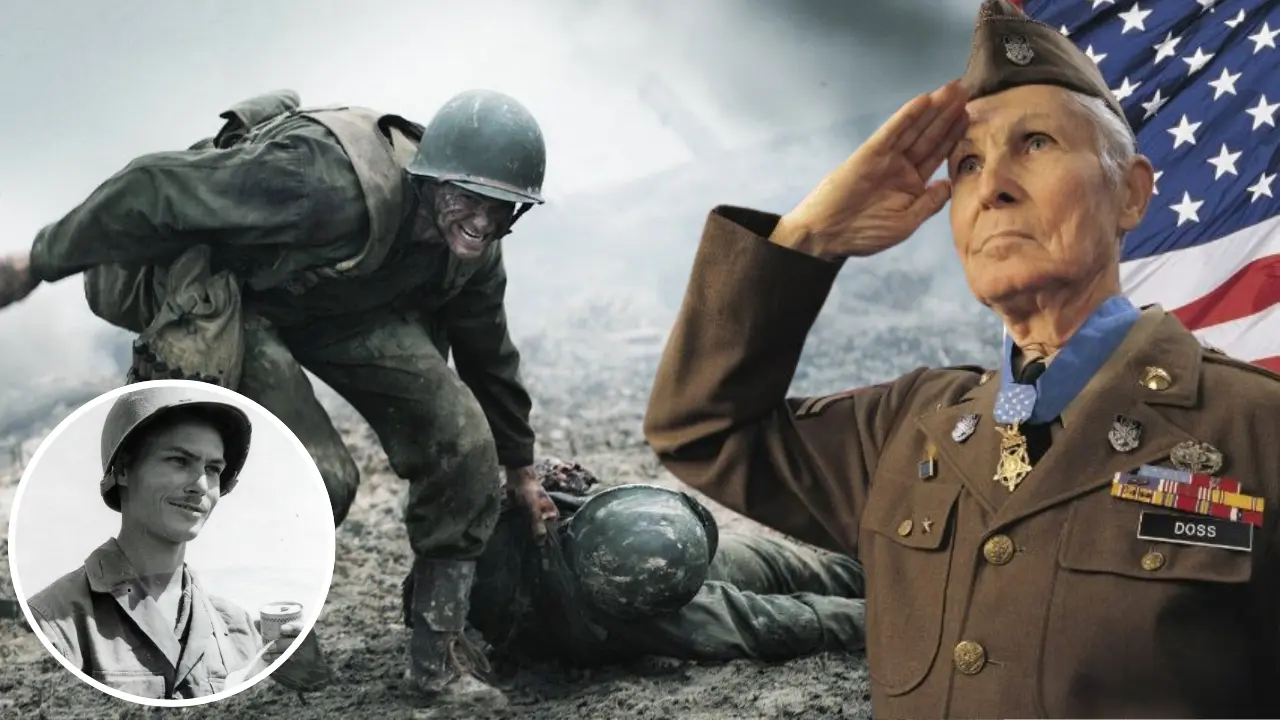
The night was loud with gunfire. Men lay wounded on a cliff in Okinawa. Most had already retreated. One soldier stayed. He had no rifle. He carried only bandages, faith, and a rope. His name was Desmond Doss, and he refused to kill anyone.
Fast Facts
Who: Desmond T. Doss, a World War II U.S. Army medic.
Choice: Served without a weapon, guided by faith and conscience.
Impact: Rescued more than 75 wounded soldiers at Hacksaw Ridge.
Why It Matters: His life proved courage does not require violence.
Who Was Desmond Doss Before the War?
Desmond Thomas Doss was born on February 7, 1919, in Lynchburg, Virginia. He grew up during the Great Depression in a working class family. His father, William Doss, was a World War I veteran who struggled after the war. His mother, Bertha Doss, held the family together and raised her children in the Seventh day Adventist faith.
As a boy, Desmond learned the Ten Commandments by heart. One image in his home stayed with him. It showed Cain killing Abel. The picture disturbed him deeply. He later said it made him promise never to take a life. Another moment sealed that belief. He once stopped his father from shooting his uncle during a drunken fight. From then on, violence felt wrong to him.
“While I believe in the commandment ‘Thou shalt not kill,’ and that bearing arms is a sin against God, my belief in freedom is as great as that of anyone else, and I had to help those boys who were fighting for it.”
Doss left school after eighth grade to help support his family. He worked at a lumber company and later at a naval shipyard. He studied first aid and earned Red Cross certification. People who knew him described him as quiet, humble, and kind. He did not drink or fight. He spent time reading his Bible and serving his church. By age twenty one, he served as a church deacon.
The Choice He Made When It Mattered
After Pearl Harbor, Desmond Doss chose to enlist in the U.S. Army in April 1942. He volunteered even though his shipyard job could have kept him out of service. Doss wanted to serve his country. He also wanted to stay true to his faith.
Doss made one clear choice. He would not carry a gun. He believed the commandment “Thou shalt not kill” applied to him at all times. Instead, he asked to serve as a combat medic so he could save lives.
“I specifically requested medical duty because I felt that while I could not kill, I could help save human life.”
This choice brought trouble. During basic training, officers ordered him to handle a rifle. He refused. Fellow soldiers mocked him and called him a coward. Some threw boots at him while he prayed. Superiors threatened court martial and even sent him for mental evaluations. Still, he did not change his mind.
Doss trained harder than others to prove his value. He worked extra hours to make up for time missed on Saturdays, which he kept as his Sabbath. He told his commanders he wanted to be the best medic in the Army.
“While everybody else is taking life, I’m going to be saving it.”
What It Cost Him Personally
The cost came quickly and often. Doss lived apart from his unit during training. Many soldiers did not trust him. Some attacked him physically. The isolation hurt him, yet he stayed calm and focused.
In combat, the danger grew worse. Doss served with the 77th Infantry Division in the Pacific. He faced brutal fighting on Guam, Leyte, and Okinawa. At Hacksaw Ridge in May 1945, his unit retreated under heavy fire. Many wounded men remained on the cliff.
Doss stayed behind alone. He moved through gunfire without a weapon. Doss carried wounded soldiers to the edge and lowered them down a rope. He did this again and again through the night.
“Lord, please help me get one more.”
That night, he saved about seventy five lives. Across the war, he saved more than one hundred.
The injuries followed. A grenade shattered his leg. He treated himself and waited hours for help. Later, a sniper shot his arm, breaking it badly. After the war, tuberculosis took part of one lung. He lived with pain and disability for the rest of his life.

Credit: @officialdesmonddoss (Instagram)
Recognition He Never Sought
The Army awarded Desmond Doss the Medal of Honor on October 12, 1945. President Harry Truman presented it and told him he felt honored to do so. Doss became the first conscientious objector to receive the award.
“I feel that I received the Congressional Medal of Honor because I kept the Golden Rule that we read in Matthew 7:12.”

Credit: @officialdesmonddoss (Instagram)
Despite this honor, Doss returned home quietly. He avoided attention, and focused on his family and faith. Doss never spoke of himself as a hero. He said he only did what he believed was right.
Why His Story Still Matters Today
Desmond Doss matters because he changed how people see courage. He showed that bravery does not require violence. He proved that strong beliefs can survive pressure, fear, and ridicule.
His story speaks to anyone who has felt pushed to abandon their values. It reminds people that kindness can stand firm, even in the worst conditions. The film Hacksaw Ridge later brought his story to millions, but the truth needs no drama.
Doss did not win his battle with force. He won it with compassion. In a noisy world that praises power, his quiet strength still speaks.