Shakuntala Devi Multiplied Two 13-Digit Numbers in 28 Seconds
Shakuntala Devi multiplied two 13-digit numbers in 28 seconds, leaving a record and an enduring puzzle about her mental skill.

On June 18, 1980, Shakuntala Devi multiplied two randomly selected 13-digit numbers at Imperial College London in 28 seconds. The Indian mental calculator, widely known as the Human Computer, produced a correct answer containing 26 digits.
The achievement has an official record. The explanation is less tidy. Devi could describe how calculating felt, and researchers could measure parts of her performance, but neither account provided a complete blueprint for what happened in her mind.
Fast Facts
- Who:
- Shakuntala Devi, an Indian mental calculator and performer widely known as the Human Computer.
- Geek Obsession:
- Rapid arithmetic, huge numbers and the numerical relationships behind calculation.
- Notable Feat:
- Multiplied two randomly selected 13-digit numbers in 28 seconds at Imperial College London on June 18, 1980.
- How It Worked:
- Research suggested highly automatic numerical knowledge, but did not fully explain her calculation process.
- Reality Check:
- The record concerns one calculation task, not proof that she could outperform every computer.
- What Happened Next:
- Guinness issued a certificate for the existing achievement in 2020, ahead of her biopic.

The calculation that made the record
The numbers chosen by Imperial College’s Computer Department were 7,686,369,774,870 and 2,465,099,745,779. Devi’s answer was 18,947,668,177,995,426,462,773,730.
Guinness World Records records the feat under “Fastest human computation.” The sheer length of the answer helps explain the fascination: every position had to be right, from the opening 18 to the final 730.
That record deserves precise wording. It documents a particular multiplication performance. It does not establish that she could outperform every computer on every task, and Guinness’s brief online entry does not explain the full procedure used to time and supervise it.
A childhood spent performing
Long before the London demonstration, numbers were part of Devi’s livelihood. In an interview published by Hinduism Today in 2000, she recalled helping with her father’s card tricks as a small child and then performing at educational institutions.
“By the time I was five years old, I was the family’s sole breadwinner.”
Source: Shakuntala Devi’s interview with Hinduism Today.
That recollection gives the stage act a different weight. A successful performance meant income for her family. The child audiences watched was also carrying a responsibility far beyond the arithmetic.
As The Indian Express documented, her adult interests extended to writing books about calculations, puzzles and helping children develop mathematical skills. The performer’s relationship with numbers also became a subject she tried to communicate to readers.
What happened when researchers tested her
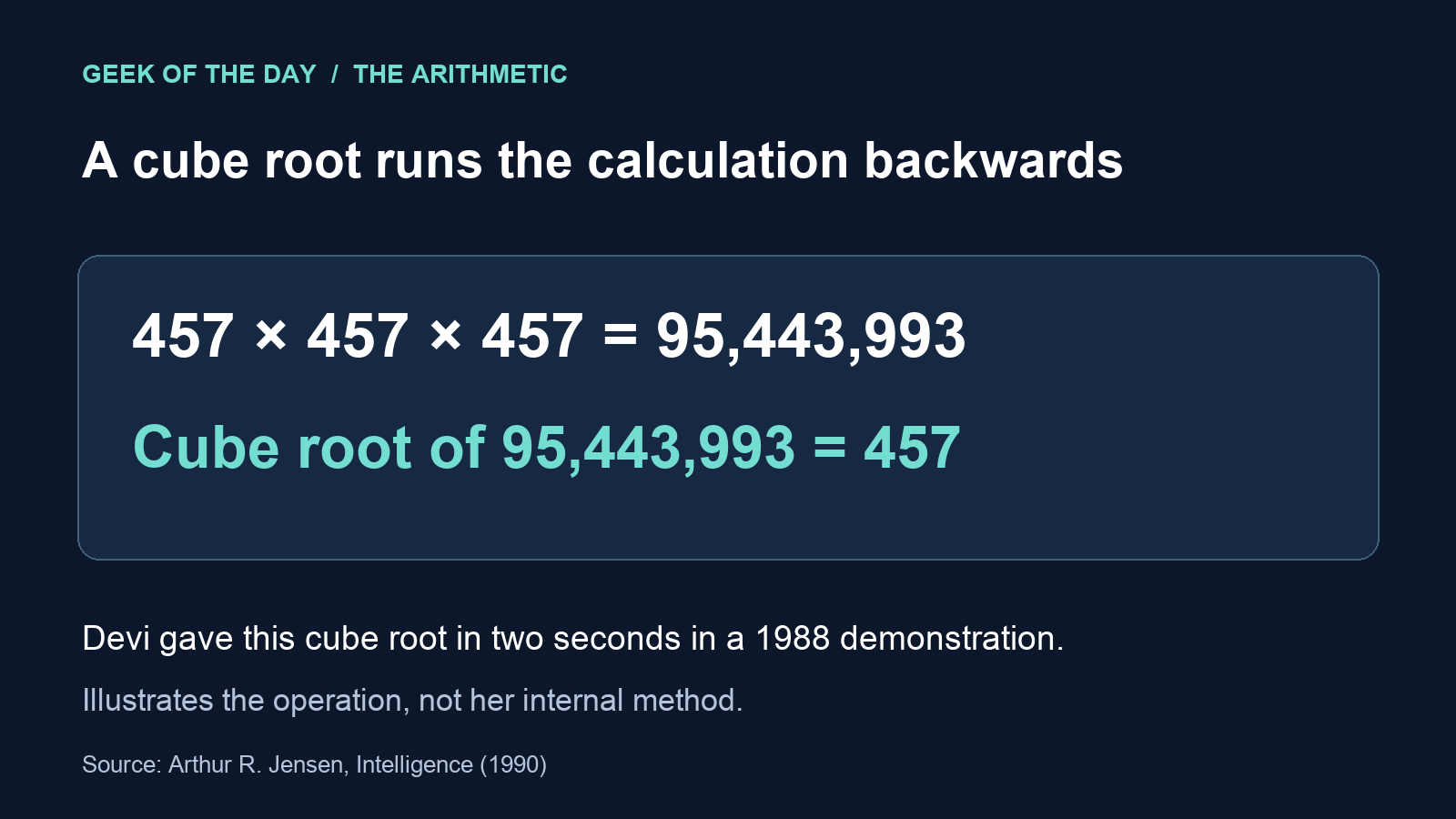
In 1988, psychologist Arthur Jensen watched Devi perform at Stanford and subsequently tested her at Berkeley. His 1990 paper in Intelligence records her giving the cube root of 95,443,993 as 457 in two seconds.
A cube root reverses multiplication: 457 × 457 × 457 equals 95,443,993. The task was to work back from the large number to the smaller one.
Her results on basic reaction-time tasks were much less exceptional. Jensen proposed that extensively learned numerical facts and procedures had become highly automatic, allowing rapid retrieval from long-term memory. This was an interpretation of her skill, not a complete demonstration of its mechanism.
Compare that uncertainty with Dominic O’Brien’s deliberately constructed memory techniques. O’Brien explains how he turns information into images and mental journeys. Devi’s calculation process was harder to make explicit. Exceptional performance does not always arrive with an equally clear explanation.
What the Human Computer nickname leaves out
Asked about her method, Devi offered a strikingly brief account:
“The answer just flashes in my mind.”
Source: Hinduism Today’s interview with Devi.
In the same interview, she described resting her mind before difficult demonstrations. Her account distinguishes the apparent immediacy of an answer from the preparation surrounding a performance.
The nickname also compresses different kinds of skill into one label. Scott Flansburg’s rapid mental arithmetic belongs to the same broad world, but separate tasks and record categories should not be treated as interchangeable rankings.
There is a modest way to explore numerical fluency without pretending to reproduce Devi’s methods. To calculate 48 × 25, use 25 = 100 ÷ 4: multiply 48 by 100, then divide by four to get 1,200. This is an ordinary arithmetic identity, not an explanation of her record. It shows how recognizing a relationship can change the work a problem requires.
A record with a long afterlife
Devi died in Bangalore on April 21, 2013, as contemporary reporting confirmed. Her calculation continued to attract attention long afterward.
In 2020, ahead of the biographical film starring Vidya Balan, Guinness issued a certificate recognizing the achievement. The release announcement explained that her daughter, Anupama Banerji, would receive the recognition. This was a later certificate for an existing achievement, not a new calculation.
The enduring question is larger than whether a person can beat a machine at a chosen problem. It is how deeply familiar numbers can become to one person. Devi left a precise answer on the record and a much harder question about the expertise behind it.
The weekly question
From obsession to clarity — one original question every week.
We answer one noisy topic at a time, in full. No daily roundup, no thread bait — just the question, the principles, and the system.