

Your body has two ages. One is the number of candles on your birthday cake. The other is your biological age, which shows how old your cells really are. Scientists now measure this using something called the “epigenetic clock.”
This clock looks at DNA methylation, a natural chemical process that turns genes on or off. Over time, these changes build up and show how fast your body is aging. But here is the good news: scientists found that exercise can actually slow this clock down. In some cases, it may even rewind it.
These clocks help scientists measure how fast a person’s cells are aging, and they are now used widely to test anti-aging treatments and lifestyle changes.
The research team, led by scientists from Japan and Hungary, reviewed many studies on how exercise affects the epigenetic clock. They discovered that people who followed structured workouts had lower biological ages. In one study, women who exercised for just eight weeks lowered their DNA age by two years. That is a powerful change in a short time.
Further Reading
What’s the Difference Between Physical Activity, Exercise, and Fitness?
Not all movement is the same. To understand how it affects aging, it’s good to know the difference between physical activity, exercise, and physical fitness.
Here’s a simple table to show what each term means and how they connect:
| Term | Characteristics | Examples |
|---|---|---|
| Physical activity: Any bodily movement produced by skeletal muscles that results in energy expenditure. | Broad concept; includes all movements in daily life. | Walking, climbing stairs, cleaning, commuting |
| Exercise: A subcategory of physical activity that is planned, structured, repetitive, and purposeful, typically aimed at improving or maintaining physical fitness. | Subset of physical activity; intentional and goal-directed. | Jogging, weight training, swimming, yoga |
| Physical fitness: A set of health- and skill-related attributes related to the ability to perform physical activity, influenced by both genetic factors and training. | Represents a physiological outcome rather than a behavior. | VO2 max, muscular strength, flexibility, endurance |
In short: physical activity is any movement, exercise is planned and purposeful, and fitness is the result. Each plays a role in slowing your body’s aging clock.
This Changes What We Know About Aging
This finding is not just about looking good or feeling fit. It suggests that exercise has the power to change the way your body ages on the inside.
The scientists showed that people with higher cardiorespiratory fitness, which means better heart and lung strength, had younger biological ages. Even people with health conditions, like breathing problems, aged more slowly when they were more fit.
In animal studies, older mice who exercised had younger muscles, hearts, and even livers. In humans, benefits showed up in the blood and muscles. Some changes may also reach the gut, which scientists now believe is tied to aging too.
Organs that benefit from exercise-based age reversal include:
- Skeletal muscle
- Heart
- Liver
- Fat tissue
- Gut microbiome
This research suggests exercise might be the most natural and effective anti-aging tool we already have.
“Collectively, these findings suggest that increased leisure-time physical activity and reduced sedentary behavior may have beneficial effects on epigenetic aging.”
— Takuji Kawamura et al., Aging-US, 2025
Everyone Can Benefit From Slowing Their Aging Clock
This science is not only for athletes or young people. The studies included older adults, people with chronic illnesses, and even those who had never worked out before.
While casual movement like walking or doing chores supports general health, researchers found that structured, goal-driven exercise routines, like aerobic or strength training, create stronger and more measurable anti-aging effects.
Anyone can benefit. Exercise helps at any age. It can be as simple as:
- Walking briskly for 30 minutes
- Using resistance bands
- Doing bodyweight exercises like squats and push-ups
- Riding a bike or swimming a few times a week
Even small steps can lead to real change at the cellular level. The key is to move with purpose, follow a routine, and keep it going.
Researchers also noticed that people with a faster biological age before they started exercising often showed the biggest improvements. So if you feel like it is too late to start, science says it is not.
Related Reading
Living near the ocean may add years to your life, not just because of the view, but due to cleaner air, better climates, and healthy lifestyles that come with coastal living.
Read MoreHow Does Exercise Affect Aging at the DNA Level?
Exercise changes the way genes work without changing the genes themselves. This happens through DNA methylation, which helps control what your cells do.
These changes are not just limited to muscles. They also show up in the liver, heart, and other organs. Exercise creates a ripple effect that reaches many parts of the body.
“Maintaining physical fitness delays epigenetic aging in multiple organs and supports the notion that exercise as a geroprotector confers benefits to various organs.”
— Kawamura and colleagues, Aging-US, 2025
Scientists are still figuring out the exact pathways. But they are confident that regular exercise causes helpful changes across your body. This could mean fewer diseases, more energy, and a longer health span, which is the number of years you stay active and independent.
Some researchers are now building new “causal epigenetic clocks.” These look at key markers that may cause aging, not just track it. In the future, they might help doctors design personalized fitness plans that slow down aging even more.
What Are Scientists Still Working On?
Even though exercise clearly slows biological aging, researchers still face key scientific challenges. This visual breaks them down.
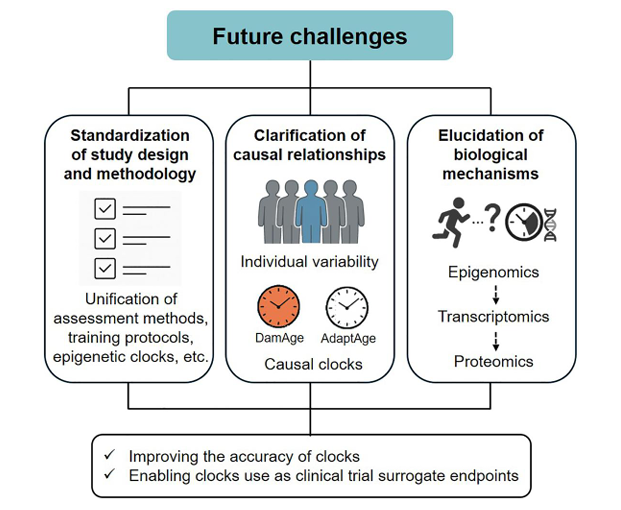
This image summarizes three big goals ahead:
- Standardizing how clocks are measured — using consistent methods and testing tools
- Understanding cause and effect — so scientists can build better causal clocks like DamAge and AdaptAge
- Mapping the biology behind it — connecting movement to DNA, gene expression, and proteins
The hope is to improve clock accuracy and make them useful for personalized medicine and future clinical trials.
Real-Life Examples Show It Works
This is not just a theory. Real-life stories back it up.
In one study, Olympic champions were compared to non-athletes. The champions, who had trained for years, showed slower biological aging. In another study, women who had never trained before became biologically younger after only two months of exercise.
And in one of the most detailed reports, people with high fitness levels aged up to two years slower than others, even when they were the same age.
These stories prove that exercise is more than a short-term fix. It changes your body from the inside out.
Related Reading
Scientists discovered that bacteria in a mother’s stomach may influence how a baby’s brain forms during pregnancy.
Read MoreStart Moving to Stay Younger
Science is now clear. Exercise is not just about burning calories or building muscles. It is one of the most powerful tools we have to slow down aging.
Not everyone responds the same way. Some people’s biological clocks slow down more quickly than others. This is why researchers are now exploring personalized exercise plans to give everyone the best shot at turning back their biological clock.
If you want to stay younger longer, move your body. Make a plan. Stay consistent. Your DNA will thank you.
Ready to Slow Down Your Aging Clock?
- Start with 30 minutes of movement a day
- Add strength training twice a week
- Track your progress and keep going
FAQs
Chronological age is how many years you have lived, based on your birthday. Biological age shows how old your body really is inside. It is measured by looking at changes in your DNA, such as chemical markers that control how your genes work. If your biological age is lower than your real age, it means your body is aging more slowly.
Casual activities like walking around the house or doing chores are helpful for staying active. But structured exercise ,like planned workouts that include cardio or strength training, is more powerful. These workouts create deeper changes in your body’s cells, which can actually slow down how your DNA ages over time.
Scientists use something called an epigenetic clock. It tracks patterns in your DNA that change as you age. When people exercise regularly, these patterns change in a way that shows the body is aging more slowly. This can be measured in blood, muscles, and even organs like the heart and liver.
Not everyone’s body reacts to exercise in the same way. Some people have a higher biological age to begin with, so they see bigger improvements. Others might need different types of workouts. That’s why scientists are now working on personalized fitness plans to help everyone get the best anti-aging results.
Sources
- Kawamura, T. et al. (2025). Exercise as a Geroprotector: Focusing on Epigenetic Aging. Aging-US. Read the full study
- World Health Organization: Physical Activity Guidelines